
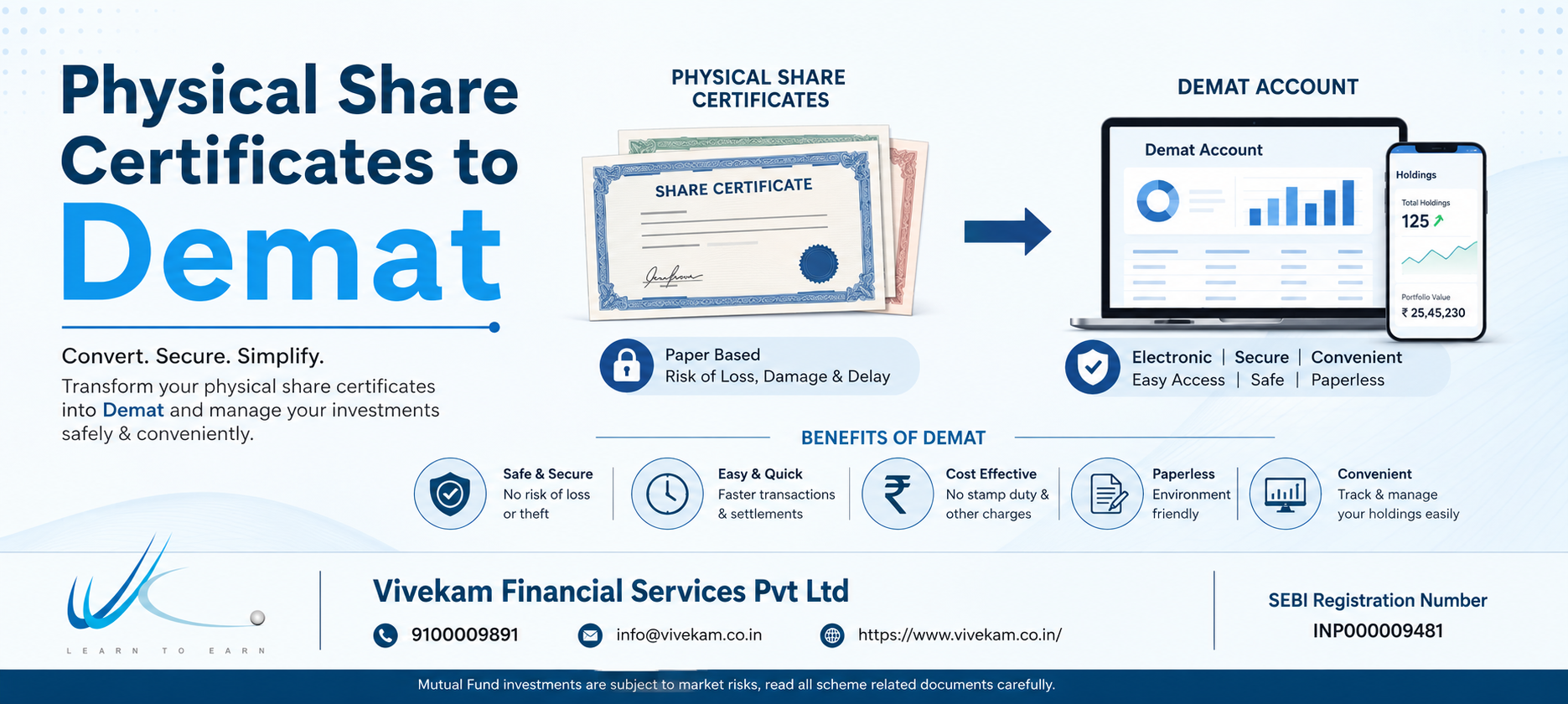
Physical Share Certificates to Demat: The Complete Guide to Digitizing Old Stock Holdings
What Are Physical Shares?
Before dematerialization was introduced in India, ownership of company shares was recorded through physical share certificates — paper documents issued by the company that legally evidenced ownership of a specified number of shares. A physical share certificate typically contains:
- Company name and registered seal
- Name of the registered shareholder
- Folio number (unique identifier maintained by the company’s registrar)
- Distinctive numbers and certificate number of the shares
- Number of shares held and face value
- Signatures of authorized signatories
Transfer of physical shares required manual endorsement and physical handover of the certificate, a process that was slow and susceptible to fraud, loss, and delay. This led to the Depositories Act, 1996, which established the legal framework for electronic holding of securities in India through two depositories: NSDL (National Securities Depository Limited) and CDSL (Central Depository Services Limited).
Regulatory Status: Transfer Restrictions on Physical Shares
Under SEBI’s directive effective April 1, 2019, transfer of securities held in physical form is not permitted, except in cases of transmission or transposition of shares. Physical shares can still be held, but cannot be sold, transferred, or gifted unless first converted into demat (electronic) form.
This regulation is the primary reason dematerialization has become a prerequisite — rather than an optional step — for any transaction involving legacy physical shareholdings, including sale, estate settlement, or portfolio consolidation.
Common Complications in Dematerializing Physical Shares
1. Name Mismatches
Names on certificates issued decades ago frequently differ from the name recorded on current PAN or Aadhaar records (missing middle name, maiden name, spelling or transliteration variation). Depositories require exact matches, and discrepancies can delay or reject a request.
2. Deceased Shareholders (Transmission)
If the registered shareholder is deceased, the process becomes transmission of shares, requiring a death certificate, legal heir or succession certificate, notarized indemnity bond, and in some cases probate, depending on shareholding value and presence of a registered nomination.
3. Missing or Damaged Certificates
Certificates that are torn, illegible, or lost require an application for a duplicate share certificate, involving an indemnity bond, and in many cases an FIR and public notice, before dematerialization can proceed.
4. Company Mergers, Name Changes, or Delisting
Companies from earlier decades may have merged, renamed, restructured, or delisted. The original Registrar and Transfer Agent (RTA) may no longer operate under the same name; the current RTA (commonly Link Intime, KFin Technologies, or Bigshare Services) must be identified before initiating the request.
5. Unclaimed Dividends and IEPF Transfer
Under the Companies Act provisions governing the Investor Education and Protection Fund (IEPF), shares on which dividends have remained unclaimed for seven consecutive years are transferred by the company to the IEPF, along with the corresponding unpaid dividend. In such cases, dematerialization alone does not restore the shares — a separate claim via Form IEPF-5 must be filed with the IEPF Authority.
6. Signature Mismatches
If the shareholder’s current signature does not match the specimen signature on record with the RTA, additional verification such as bank attestation may be required.
7. Multiple Folios and Joint Holdings
Shareholders often hold shares of the same or different companies across multiple folios, sometimes with varying combinations of joint holders. Each distinct folio-holder combination generally requires a separate dematerialization request.
Due to these factors, the dematerialization process commonly takes several weeks to a few months rather than days, depending on documentation accuracy and the complexity of the case.
Step-by-Step Process: Dematerializing Physical Shares
Step 1: Open a Demat Account
A demat account with a Depository Participant (DP) — a bank, brokerage, or discount broker registered with NSDL or CDSL — is required before initiating dematerialization. KYC documentation includes PAN, Aadhaar, address proof, and a cancelled cheque or bank statement. The account must be opened in the same name (and, for joint holdings, the same order of names) as recorded on the physical certificate.
Step 2: Organize Certificate Details
For each certificate, record:
- Folio number
- Distinctive numbers (from–to)
- Certificate number
- Number of shares
Step 3: Obtain the Dematerialization Request Form (DRF)
The DP issues a DRF specific to each company/ISIN. A separate DRF is required for each company being converted. Some DPs perform an ISIN master check to confirm the company’s current eligibility for demat.
Step 4: Complete and Sign the DRF
The form must show the shareholder name matching the demat account and PAN exactly, accurate folio and certificate details, and signatures of all joint holders in the same order as the original certificate.
Step 5: Submit Original Certificates
Original certificates (not photocopies) are submitted with the signed DRF to the DP, which records the certificate details in the system for processing.
Step 6: DP Forwards Request to the RTA
The DP sends the DRF and certificates to the company’s Registrar and Transfer Agent (RTA), which maintains the official shareholder register for that company.
Step 7: RTA Verification
The RTA verifies the signature against specimen records, PAN and identity details, and confirms the certificate has not been previously dematerialized, reported lost or stolen, or transferred to IEPF. Discrepancies result in queries that require supporting documentation.
Step 8: Credit to Demat Account
On verification, the RTA confirms the request to the depository (NSDL/CDSL), which instructs the DP to credit the equivalent shares in electronic form to the shareholder’s demat account. The physical certificates are simultaneously cancelled to prevent duplicate claims.
Step 9: Confirm Holdings
The updated holdings can be verified through the demat account login or the Consolidated Account Statement (CAS) issued monthly by NSDL/CDSL.
Typical timeline: 15 days to 2–3 months, depending on documentation accuracy, RTA responsiveness, and the presence of any complications listed above.
Special Case Procedures
Deceased Shareholder (Transmission-cum-Dematerialization)
Requires a transmission request alongside the DRF: death certificate, PAN of the legal heir, notarized indemnity bond, and, for higher-value holdings without a registered nomination, a succession certificate or legal heirship certificate.
Shares Transferred to IEPF
Requires filing Form IEPF-5 on the Ministry of Corporate Affairs (MCA) portal, along with an indemnity bond and claim form submitted to the company/RTA’s Nodal Officer. This is a separate process from standard dematerialization with a longer processing timeline.
Lost Certificate
Requires an application for a duplicate certificate, including an indemnity bond, and in many cases an FIR and public notice, prior to submitting the DRF.
Frequently Asked Questions
Q1. Is there a deadline to dematerialize physical shares? There is no expiry on holding physical shares, but SEBI’s April 2019 rule prohibits their transfer, sale, or gifting until dematerialized.
Q2. Can shares of a company that no longer exists under its original name be dematerialized? Yes, if the company underwent a legitimate merger, acquisition, or name change and the current entity’s ISIN is traceable. Delisted or wound-up companies require additional verification, potentially involving the Official Liquidator.
Q3. Is a separate demat account needed for each company? No. A single demat account can hold shares of multiple companies; a separate DRF is required per company/ISIN.
Q4. What is required if shares were purchased under a different name (maiden name, spelling variation)? A name-change affidavit, gazette notification (where applicable), or marriage certificate is required to reconcile the identity discrepancy with the RTA.
Q5. Are there charges for dematerialization? Most DPs charge a nominal fee per certificate or per request; fee structures vary by DP and account type.
Conclusion:
SEBI regulation effective April 1, 2019 restricts transfer of physical shares, making dematerialization a prerequisite for selling, gifting, or transferring legacy paper holdings. The process involves opening a demat account, submitting a DRF with original certificates through a DP, RTA verification, and electronic credit of shares — typically completed within 15 days to 3 months. Common complications include name mismatches, deceased shareholders, lost certificates, company restructuring, and shares transferred to the IEPF due to unclaimed dividends, each requiring specific supporting documentation. Regulatory data from SEBI and the depositories indicates a significant volume of shares and dividends remain unclaimed in India due to undigitized holdings.
Disclaimer: This article is for general educational and informational purposes only and does not constitute investment, legal, or financial advice. Dematerialization requirements, forms, and regulations may be updated by SEBI, NSDL, CDSL, or the Ministry of Corporate Affairs from time to time. Readers should consult their Depository Participant, a SEBI-registered investment advisor, or a qualified legal professional for guidance specific to their holdings.