
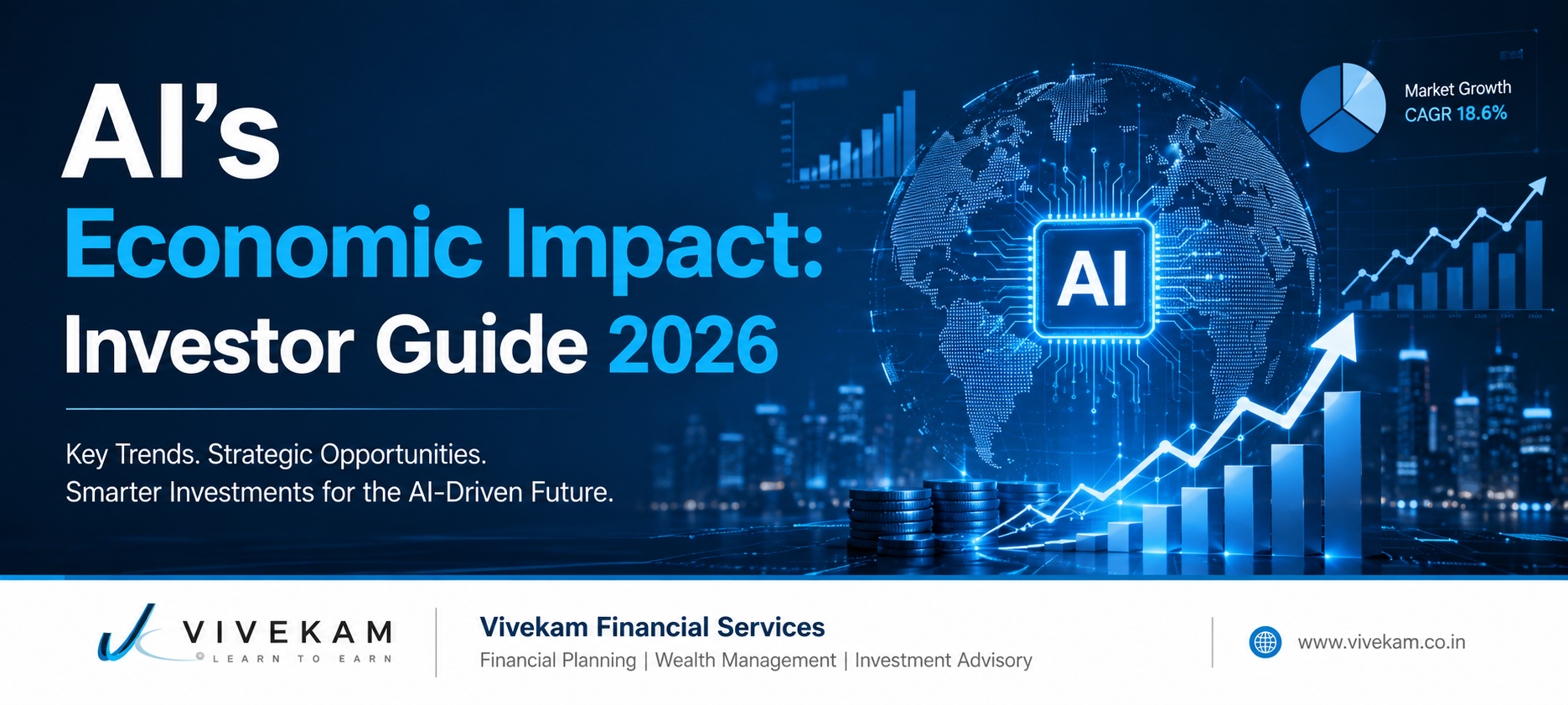
AI's Economic Impact: Investor Guide
Artificial intelligence (AI) is no longer a futuristic concept; it’s a powerful engine driving significant economic transformation in 2026. Projections suggest AI could contribute trillions to the global economy in the coming years, with some estimates pointing to a potential $15.7 trillion boost by 2030. This pervasive integration is fundamentally altering industries, creating new markets, and demanding a strategic shift in how investors approach opportunities. Understanding these seismic shifts is crucial for navigating the evolving economic landscape and capitalizing on AI’s immense potential.
The economic impact of AI is multifaceted, touching everything from productivity gains and labor market dynamics to consumer behavior and global competitiveness. As AI technologies mature and become more accessible, their influence will only deepen, presenting both unprecedented opportunities and significant challenges for investors. This article delves into the core ways AI is reshaping the economy in 2026 and outlines key considerations for investors looking to align their portfolios with this transformative trend.
AI’s Economic Drivers: Productivity, Innovation, and New Markets
At its heart, AI’s economic impact stems from its ability to enhance productivity, foster innovation, and create entirely new market categories. These three pillars are interconnected, forming a virtuous cycle that accelerates economic growth.
Productivity Gains Through Automation and Optimization
One of the most immediate and measurable impacts of AI is its capacity to automate repetitive tasks and optimize complex processes. In manufacturing, AI-powered robots and intelligent systems are streamlining assembly lines, reducing errors, and increasing output. In logistics, AI algorithms are optimizing delivery routes, managing warehouse inventory, and predicting demand with remarkable accuracy. Even in knowledge-based industries, AI tools are automating data analysis, report generation, and customer service interactions.
For example, AI-driven predictive maintenance in factories can anticipate equipment failures before they occur, preventing costly downtime. This not only saves money but also ensures smoother, more efficient operations. In finance, AI algorithms are used for fraud detection, algorithmic trading, and personalized financial advice, all contributing to increased efficiency and reduced risk. The ability of AI to process vast amounts of data and identify patterns far beyond human capability allows businesses to make more informed decisions, allocate resources more effectively, and ultimately, drive higher productivity.
Fostering Innovation and New Business Models
Beyond optimizing existing processes, AI is a powerful catalyst for innovation. It enables the development of novel products and services that were previously unimaginable. Generative AI, for instance, is revolutionizing content creation, software development, and even scientific research by rapidly generating new designs, code, and hypotheses. AI-powered drug discovery platforms are accelerating the identification of potential new medicines, while AI in materials science is leading to the creation of advanced new substances.
These innovations often lead to the creation of entirely new business models. Companies are emerging that specialize in AI-driven personalized education, AI-powered diagnostic tools for healthcare, or AI-enhanced entertainment experiences. The ability of AI to understand and respond to individual user needs is paving the way for hyper-personalization across various sectors, creating new revenue streams and competitive advantages. This constant churn of innovation ensures that the economic landscape remains dynamic, with new leaders and new market opportunities constantly emerging.
Creation of New Markets and Industries
The proliferation of AI technologies has directly led to the establishment of new markets and industries. The “AI as a Service” (AIaaS) sector is booming, offering cloud-based AI tools and platforms that allow businesses of all sizes to leverage AI without significant upfront investment in infrastructure or expertise. Companies focused on AI ethics, AI security, and AI governance are also gaining prominence as the societal implications of AI become more apparent.
Furthermore, AI is enabling entirely new forms of interaction and commerce. The metaverse, while still evolving, relies heavily on AI for creating immersive experiences, intelligent non-player characters (NPCs), and personalized content delivery. AI-powered virtual assistants are becoming ubiquitous, managing schedules, providing information, and facilitating transactions, effectively creating new channels for consumer engagement and sales. The economic value generated by these new AI-centric markets is substantial and is expected to grow exponentially in the coming years.
AI’s Impact on Key Economic Sectors
AI’s influence is not confined to a few tech giants; it’s a transformative force across virtually every sector of the economy. Understanding these sector-specific impacts is vital for investors seeking targeted opportunities.
Healthcare
In healthcare, AI is revolutionizing diagnostics, drug discovery, and personalized treatment plans. AI algorithms can analyze medical images like X-rays and MRIs with remarkable speed and accuracy, often detecting anomalies that might be missed by the human eye. This leads to earlier diagnoses and better patient outcomes. AI is also accelerating the development of new pharmaceuticals by identifying promising drug candidates and predicting their efficacy. Personalized medicine, tailored to an individual’s genetic makeup and lifestyle, is becoming a reality with AI’s ability to process complex patient data.
Finance
The financial services industry has been an early adopter of AI. AI-powered algorithms are used for high-frequency trading, risk management, fraud detection, and customer service through chatbots. Robo-advisors, which use AI to provide automated investment advice, are becoming increasingly popular, democratizing access to financial planning. AI is also enhancing credit scoring models, making them more accurate and inclusive. The ability of AI to analyze market trends, predict financial fluctuations, and manage vast portfolios efficiently is reshaping how financial institutions operate and how individuals manage their wealth.
Retail and E-commerce
AI is transforming the retail experience through personalization, inventory management, and enhanced customer service. Recommendation engines, powered by AI, analyze customer behavior to suggest products, driving sales and improving customer satisfaction. AI-powered chatbots handle customer inquiries 24/7, freeing up human agents for more complex issues. In inventory management, AI forecasts demand, optimizes stock levels, and reduces waste. Furthermore, AI is enabling new retail formats, such as cashier-less stores and personalized online shopping experiences.
Manufacturing and Supply Chain
As mentioned earlier, AI is a cornerstone of modern manufacturing. Predictive maintenance, quality control through computer vision, and robotic automation are all driven by AI, leading to increased efficiency, reduced costs, and improved product quality. In supply chain management, AI optimizes logistics, predicts disruptions, and enhances visibility, creating more resilient and efficient global supply networks. The “smart factory” concept, where AI orchestrates all aspects of production, is becoming a reality.
Transportation and Logistics
The autonomous vehicle revolution is heavily reliant on AI for navigation, object detection, and decision-making. Beyond self-driving cars, AI is optimizing traffic flow in cities, managing public transportation networks, and improving the efficiency of freight transportation. AI algorithms in logistics can reroute shipments in real-time to avoid delays, optimize fuel consumption for fleets, and improve overall delivery times.
Entertainment and Media
AI is personalizing content recommendations on streaming platforms, generating music and art, and creating more immersive gaming experiences. Generative AI is assisting in scriptwriting, character creation, and special effects production. The ability of AI to understand audience preferences and deliver tailored content is reshaping how media is consumed and produced.
AI and the Labor Market: Challenges and Opportunities
The impact of AI on the labor market is a complex and often debated topic. While AI-driven automation will undoubtedly displace some jobs, it will also create new roles and require new skill sets.
Job Displacement and the Need for Reskilling
Repetitive tasks, whether manual or cognitive, are most susceptible to automation. This includes roles in data entry, assembly line work, and some customer service functions. As AI becomes more capable, the range of tasks that can be automated will expand. This necessitates a proactive approach to reskilling and upskilling the workforce. Governments, educational institutions, and corporations must collaborate to provide training programs that equip individuals with the skills needed for the AI-driven economy.
Creation of New Roles and Skill Demands
Conversely, AI is creating new job categories. There is a growing demand for AI developers, data scientists, AI ethicists, AI trainers, and prompt engineers. Furthermore, roles that require uniquely human skills like creativity, critical thinking, emotional intelligence, and complex problem-solving are likely to become even more valuable. The future of work will likely involve humans and AI collaborating, with AI handling routine tasks and humans focusing on higher-level cognitive functions.
The Gig Economy and Remote Work
AI tools can facilitate the growth of the gig economy and remote work by improving communication, project management, and task allocation. AI-powered platforms can match freelancers with suitable projects more efficiently, and AI tools can enhance collaboration among remote teams. This could lead to a more flexible and distributed workforce.
Investing in the AI Revolution: Strategies for 2026
For investors, the AI revolution presents a landscape ripe with opportunity, but it also requires careful strategic planning.
Identifying AI Enablers and Beneficiaries
Investors should consider two main categories of AI-related investments:
- AI Enablers: These are companies that provide the foundational technology and infrastructure for AI. This includes semiconductor manufacturers (e.g., NVIDIA, AMD), cloud computing providers (e.g., Amazon AWS, Microsoft Azure, Google Cloud), AI software and platform developers, and companies specializing in AI data management and cybersecurity.
- AI Beneficiaries: These are companies across various sectors that are effectively leveraging AI to gain a competitive advantage, improve efficiency, or create new products and services. This could be a pharmaceutical company using AI for drug discovery, a retailer using AI for personalization, or a logistics firm optimizing its supply chain with AI.
Key Investment Themes
Several key investment themes are emerging within the AI space:
- AI Infrastructure: The demand for computing power, specialized chips, and cloud services to train and deploy AI models will continue to surge.
- Generative AI: Companies developing and applying generative AI technologies for content creation, coding, design, and other applications are poised for significant growth.
- AI in Healthcare: Investment in AI-driven diagnostics, drug discovery, and personalized medicine offers substantial long-term potential.
- AI for Automation: Companies focused on AI solutions for industrial automation, robotics, and process optimization will benefit from the drive for efficiency.
- AI Ethics and Governance: As AI becomes more integrated into society, companies providing solutions for AI safety, bias detection, and regulatory compliance will become increasingly important.
Diversification and Risk Management
While the potential rewards of AI investing are high, so are the risks. The AI landscape is evolving rapidly, with new technologies and companies emerging constantly. It’s crucial to:
- Diversify: Spread investments across different AI sub-sectors, geographies, and company sizes to mitigate risk.
- Conduct Thorough Due Diligence: Understand the technology, business model, competitive landscape, and management team of any AI company you consider investing in.
- Stay Informed: The pace of AI development is rapid. Continuous learning and staying updated on industry trends are essential.
- Consider Long-Term Trends: AI is a long-term transformative technology. Focus on companies with sustainable competitive advantages and a clear path to profitability.
- Understand Valuation: AI companies can often command high valuations. Investors need to assess whether these valuations are justified by future growth prospects.
Ethical and Regulatory Considerations
As AI’s economic influence grows, so do concerns about its ethical implications and the need for regulation. Issues such as data privacy, algorithmic bias, job displacement, and the potential for misuse are being actively debated and addressed by policymakers worldwide. Investors should be aware of these developments, as regulatory changes could impact the growth and profitability of AI companies. Companies that demonstrate a strong commitment to ethical AI development and compliance are likely to be more resilient in the long run.
The Future Outlook: AI as an Economic Supercharger
Artificial intelligence is not just another technological advancement; it is a fundamental economic paradigm shift. In 2026, its impact is already profound, driving productivity, innovation, and the creation of new economic frontiers. For investors, this presents a unique opportunity to participate in one of the most significant economic transformations of our time.
The key to successful investing in this era lies in understanding the underlying drivers of AI’s economic impact, identifying companies that are either enabling AI or benefiting from its adoption, and adopting a disciplined, long-term approach to portfolio construction. While challenges related to labor markets and ethical considerations remain, the overall trajectory points towards AI acting as a powerful supercharger for economic growth and global prosperity. By staying informed, diversifying strategically, and focusing on sustainable value creation, investors can position themselves to thrive in this AI-driven economy.
Frequently Asked Questions
1. What is the primary economic impact of AI in 2026?
The primary economic impact of AI in 2026 is its role in driving productivity gains through automation and optimization, fostering innovation by enabling new products and services, and creating entirely new markets and industries.
2. Which sectors are most significantly affected by AI?
Sectors experiencing significant AI impact include healthcare (diagnostics, drug discovery), finance (trading, risk management), retail (personalization, inventory), manufacturing (automation, efficiency), transportation (autonomous vehicles, logistics), and entertainment (content creation, recommendations).
3. How should investors approach AI-related investments?
Investors should approach AI by identifying “AI enablers” (companies providing AI infrastructure and technology) and “AI beneficiaries” (companies leveraging AI for competitive advantage). Diversification across AI sub-sectors, thorough due diligence, and a long-term perspective are crucial.
4. What are the main challenges associated with AI’s economic impact?
Key challenges include potential job displacement due to automation, the need for workforce reskilling and upskilling, ethical concerns regarding data privacy and bias, and the evolving regulatory landscape surrounding AI technologies.
5. Will AI create more jobs than it eliminates?
While AI will automate certain jobs, it is also expected to create new roles in areas like AI development, data science, AI ethics, and roles requiring uniquely human skills. The net effect on job creation is still a subject of ongoing analysis and debate, but the nature of work is undeniably changing.
6. What role does AI play in the global economy?
AI is increasingly becoming a driver of global economic competitiveness. Nations and companies that effectively adopt and develop AI technologies are likely to experience enhanced economic growth, innovation, and market leadership.