
Understanding Short-Term Capital Gains Tax
Sold shares quickly and made a profit? Redeemed mutual funds within a year? Flipped property for short-term gains?
Then you may have to pay Short term capital gains tax.
Every year, thousands of Indian investors unknowingly pay extra taxes because they misunderstand how STCG works. Some sell investments too early. Others fail to use exemption limits or loss adjustments. Many simply don’t realize that holding an asset for a few extra months could dramatically reduce their tax burden.
That’s why understanding Tax on short term capital gains is essential for every investor in India.
Whether you’re investing in:
- stocks,
- equity mutual funds,
- property,
- gold,
- or debt funds,
…the rules around STCG tax rate, holding periods, and exemptions can directly impact your actual returns.
In this complete guide, you’ll learn:
- what is short term capital gain,
- how STCG is calculated,
- STCG on shares and mutual funds,
- STCG vs LTCG,
- exemption rules,
- tax-saving strategies,
- and common mistakes investors should avoid.
Let’s break it all down in simple language.
What is Short Term Capital Gain?
A Short term capital gain occurs when you sell a capital asset within a specified short holding period and earn a profit.
In simple words:
Buy an asset → Sell it quickly for profit → Pay STCG tax.
The holding period depends on the type of asset.
For example:
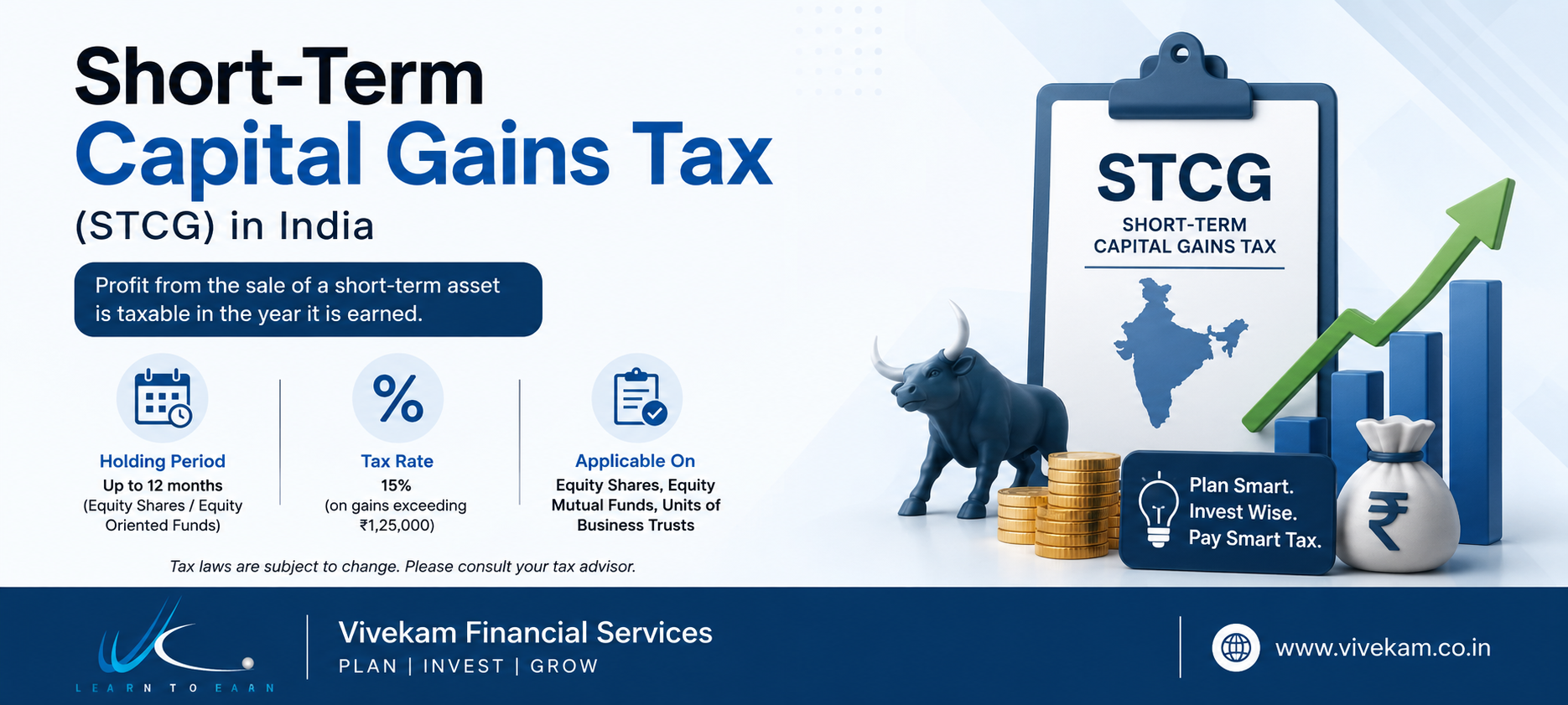
- Listed shares sold within 12 months generate STCG.
- Property sold within 24 months generates STCG.
- Gold sold within 36 months may qualify as STCG.
The profit earned from such transactions is called Short term capital gains.
Meaning of Capital Assets
Capital assets include investments and valuable items such as:
- Equity shares
- Mutual funds
- Real estate
- Gold
- Bonds
- ETFs
- Jewelry
- Debentures
Whenever these assets are sold for a profit, capital gains tax may apply.
When Does a Gain Become STCG?
The Income Tax Act classifies gains based on how long you hold the asset before selling it.
Asset Type | Holding Period for STCG |
Listed equity shares | Less than 12 months |
Equity mutual funds | Less than 12 months |
Real estate | Less than 24 months |
Gold | Less than 36 months |
Debt mutual funds | Depends on rules applicable |
If sold before crossing the long-term threshold, profits become taxable as STCG.
 Even selling an investment a few days before completing the long-term holding period can significantly increase your tax liability.
Types of Assets Covered Under STCG
Different assets attract different taxation rules.
Understanding these categories helps investors avoid costly mistakes.
STCG on Equity Shares
One of the most common forms of STCG on equity comes from stock market investing.
If you purchase shares and sell them within 12 months, profits are treated as Short term capital gain on shares.
This applies to:
- NSE-listed shares
- BSE-listed shares
- Equity ETFs
- Certain listed securities
If Securities Transaction Tax (STT) has been paid, special STCG tax rules apply under Section 111A.
STCG on Mutual Funds
Investors often assume all mutual funds are taxed equally. That’s incorrect.
The taxation depends on:
- equity exposure,
- holding period,
- and fund category.
Equity-Oriented Funds
If sold within 12 months:
- taxed at 15%.
Debt Funds
Usually taxed according to slab rates.
STCG on Property
Selling a property within 24 months of purchase generates short-term capital gains.
Examples:
- residential flat,
- commercial office,
- land,
- inherited property sold quickly.
In such cases:
- gains are added to total income,
- taxed according to slab rates.
This often results in a high tax burden for high-income individuals.
STCG Tax Rate in India
The STCG tax rate depends mainly on the asset type.
Many investors incorrectly assume all capital gains are taxed at 15%. That’s not true.
STCG Tax Rate on Equity
Under Section 111A:
- listed equity shares,
- equity mutual funds,
- and business trust units
are taxed at:
15% STCG tax
Conditions:
- STT must be paid,
- assets should qualify as equity-oriented investments.
Additionally:
- 4% cess applies,
- surcharge may apply for high-income taxpayers.
Tax on Non-Equity Assets
For non-equity assets:
- gains are added to total taxable income,
- taxed according to income slab.
These include:
- debt mutual funds,
- gold,
- real estate,
- unlisted shares.
Example
If your annual income falls under the 30% slab:
- your STCG tax may effectively become 30% + cess.
STCG Tax Rate
Asset Type | STCG Tax Rate |
Listed equity shares | 15% |
Equity mutual funds | 15% |
Debt mutual funds | Slab rate |
Gold | Slab rate |
Property | Slab rate |
Unlisted shares | Slab rate |
Short Term Capital Gain on Shares
Understanding Short term capital gain on shares is essential for active traders and retail investors.
Listed Shares
If listed shares are sold within one year:
- profits are taxed at 15%.
Example
Particulars | Amount |
Purchase price | ₹1,00,000 |
Sale value | ₹1,40,000 |
Profit | ₹40,000 |
STCG Tax @15% | ₹6,000 |
Your actual post-tax gain:
- ₹34,000
Unlisted Shares
Unlisted shares follow different taxation rules.
Examples:
- startup shares,
- private company equity,
- pre-IPO shares.
Here:
- holding period is usually 24 months,
- gains are taxed according to slab rates.
This becomes important for startup employees with ESOPs.
STCG on Mutual Funds
The taxation of mutual funds depends heavily on whether the scheme is equity-oriented or debt-oriented.
STCG on Equity Mutual Funds
If an equity mutual fund is sold within 12 months:
- gains are taxed at 15%.
For a fund to qualify:
- at least 65% must be invested in equities.
Examples
- Large-cap funds
- Mid-cap funds
- ELSS funds
- Index funds
STCG on Debt Mutual Funds
Debt mutual funds do not receive the same favorable tax treatment.
Instead:
- gains are added to total income,
- taxed according to slab rate.
This can significantly affect investors in higher tax brackets.
SIP Redemption and STCG
Many SIP investors forget this important rule:
Every SIP installment is treated separately for taxation.
Example:
- SIP installment bought in January,
- redeemed in June,
- may attract STCG.
But another installment held for over one year may qualify for LTCG.
STCG Exemption Limit
A common investor question is:
“Is there any STCG exemption limit?”
The answer is:
- partially yes,
- but with conditions.
Basic Exemption Rules
Resident individuals can adjust unused basic exemption limit against STCG under Section 111A.
Example
Particulars | Amount |
Basic exemption limit | ₹2,50,000 |
Salary income | ₹2,10,000 |
Remaining exemption | ₹40,000 |
If STCG = ₹50,000:
- only ₹10,000 becomes taxable.
NRI Rules
NRIs usually cannot claim the same adjustment benefits available to resident taxpayers.
Taxation depends on:
- residential status,
- DTAA agreements,
- investment category.
Short Term vs Long Term Capital Gains
Understanding short term vs long term capital gains helps investors optimize taxes legally.
Holding Period Comparison
Asset | STCG | LTCG |
Listed shares | <12 months | >12 months |
Property | <24 months | >24 months |
Gold | <36 months | >36 months |
STCG vs LTCG Tax Rates
Type | Tax Rate |
STCG on equity | 15% |
LTCG on equity | 10% above ₹1.25 lakh |
STCG on property | Slab rate |
LTCG on property | 20% with indexation |
Long-term investing often results in better tax efficiency.
Difference Between LTCG and STCG
The difference between ltcg and stcg goes beyond taxation.
Comparison Table
Feature | STCG | LTCG |
Holding period | Short | Long |
Tax rate | Usually higher | Usually lower |
Indexation | Not available | Available on some assets |
Ideal for | Traders | Long-term investors |
Wealth creation | Moderate | Stronger over time |
How to Calculate Short-Term Capital Gains
Many investors calculate gains incorrectly.
The correct formula is simple.
Formula for STCG Calculation
STCG = Sale Price – (Purchase Price + Expenses)
Expenses include:
- brokerage,
- transaction charges,
- stamp duty,
- transfer costs.
Example of STCG Calculation
Particulars | Amount |
Purchase value | ₹2,00,000 |
Sale value | ₹2,70,000 |
Brokerage | ₹5,000 |
Calculation
Net Cost:
- ₹2,05,000
STCG:
- ₹65,000
Tax @15%:
- ₹9,750
Tax Saving Tips for STCG
Although STCG is taxable, there are legal ways to reduce your tax burden.
1. Hold Investments Longer
Sometimes waiting a few extra months can convert:
- STCG → LTCG
This often reduces taxation significantly.
2. Use Tax-Loss Harvesting
Tax-loss harvesting means:
- selling loss-making investments,
- adjusting losses against gains.
Benefits:
- lowers taxable income,
- improves portfolio efficiency.
3. Offset Capital Losses
Short-term capital losses can be adjusted against:
- STCG,
- LTCG.
Unused losses can be carried forward for 8 years.
4. Plan Redemptions Carefully
Instead of redeeming everything at once:
- stagger withdrawals strategically.
This may reduce your effective tax burden.
Filing STCG in Income Tax Return
Proper reporting is extremely important.
Failure to disclose STCG can trigger:
- notices,
- penalties,
- scrutiny.
Relevant ITR Forms
Taxpayer Type | ITR Form |
Salaried individuals | ITR-2 |
Traders/business income | ITR-3 |
Documents Required
Keep these ready:
- broker statements,
- AIS/TIS reports,
- mutual fund statements,
- capital gains reports,
- Form 26AS.
For official guidance, visit the Income Tax Department of India.
Common Mistakes Investors Make
Many investors unknowingly increase their taxes through avoidable mistakes.
Selling Too Early
Selling investments before completing long-term holding periods often increases tax liability.
Ignoring STCG Reporting
Even small gains must be disclosed in income tax returns.
Confusing Trading Income with Capital Gains
Frequent stock trading may sometimes be classified as business income instead of capital gains.
This changes:
- tax treatment,
- deductions,
- compliance requirements.
Ignoring Loss Set-Off Rules
Many taxpayers forget to adjust capital losses against gains.
This leads to unnecessary tax payments.
FAQs About Short-Term Capital Gains Tax
1. What is short term capital gain?
It is the profit earned by selling a capital asset within a short holding period specified under the Income Tax Act.
2. What is the STCG tax rate in India?
For listed equity shares and equity mutual funds:
- 15%
For other assets:
- slab rates apply.
- What is STCG on shares?
It refers to gains earned from selling shares within 12 months of purchase.
4. What is the difference between LTCG and STCG?
The main differences include:
- holding period,
- tax rate,
- indexation benefits,
- investment strategy.
5. Is there any STCG exemption limit?
Resident individuals can adjust unused basic exemption limits under certain conditions.
6. How is STCG on mutual funds taxed?
- Equity mutual funds → 15%
- Debt mutual funds → slab rates
- Can STCG losses be carried forward?
Yes. Short-term capital losses can be carried forward for up to 8 years.
8. Is STCG applicable on SIP investments?
Yes. Each SIP installment is taxed separately based on holding period.
Conclusion
Understanding Short-Term Capital Gains Tax (STCG) in India is no longer optional for modern investors.
Whether you invest in:
- shares,
- mutual funds,
- ETFs,
- or property,
…the tax impact can significantly affect your real returns.
The smartest investors don’t just focus on profits.
They focus on:
- post-tax returns,
- holding periods,
- tax efficiency,
- and long-term wealth creation.
Before selling any investment, always ask:
“Can waiting a little longer reduce my taxes?”
In many cases, the answer is yes.
By understanding:
- STCG tax rate,
- STCG on equity,
- STCG vs LTCG,
- and the difference between LTCG and STCG,
you can make more informed financial decisions and legally reduce your tax burden over time.