
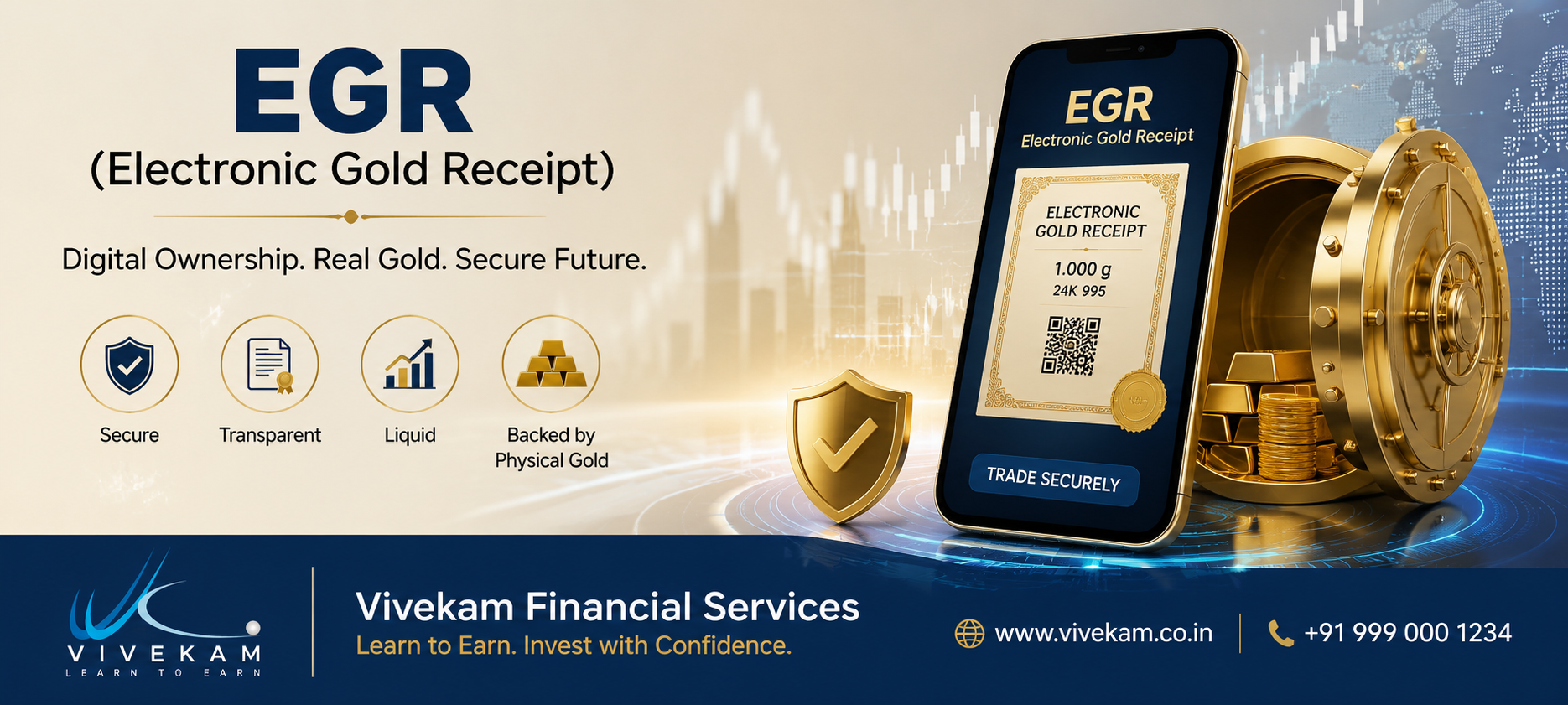
Electronic Gold Receipt (EGR): Powerful Benefits Every Investor Must Know
For centuries, Indians have trusted gold more than stocks, bonds, and sometimes even banks. During uncertain times, families still rush toward gold because it feels safe, familiar, and reliable.
But there’s a problem.
Traditional gold investing comes with hidden headaches:
- Risk of theft
- Storage costs
- Purity disputes
- High making charges
- Poor resale transparency
That’s exactly where EGR (Electronic Gold Receipt) changes the game.
Instead of storing physical gold in lockers or buying jewelry with inflated charges, investors can now own digitally tradable gold receipts backed by real physical gold stored in regulated vaults.
Think of it as the modernization of India’s oldest investment obsession.
The launch of EGR (Electronic Gold Receipt) by Securities and Exchange Board of India is more than just another financial product. It’s an attempt to bring India’s massive gold economy into a transparent, exchange-driven ecosystem similar to equities and commodities.
And if this system gains widespread adoption, it could completely transform how Indians buy, sell, trade, and store gold.
In this detailed guide, you’ll learn:
- How EGR actually works
- Why regulators introduced it
- Benefits and risks investors must know
- How EGR compares with physical gold and ETFs
- Taxation rules
- Future growth potential of electronic gold markets
What is EGR (Electronic Gold Receipt)?
EGR (Electronic Gold Receipt) is a digital representation of physical gold stored in authorized vaults approved by market regulators.
When a person deposits gold into a recognized vault, the vault issues an electronic receipt representing ownership of that gold. This receipt can then be traded electronically on stock exchanges.
In simple words:
EGR allows investors to own gold without physically holding it.
This system creates a standardized and transparent marketplace where gold behaves much like financial securities.
Unlike jewelry purchases, EGR eliminates:
- Making charges
- Purity uncertainty
- Physical handling risks
- Informal pricing practices
Each EGR unit is backed by actual physical gold, making the system more trustworthy than many informal gold schemes.
History and Introduction of EGR in India
India’s relationship with gold is emotional, cultural, and financial all at once.
According to industry estimates, Indian households collectively hold thousands of tonnes of gold, making India one of the world’s largest gold-consuming nations.
Yet the gold market remained surprisingly fragmented for decades.
Problems included:
- Non-standard purity
- Unorganized dealers
- Cash-based transactions
- Limited transparency
- Weak price discovery
Recognizing these inefficiencies, Securities and Exchange Board of India approved the framework for EGR (Electronic Gold Receipt) in 2021.
The objective was ambitious:
- Create a national gold exchange ecosystem
- Digitize gold ownership
- Improve investor confidence
- Formalize India’s gold economy
- Increase liquidity and efficiency
This move aligns with India’s broader push toward financial digitization and transparent investment systems.
How EGR Works
At first glance, the EGR ecosystem may seem complicated. But the process is actually quite structured.
Several participants work together:
- Investors
- Vault managers
- Depositories
- Stock exchanges
- Clearing corporations
Together, they create a regulated chain of custody for gold ownership.
Depositing Gold
The process begins when physical gold is deposited into an authorized vault.
Before acceptance, the gold undergoes:
- Purity testing
- Quality verification
- Weight confirmation
- Standardization checks
Once verified, an equivalent EGR (Electronic Gold Receipt) is issued electronically.
This receipt becomes a tradable financial instrument.
One important advantage here is standardization. Investors no longer need to argue with jewelers about resale value or gold quality.
Vault Managers
Vault managers play a critical role in the EGR ecosystem.
They are responsible for:
- Secure storage
- Insurance protection
- Inventory management
- Gold verification
- Redemption handling
These entities operate under strict regulatory supervision.
Without trusted vault infrastructure, the entire EGR system would collapse because investors rely on confidence that real gold backs every electronic receipt.
Trading on Stock Exchanges
After issuance, EGRs can be bought and sold on recognized exchanges just like stocks.
This is where EGR becomes revolutionary.
Traditional gold transactions often involve:
- Physical movement
- Negotiation
- Purity checks
- Manual billing
EGR removes these frictions entirely.
Investors can trade gold digitally from their trading accounts with transparent market pricing visible in real time.
That dramatically improves:
- Liquidity
- Accessibility
- Price efficiency
- Transaction speed
Features of EGR (Electronic Gold Receipt)
Feature | Why It Matters |
Digital Ownership | No need to physically handle gold |
Regulated Framework | Higher investor trust |
Exchange-Traded | Easy buying and selling |
Standardized Purity | Eliminates quality disputes |
Secure Vault Storage | Reduces theft risk |
Transparent Pricing | Better market efficiency |
Demat Compatibility | Seamless investing experience |
These features make EGR highly attractive for modern investors who want exposure to gold without traditional complications.
Benefits of EGR for Investors
1. Safe Storage
One of the biggest fears associated with physical gold is security.
Families often spend additional money on:
- Bank lockers
- Home safes
- Insurance
With EGR (Electronic Gold Receipt), the gold stays in regulated vaults protected by professional security systems.
This significantly reduces personal storage risks.
2. Transparency
Gold buyers frequently face hidden pricing structures.
Jewelry purchases may include:
- Making charges
- Wastage costs
- Purity uncertainty
EGR introduces standardized pricing through exchange-based trading.
That means investors can see:
- Live market prices
- Trade history
- Transparent valuation
This improves trust in the gold investment ecosystem.
3. Better Liquidity
Selling jewelry is often frustrating.
Many investors discover:
- Lower resale prices
- Deduction charges
- Lengthy verification processes
EGR solves this problem through exchange-based liquidity.
Investors can potentially sell their holdings much faster compared to physical gold transactions.
4. Easy Trading
Modern investors prefer convenience.
EGR allows users to:
- Trade online
- Monitor holdings digitally
- Avoid physical delivery hassles
- Integrate gold into broader investment portfolios
This makes gold investing feel as seamless as stock trading.
Risks and Challenges of EGR
Despite its advantages, EGR (Electronic Gold Receipt) is not risk-free.
Market Volatility
Gold prices fluctuate due to:
- Inflation trends
- Interest rate changes
- Currency movements
- Geopolitical tensions
Even though gold is considered a “safe haven,” short-term price swings can still impact investors.
Regulatory Uncertainty
Since EGR is relatively new in India, future regulations may evolve.
Changes in:
- Tax treatment
- Exchange rules
- Redemption policies
could influence investor returns.
Limited Investor Awareness
A major challenge today is education.
Most retail investors still understand:
- Jewelry
- Coins
- Gold ETFs
But EGR remains unfamiliar territory.
Adoption may take time until awareness improves nationwide.
EGR vs Physical Gold
Factor | EGR | Physical Gold |
Storage Risk | Minimal | High |
Purity Assurance | Standardized | Variable |
Trading Ease | Very High | Moderate |
Emotional Value | Low | Very High |
Making Charges | None | Usually High |
Liquidity | Exchange-based | Dealer-dependent |
Physical gold still carries emotional and cultural importance, especially in India. But from a pure investment perspective, EGR introduces greater efficiency.
EGR vs Gold ETFs
Many investors compare EGR (Electronic Gold Receipt) with Gold ETFs because both offer digital gold exposure.
However, there are key differences.
Feature | EGR | Gold ETF |
Direct Gold Ownership | Yes | Indirect |
Physical Redemption | Possible | Limited |
Exchange Trading | Yes | Yes |
Expense Ratio | Lower Potentially | Applicable |
Storage Structure | Vault-backed | Fund-managed |
EGR could appeal more to investors who want closer linkage to actual physical gold ownership.
Taxation Rules for EGR
Taxation remains one of the most important considerations for investors.
Currently, taxation treatment for EGR (Electronic Gold Receipt) depends on:
- Holding period
- Capital gains classification
- Applicable regulatory guidelines
Short-term gains may be taxed according to the investor’s income slab, while long-term gains could attract capital gains taxation.
Because regulations continue evolving, investors should regularly monitor updates from SEBI Official Website and consult tax professionals before making large investments.
Who Should Invest in EGR?
EGR may be suitable for:
- Digital-first investors
- Young professionals
- Portfolio diversifiers
- Long-term wealth preservers
- Traders seeking liquidity
However, investors who prioritize emotional ownership or jewelry usage may still prefer physical gold.
Future of EGR in India
The long-term potential of EGR (Electronic Gold Receipt) is enormous.
If adoption increases, India could eventually develop:
- A fully organized gold exchange ecosystem
- Improved gold price discovery
- Greater international participation
- Better transparency in bullion markets
This may also reduce dependence on fragmented offline gold trading systems.
In many ways, EGR represents the financialization of gold ownership.
And that could fundamentally reshape India’s investment culture over the next decade.
Government and SEBI Regulations
Securities and Exchange Board of India regulates the EGR ecosystem to ensure:
- Investor protection
- Standardized vault operations
- Transparent trading
- Secure settlement systems
Strong regulation is essential because trust forms the backbone of any gold-backed financial product.
How to Start Investing in EGR
Getting started with EGR (Electronic Gold Receipt) is relatively straightforward.
Step-by-Step Process
- Open a Demat account
- Choose a registered stockbroker
- Access EGR-enabled exchanges
- Research available EGR products
- Buy electronically through trading platforms
Before investing, compare:
- Brokerage fees
- Liquidity levels
- Redemption policies
- Regulatory compliance
Frequently Asked Questions (FAQs)
1. What is EGR (Electronic Gold Receipt)?
EGR is a digital receipt representing physical gold stored securely in regulated vaults.
2. Is EGR safer than physical gold?
In many ways, yes. EGR removes risks associated with theft, storage, and purity disputes.
3. Can EGR be converted into physical gold?
Yes, investors may redeem EGR units for physical gold depending on exchange and vault rules.
4. Is EGR regulated in India?
Yes. The framework is regulated by Securities and Exchange Board of India.
5. How is EGR different from Gold ETFs?
EGR represents direct ownership of vaulted gold, while Gold ETFs are fund-based investment products.
6. Who should invest in EGR?
EGR may suit investors seeking digital gold exposure with improved transparency and liquidity.
Conclusion
EGR (Electronic Gold Receipt) could become one of the most important innovations in India’s gold investment market.
It combines:
- The trust of physical gold
- The convenience of digital trading
- The safety of regulated vault storage
- The transparency of exchange-based pricing
While adoption is still in early stages, the long-term outlook appears promising.
For investors looking beyond traditional jewelry purchases, EGR offers a smarter and potentially more efficient way to participate in India’s enduring love for gold.