
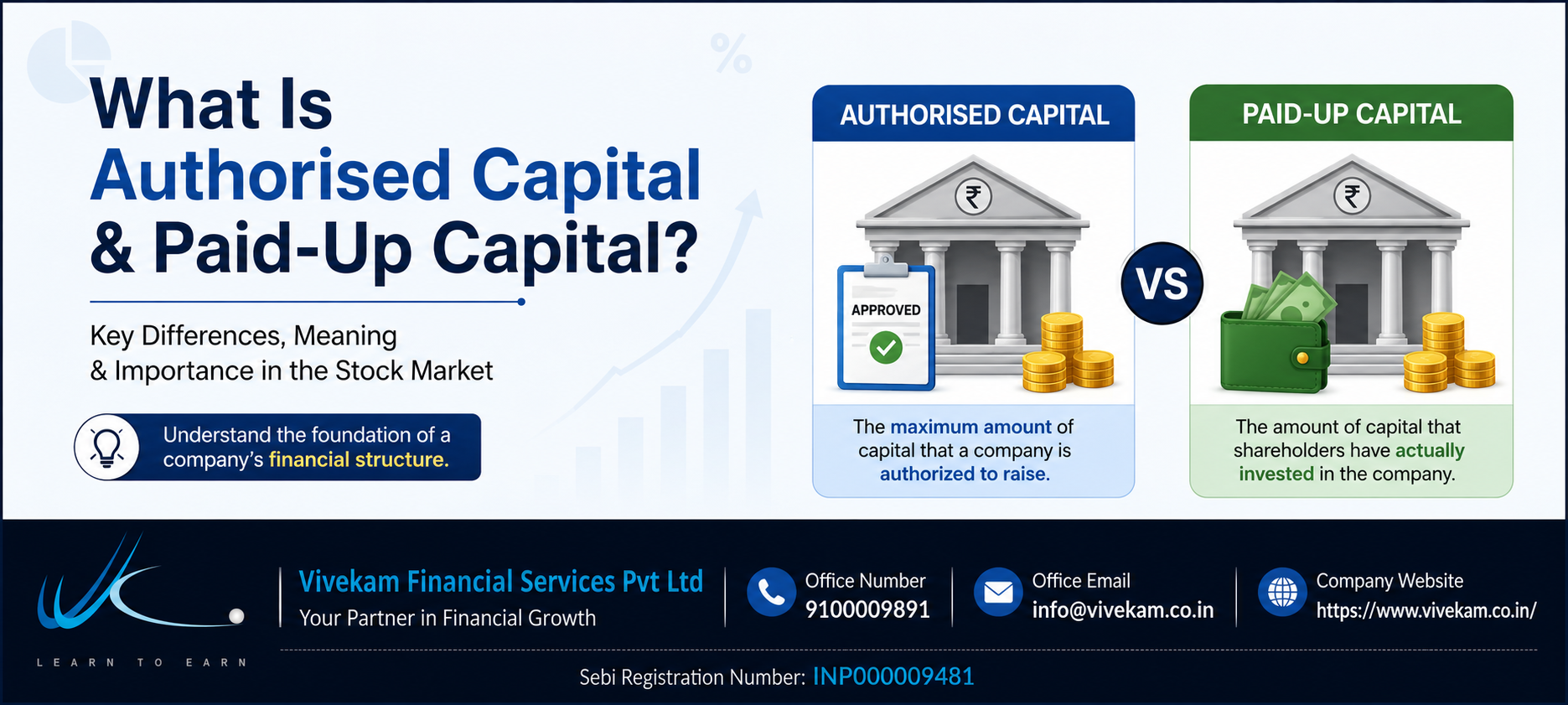
What Is Authorised Capital & Paid-Up Capital?
When people begin exploring the stock market, they quickly encounter terms such as authorised capital, paid-up capital, issued shares, face value and market capitalisation. At first glance, these terms can feel unnecessarily complicated. After all, if a company has shares trading on a stock exchange, why do investors need to know how much capital the company is authorised to issue or how much shareholders have actually paid? The answer is that these figures provide useful clues about a company’s legal share-issuing capacity and the amount of share capital actually subscribed and paid for by shareholders. They are not interchangeable, and confusing them can make a company’s financial statements much harder to understand.
A useful way to think about the distinction is to imagine a company has a large container representing the maximum amount of share capital it is legally permitted to issue under its constitutional documents. That container represents its authorised capital. The portion of that capacity that has actually been issued, subscribed for and paid by shareholders represents the company’s paid-up capital. A company may have considerable room between the two figures, or the figures may be relatively close. Neither situation automatically means the company is financially strong or weak. Investors need to understand what the numbers mean, why they changed and how they relate to the company’s overall business.
This distinction becomes particularly important when analysing listed companies, corporate actions and changes in share count. A business can increase its authorised capital to create room for a future issue of shares, while paid-up capital can change when shares are actually issued and paid for. Therefore, understanding authorised capital vs paid-up capital is less about memorising two definitions and more about understanding how a company’s equity structure evolves over time.
Understanding Share Capital in Simple Terms
Share capital is the portion of a company’s capital structure that comes from issuing shares to shareholders. When a company is incorporated or subsequently raises equity, it can divide its share capital into a specified number of shares, each having a stated face value. For example, if a company has 10 million shares with a face value of ₹10 each, the nominal share capital represented by those shares is ₹100 million. The market value of those shares can be dramatically different because the stock exchange price reflects what investors are willing to pay for ownership in the company. This is one of the first distinctions a new investor should learn: face value and market price are not the same thing.
Share capital is also different from the total value of a company’s business. A company could have relatively modest paid-up share capital while owning substantial assets, generating significant revenue and commanding a large market valuation. Conversely, a company may have a large number of shares without necessarily having a highly valuable or profitable business. That is why share capital should be treated as one piece of the financial puzzle rather than a standalone measure of investment quality.
For stock market analysis, investors generally encounter share-capital information in annual reports, financial statements, corporate announcements and exchange filings. The figures can help explain why a company’s number of outstanding shares has changed and whether a corporate action has altered the equity base. When used alongside revenue, profits, cash flow, debt, earnings per share and market capitalisation, share-capital information becomes much more meaningful.
Why Share Capital Matters to Investors
Share capital matters because the number and structure of shares can influence several important calculations. One obvious example is earnings per share (EPS). If a company earns the same amount of profit but substantially increases the number of shares outstanding, the profit attributable to each share can change. This is why investors pay attention to new share issues, bonus issues, rights issues, employee stock options and other transactions that can alter the share count.
It is also important to understand that simply having a high paid-up capital figure does not automatically make a company a better investment. Suppose Company A has paid-up capital of ₹50 crore and Company B has paid-up capital of ₹500 crore. It would be a mistake to conclude that Company B is automatically ten times larger or stronger. The face value per share, number of shares, profitability, assets, liabilities, cash generation and market price all matter. Comparing paid-up capital without considering these factors is like comparing two houses only by the number of bricks used to build them.
For beginners, the most useful approach is to ask three questions whenever share capital appears in a financial statement: How many shares exist? What is the face value of each share? And has the number of shares changed recently? Those questions provide much more analytical value than simply looking for the company with the biggest capital figure.
What Is Authorised Capital?
Authorised capital is the maximum amount of share capital that a company is authorised to issue under its governing corporate documents and applicable company law. In India, the concept is generally associated with the authorised share capital specified in the company’s constitutional documents and maintained through the relevant corporate filings. It establishes an upper limit on the nominal share capital that the company can issue without first taking the necessary steps to increase that limit.
Think of authorised capital as the company’s approved ceiling for issuing equity shares. If a company has authorised share capital of ₹100 crore, it cannot simply issue ₹150 crore worth of nominal share capital while ignoring that ceiling. If it wants to go beyond the existing authorised limit, it generally needs to follow the prescribed corporate process to increase the authorised capital. The exact procedure can depend on the company’s constitutional documents, shareholder approvals and applicable legal requirements.
The word authorised is important. It does not mean the company has received ₹100 crore from investors. It means the company has the legal capacity, subject to applicable requirements, to issue shares up to that nominal capital limit. This is where many beginners make their first mistake. Authorised capital is a capacity figure, not necessarily a measure of cash sitting in the company’s bank account.
Authorised Capital Meaning
The simplest authorised capital meaning is: the maximum nominal share capital a company is permitted to issue under its authorised limit. The figure is generally calculated by multiplying the number of shares that can be issued by their face value.
For example, imagine a company has authorised share capital of ₹20 crore divided into 2 crore equity shares with a face value of ₹10 each. The company has capacity for ₹20 crore of nominal share capital. However, it may initially issue only 1 crore shares. If those shares are fully paid at ₹10 face value, the paid-up share capital associated with them would be ₹10 crore. The remaining authorised capacity would still be available for future issuance, assuming all relevant legal and corporate requirements are satisfied.
This example also highlights why authorised capital should not be confused with the amount investors pay for shares in the market. If the company originally issues a share with a face value of ₹10 for ₹50, the investor may pay ₹50, but the nominal share capital component is ₹10 and the additional ₹40 is generally treated separately as securities premium, subject to the applicable accounting and legal framework. Therefore, authorised capital is fundamentally linked to the nominal or face-value component of the company’s share structure.
For investors, the authorised figure is useful when interpreting corporate actions. A company with substantial unused authorised capital may have room to issue additional shares without first increasing the authorised limit, although it still needs to satisfy the other requirements applicable to the proposed issue.
What Is Paid-Up Capital?
Paid-up capital refers to the amount of share capital that shareholders have actually paid to the company for the shares issued to them, subject to the company’s particular share terms and applicable accounting and legal treatment. This is the figure most closely associated with the equity share capital actually subscribed and paid. In simple language, if authorised capital is the company’s permitted ceiling, paid-up capital represents the portion of issued share capital for which shareholders have provided the required capital.
The term is often searched online as paid up capital meaning, and the simplest explanation is that it represents the capital actually paid by shareholders against the shares issued by the company. However, a careful reading matters because paid-up capital is not necessarily identical to the total cash value that investors have spent buying shares on a stock exchange. When an investor purchases an already-listed share from another investor in the secondary market, the money normally changes hands between those investors rather than going directly to the company.
This distinction is crucial. If you purchase 100 shares of a listed company from another shareholder at ₹500 per share, you have spent ₹50,000, but the company does not suddenly increase its paid-up capital by ₹50,000. The company’s share capital changes when the company itself issues shares or undertakes relevant capital transactions, not simply because ownership of existing shares moves between investors on the exchange.
Paid Up Capital Meaning
The paid up capital meaning becomes easier to understand when you separate a primary share issue from secondary-market trading. In a primary issue, a company issues shares to investors and receives capital according to the terms of that issue. That transaction can affect the company’s share capital. In a secondary-market transaction, an investor sells existing shares to another investor, and the company is generally not receiving the purchase price.
For example, suppose a company has 10 million equity shares with a face value of ₹10 each, and all shares have been fully paid. Its paid-up equity share capital would be ₹100 million. Now imagine one shareholder sells 100,000 of those shares on the stock exchange. The buyer becomes the new owner of those shares, but the company’s paid-up share capital does not become larger merely because the shares changed hands.
This is why paid-up capital should never be confused with market capitalisation. Market capitalisation is generally calculated by multiplying the current market price by the number of outstanding shares. Paid-up capital is based on the share capital recognised at its nominal value and related capital terms. A company can therefore have paid-up capital of ₹100 crore while having a market capitalisation of several thousand crore, depending on its share price and outstanding shares.
Authorised Capital vs Paid-Up Capital
The difference between authorised capital vs paid up capital can be reduced to one central idea: authorised capital describes the permitted ceiling, while paid-up capital describes the capital actually paid against issued shares. A company can have authorised capital of ₹100 crore but paid-up capital of only ₹40 crore. In that case, the company has ₹60 crore of nominal authorised capacity that has not yet been used through issued paid-up share capital, subject to the applicable legal and corporate framework.
This gap is sometimes called the unused portion of authorised share capital. It can provide flexibility when a company wants to issue additional shares. But having unused authorised capital does not mean the company is guaranteed to raise money or that investors are necessarily going to receive new shares. Any future issuance depends on the company’s funding requirements, board and shareholder approvals where required, regulatory requirements, investor participation and the specific nature of the proposed issue.
The two figures also answer different questions. Authorised capital answers, “How much nominal share capital is the company permitted to issue?” Paid-up capital answers, “How much share capital has actually been paid up by shareholders against shares issued?” Once that distinction becomes intuitive, many corporate filings become much easier to read.
Key Differences at a Glance
Basis | Authorised Capital | Paid-Up Capital |
Basic meaning | Maximum authorised nominal share capital | Share capital actually paid by shareholders |
Main purpose | Sets the permitted ceiling for issuing shares | Represents issued share capital paid by shareholders |
Can it be unused? | Yes | Represents capital already issued and paid, subject to applicable terms |
Changes when shares are traded on an exchange? | Generally no | Generally no |
Can change through a new share issue? | May remain unchanged if sufficient capacity exists | Yes |
Related to face value? | Yes | Yes |
Same as market capitalisation? | No | No |
Direct measure of company value? | No | No |
A useful mental shortcut is to picture a cinema with a maximum legal seating capacity. Authorised capital is like the approved capacity; paid-up capital is like the seats that have actually been sold and paid for. The capacity does not mean every seat is occupied, and selling a ticket to one customer does not necessarily change the building’s maximum capacity.
How Authorised and Paid-Up Capital Work Together
Authorised and paid-up capital are connected because one establishes the available ceiling while the other reflects the capital actually issued and paid. A company generally cannot issue shares beyond its authorised limit without first completing the appropriate process to increase that limit. This makes authorised capital an important part of the company’s corporate architecture, while paid-up capital records how much of that capacity has been utilised through share issuance.
Consider a hypothetical company called Sunrise Technologies Ltd. Suppose it has authorised share capital of ₹50 crore and paid-up share capital of ₹20 crore. The company therefore has authorised capacity beyond its existing paid-up capital. If management later decides to issue new shares with an aggregate nominal value of ₹10 crore, the existing authorised limit could potentially accommodate that issue, assuming the other legal and corporate conditions are satisfied. After the new shares are properly issued and paid, the company’s paid-up capital could increase accordingly.
That does not mean the company’s market capitalisation increases by exactly ₹10 crore. The issue price may be higher than face value, and the market value of the company depends on the trading price and share count. This is an important distinction when reading announcements. An equity issue can bring fresh funds into a company while also changing the number of outstanding shares and potentially affecting existing shareholders’ ownership percentages.
A Simple Example of Capital Structure
Suppose ABC Ltd has an authorised share capital of ₹100 crore, divided into 10 crore equity shares with a face value of ₹10 each. Initially, the company issues 4 crore shares, fully paid at ₹10 each. Its paid-up share capital would therefore be ₹40 crore, leaving ₹60 crore of authorised but unissued nominal capital.
Now imagine ABC decides to raise additional equity by issuing 2 crore new shares at ₹50 per share. The company receives ₹100 crore in gross proceeds before considering applicable issue costs and accounting treatment. But the nominal share-capital component of those new shares is ₹20 crore because each share has a ₹10 face value. The remaining amount above face value is generally recognised separately, such as in a securities premium account, according to the applicable accounting and corporate framework.
After the issue, assuming the shares are fully paid and the transaction is completed, the company’s paid-up share capital could become ₹60 crore. Its authorised capital would remain ₹100 crore unless it subsequently changes that authorised limit. This example shows why the amount raised in an equity issue can be much larger than the increase in paid-up capital.
Purpose of Authorised Capital in a Company
The purpose of authorised capital is to establish the company’s permitted ceiling for issuing nominal share capital. It gives the company a defined framework within which it can raise equity as its business develops. A start-up, for example, may establish an authorised capital level that gives it room for future fundraising, while a mature listed company may periodically revise its authorised capital to accommodate planned corporate actions or changes in its equity structure.
Authorised capital also provides a formal governance mechanism. A company cannot simply create unlimited shares whenever management wants. Increasing the authorised limit can require prescribed corporate approvals and filings. These requirements help maintain transparency around changes to the company’s capital structure and ensure that significant changes are properly documented.
From an investor’s perspective, authorised capital is particularly relevant when a company announces an equity-related transaction. If the proposed issue would exceed the existing authorised limit, the company may first need to increase its authorised capital. Investors should therefore read the entire corporate announcement rather than focusing on a single number.
It is also important not to overinterpret the figure. A high authorised capital does not prove that a company has strong finances. It simply indicates that the company has a certain authorised capacity for nominal share capital. A company could have a large authorised limit and very little paid-up capital, or substantial paid-up capital and a comparatively small amount of unused authorised capacity. Financial strength must be evaluated using a much broader set of indicators.
Purpose of Paid-Up Capital in a Company
Paid-up capital represents actual shareholder-funded share capital recognised by the company. It forms part of the company’s equity and is therefore an important component of its capital structure. When a company raises equity from shareholders through a primary issuance, the paid-up capital records the nominal share-capital portion of that transaction, while any amount received above face value is accounted for separately according to the relevant framework.
Paid-up capital can be used in various corporate calculations and disclosures. It helps establish the company’s issued equity base and can be relevant when determining ownership percentages, voting rights and the number of shares available to investors. For listed companies, the number of shares represented by paid-up capital is also relevant when understanding metrics such as earnings per share.
However, paid-up capital is not the same as the company’s total equity. Shareholders’ equity can include paid-up share capital, securities premium, retained earnings, reserves and other components, depending on the company’s financial statements and accounting standards. A company with relatively low paid-up capital can still have substantial shareholders’ equity if it has accumulated profits and reserves over many years.
That is why an investor should avoid judging a company based solely on its paid-up capital. The number is informative, but context gives it meaning. The real analytical question is how that share capital interacts with profitability, cash flows, debt, assets, ownership structure and the company’s future plans.
Importance of Paid-Up Capital in the Stock Market
For stock market participants, paid-up capital becomes useful because it helps explain the company’s equity base. The number of shares outstanding is central to several market metrics, and paid-up capital provides a route to understanding that number when the face value of the shares is known. If a company reports ₹25 crore of paid-up equity share capital and each share has a face value of ₹10, an investor can infer that the corresponding fully paid share count is approximately 2.5 crore shares, assuming the figure represents fully paid equity shares without complications from different classes or unpaid amounts.
This information can be particularly valuable when analysing changes in ownership or share count. Suppose a company announces a new equity issue. The increase in shares can affect existing shareholders’ percentage ownership, earnings per share and voting power. The transaction may be beneficial if the company uses the funds productively, but simply issuing shares does not automatically create value for existing shareholders.
Paid-up capital also helps investors distinguish between a company’s accounting share capital and its market value. A company may have paid-up capital of ₹10 crore and a market capitalisation of ₹2,000 crore. Another company could have paid-up capital of ₹200 crore and a market capitalisation of ₹1,500 crore. Neither comparison tells you which business is better without examining profitability, growth, capital efficiency, valuation and risk.
In short, paid-up capital is best viewed as a structural financial indicator, not a stock-picking shortcut.
Does Paid-Up Capital Affect a Company’s Share Price?
Paid-up capital does not mechanically determine a company’s stock price. The market price is influenced by investors’ expectations about the company’s future earnings, cash flows, growth opportunities, competitive position, interest rates, economic conditions, sentiment and many other factors. Paid-up capital tells you about the company’s share-capital structure, but it does not directly tell you what one share should be worth.
There can, however, be an indirect relationship when a company’s share count changes. Imagine a company earns ₹100 crore and has 10 crore shares outstanding. Its earnings per share would be ₹10. If it subsequently issues another 10 crore shares and profits remain ₹100 crore, the earnings are now spread across 20 crore shares, making the simple EPS calculation ₹5, assuming all other factors remain unchanged. This is a basic illustration of dilution.
The real outcome can be different if the new capital helps the company expand, increase profits or reduce financial risk. If the additional funds generate strong returns, future earnings may rise enough to offset or exceed the dilution effect. Conversely, issuing shares without creating sufficient economic value can be less attractive to existing shareholders.
Therefore, when paid-up capital rises, investors should ask why it increased and what the company plans to do with the new capital. The reason behind the change often matters more than the change itself.
Can a Company Increase Its Authorised Capital?
Yes, a company can generally increase its authorised share capital by following the applicable corporate and legal procedure. In India, this may involve provisions under the Companies Act, the company’s articles and relevant filings and approvals. The exact process depends on the company’s circumstances, its constitutional documents and the nature and extent of the proposed increase.
Why would a company do this? One common reason is to create sufficient room for a proposed issue of new shares. A company approaching a large fundraising round may discover that its existing authorised capital is insufficient for the nominal value of the shares it intends to issue. Increasing the authorised limit can provide the necessary capacity before the issue is completed.
Another reason could be a corporate restructuring or a broader change in the company’s capital plans. The increase itself does not necessarily bring new cash into the business. This point is easy to miss. Raising authorised capital changes the company’s capacity to issue shares; it is the subsequent issuance and subscription of shares that can bring new equity funds into the company.
For investors, an announcement regarding increased authorised capital should therefore be interpreted carefully. It may indicate that management is preparing for a future capital action, but it is not proof that a fundraising transaction will definitely occur or that the share price will rise. The actual issue terms, pricing, purpose, dilution and use of proceeds are much more important.
How Companies Increase Paid-Up Capital
Paid-up capital can increase when a company issues additional shares that are subscribed and paid for under the relevant terms. This can happen through different corporate actions, including public offerings, rights issues, private placements or other permitted forms of equity issuance. Bonus shares can also change the paid-up share capital even though they do not involve shareholders paying fresh cash to the company in the same way as a conventional cash issue.
The distinction between these transactions matters. A rights issue can bring fresh funds from existing eligible shareholders. A private placement can involve issuing shares to selected investors under the applicable legal framework. A public issue can raise equity from a broader investor base. A bonus issue, by contrast, generally involves capitalising eligible reserves rather than receiving fresh cash from shareholders.
These transactions can change the number of shares and therefore affect ownership percentages and per-share metrics. Suppose an investor owns 1 million shares in a company with 10 million shares outstanding. The investor owns 10%. If the company issues another 10 million shares to other investors and the original shareholder does not participate, the original investor’s percentage ownership could fall to 5%, assuming the transaction is completed on those simple terms.
This is why changes in paid-up capital deserve context. An increase is not inherently positive or negative. What matters is why the shares were issued, at what terms, to whom, how much capital was raised, and whether the company can generate attractive returns from the funds.
What Investors Should Check in Financial Statements
When reviewing a company’s financial statements, investors should look beyond the headline paid-up capital number. Start by checking the number of equity shares, their face value and whether the shares are fully paid. Then compare the current share count with previous periods. A meaningful change can point toward a rights issue, acquisition consideration, employee stock options, conversion of securities, bonus issue or another capital transaction.
The notes accompanying the financial statements can be especially useful because they often provide more detail than the primary balance sheet. Investors may find information about authorised share capital, issued capital, subscribed capital, paid-up capital, changes during the year, rights attached to different classes of shares and other relevant details.
It is also worth checking whether the company has outstanding instruments that could eventually affect the share count. Convertible securities, employee stock options and similar instruments can be relevant to future dilution even though they may not yet be included in the current paid-up share capital in the same manner as issued equity shares.
A practical checklist for beginners is:
- Compare authorised capital with paid-up capital.
- Check the face value per share.
- Review changes in the number of shares outstanding.
- Read the notes explaining changes in share capital.
- Look for recent rights, bonus, preferential or public issues.
- Examine potential dilution from convertible instruments or employee options.
- Compare share-capital changes with changes in profit, cash flow and shareholders’ equity.
These steps turn a seemingly boring accounting figure into useful information about how the company is financing itself.
Common Misunderstandings About Share Capital
One of the biggest misconceptions is that authorised capital is money the company already has. It is not. Authorised capital represents a ceiling on nominal share capital that the company is permitted to issue. The company does not automatically receive cash merely because its authorised capital is increased.
Another common misunderstanding is that paid-up capital equals the company’s market value. It does not. Market capitalisation is based on the market price of outstanding shares, while paid-up share capital is tied to the nominal share-capital amount. The difference can be enormous, particularly for successful listed companies whose shares trade at prices substantially above face value.
Some investors also assume that purchasing shares on an exchange increases the company’s paid-up capital. Generally, it does not. Secondary-market trading transfers ownership of existing shares between investors. The company normally receives funds when it issues shares in the primary market, not every time those shares subsequently change hands.
A further misconception is that a higher paid-up capital automatically means a stronger company. That conclusion is too simplistic. A company’s financial health depends on factors such as profitability, cash generation, debt, asset quality, competitive advantages, management decisions and capital efficiency. Share capital provides structural information, not a complete health score.
Once these misconceptions are cleared away, the terminology becomes much less intimidating. The numbers start to function like signposts rather than mysterious accounting jargon.
Authorised Capital, Paid-Up Capital and Market Capitalisation
These three concepts are closely encountered in stock market discussions but describe very different things. Authorised capital is the maximum nominal share capital the company is permitted to issue under its authorised limit. Paid-up capital represents the nominal share capital actually paid by shareholders for issued shares. Market capitalisation, meanwhile, reflects the market’s current valuation of the company’s outstanding shares.
A simple example makes the difference obvious. Suppose a company has authorised capital of ₹100 crore and paid-up capital of ₹20 crore. Assume the paid-up capital represents 2 crore shares with a face value of ₹10 each. If those shares trade on the stock exchange at ₹300 per share, the company’s market capitalisation based on 2 crore shares would be ₹600 crore.
Notice what happened. The authorised capital is ₹100 crore, paid-up capital is ₹20 crore and market capitalisation is ₹600 crore. Three figures, three different meanings. None of the numbers is a mistake.
Measure | What it tells you |
Authorised capital | Maximum authorised nominal share capital |
Paid-up capital | Nominal share capital paid against issued shares |
Market capitalisation | Market value based on share price × outstanding shares |
This distinction is especially important when comparing listed companies. Investors should never rank companies by paid-up capital and assume they are ranking them by size. Market capitalisation, enterprise value, revenue, assets and other measures answer different questions and should be selected according to the purpose of the analysis.
Why These Numbers Matter During Corporate Actions
Corporate actions are one of the situations where authorised and paid-up capital become particularly relevant. Companies regularly make changes to their equity structure for reasons ranging from fundraising and acquisitions to employee compensation and capital restructuring. Investors who understand the underlying terminology can interpret these announcements more confidently.
Suppose a company announces a rights issue. Existing eligible shareholders may have the opportunity to purchase additional shares, usually under specified terms. If the issue is completed, the company’s paid-up share capital can increase because new shares have been issued and paid for. The authorised capital may or may not need to change depending on whether sufficient authorised capacity already exists.
A bonus issue works differently. In a bonus issue, additional shares may be issued by capitalising eligible reserves. Shareholders receive additional shares according to the announced ratio, but the transaction is not the same as shareholders paying fresh cash into the company. The number of shares increases, and the nominal share capital can increase through the capitalisation process, while the economic value of the investor’s overall holding does not automatically increase merely because the number of shares has risen.
Corporate actions therefore need to be analysed from several angles: share count, face value, issue price, source of funds, ownership dilution, reserves, EPS and the company’s stated purpose. Looking at only the paid-up capital figure can hide the real story.
How to Read Share Capital on a Balance Sheet
When reading a balance sheet, start with the equity section and then move into the accompanying notes. The balance sheet may present share capital as a single figure, but the notes usually provide the details necessary to understand how that number was calculated. Look for authorised share capital, issued share capital, subscribed capital and paid-up capital, where applicable under the reporting framework.
Next, check the face value of the shares. This is important because paid-up capital divided by the face value can help you understand the approximate number of shares represented by the capital figure, subject to the precise structure of the company’s share capital. If the company has multiple classes of shares or partly paid shares, the calculation needs additional care.
After that, compare the current year with the previous year. Has the number of shares increased? Has the company carried out a rights issue, bonus issue or preferential allotment? Did employees exercise stock options? Was there a merger or acquisition involving the issue of shares? The notes should provide clues.
Finally, connect the capital movement with the cash flow statement and other equity movements. If the company issued shares for cash, you should expect the financial statements to reflect the related financing activity. If the change arose through a non-cash transaction such as a bonus issue, the economic interpretation is different.
This habit of cross-checking is useful because financial statements are interconnected. A single number rarely tells the whole story.
Practical Example for Stock Market Beginners
Imagine a listed company named Greenfield Industries Ltd. It has authorised share capital of ₹200 crore, represented by 20 crore shares with a face value of ₹10 each. Its existing paid-up share capital is ₹80 crore, representing 8 crore fully paid equity shares. The company therefore has authorised capacity that exceeds its existing paid-up capital.
Greenfield later announces an equity fundraising transaction in which it plans to issue 2 crore new shares at ₹150 per share. The gross amount raised before relevant costs would be ₹300 crore. However, the increase in nominal paid-up share capital would be ₹20 crore because the face value is ₹10 per share. The remaining ₹280 crore above face value would generally be accounted for separately, subject to the applicable accounting and legal framework.
After the issue, assuming the shares are fully subscribed and paid, Greenfield could have paid-up share capital of ₹100 crore. Its authorised capital would still be ₹200 crore if no change to the authorised limit were required. The total number of shares would rise from 8 crore to 10 crore.
What does this mean for an existing shareholder? Suppose an investor previously owned 80 lakh shares. Before the issue, that investor owned 10% of the company because 80 lakh represents 10% of 8 crore shares. If the investor does not participate in the new issue, the investor would own 8% after the issue because the total share count has increased to 10 crore.
That is the basic mechanics of dilution. But whether dilution is good or bad depends on what Greenfield does with the ₹300 crore it raises. If the company invests the money into highly profitable expansion, future earnings could grow significantly. If the money is used inefficiently, existing shareholders may not receive an attractive return on the additional capital.
The lesson is simple: never analyse a capital increase in isolation. Follow the money, understand the share-count change and examine the business purpose.
Frequently Asked Questions
1. What is the difference between authorised capital and paid-up capital?
Authorised capital is the maximum nominal share capital a company is authorised to issue under its applicable corporate framework. Paid-up capital is the share capital actually paid by shareholders against shares issued by the company. For example, a company could have ₹100 crore of authorised capital and ₹40 crore of paid-up capital, leaving unused authorised capacity.
2. What is the paid up capital meaning in simple words?
The paid up capital meaning can be simplified as the amount of share capital that shareholders have actually paid for shares issued by the company. It is linked to the nominal or face value of the issued shares and should not be confused with the market value of those shares.
3. Is paid-up capital the same as market capitalisation?
No. Paid-up capital is based on the company’s share-capital structure, particularly the nominal value of issued and paid shares. Market capitalisation is generally calculated by multiplying the current market price by the number of outstanding shares. A company’s market capitalisation can therefore be many times higher than its paid-up capital.
4. Does buying shares on the stock exchange increase paid-up capital?
Generally, no. When you buy existing shares on a stock exchange, the transaction is normally between you and the selling shareholder. The company does not receive the purchase price simply because the shares change hands. Paid-up capital generally changes when the company itself issues or otherwise alters its share capital through an applicable corporate transaction.
5. Why should stock market investors care about authorised capital?
Authorised capital helps investors understand the company’s permitted capacity for issuing nominal share capital. It can become particularly relevant when a company announces fundraising or another equity-related corporate action. However, authorised capital by itself does not indicate profitability, financial strength or whether a stock is attractively valued.
Conclusion
Understanding authorised capital and paid-up capital gives stock market investors a clearer view of how a company’s equity structure works. Authorised capital represents the maximum nominal share capital the company is permitted to issue under its authorised limit, while paid-up capital represents the share capital actually paid by shareholders against issued shares. The two figures are connected, but they answer different questions and should never be treated as synonyms.
The distinction becomes especially valuable when companies raise funds, issue bonus shares, undertake rights issues, make preferential allotments or otherwise change their share count. Paid-up capital can help investors understand the company’s equity base, while authorised capital can show how much additional nominal share-capital capacity exists. Neither figure, however, should be mistaken for market capitalisation or treated as a standalone measure of financial strength.
For anyone learning stock market analysis, the most useful habit is to look beyond the number itself. Check the face value, number of shares, changes over time, reason for those changes and the company’s use of capital. Then connect that information with earnings, cash flow, debt, reserves and valuation. Once you start viewing share capital as part of a larger financial story, terms such as authorised capital meaning, paid up capital meaning, paid-up capital, and authorised capital vs paid-up capital become much easier to understand.
The stock market may look like a world of prices and charts, but behind every listed share is a legal and financial structure. Learning that structure is one of the simplest ways to become a more informed reader of company filings.