
Long Term Capital Gains Tax on Shares in India: Rates, Rules & Calculation
What Is Long Term Capital Gain (LTCG)?
Long term capital gain is the profit you make when you sell a capital asset — in this context, listed equity shares or equity mutual fund units — after holding it for more than 12 months. Hold it for 12 months or less, and the profit is classified as short-term capital gain (STCG), which is taxed differently and, in most cases, more heavily.
The distinction isn’t cosmetic. It determines your tax rate, your exemption eligibility, and how you’re allowed to set off losses. Get the holding period wrong by even a day, and you’ve misclassified the gain.
LTCG Tax Rate on Shares: The Current Numbers
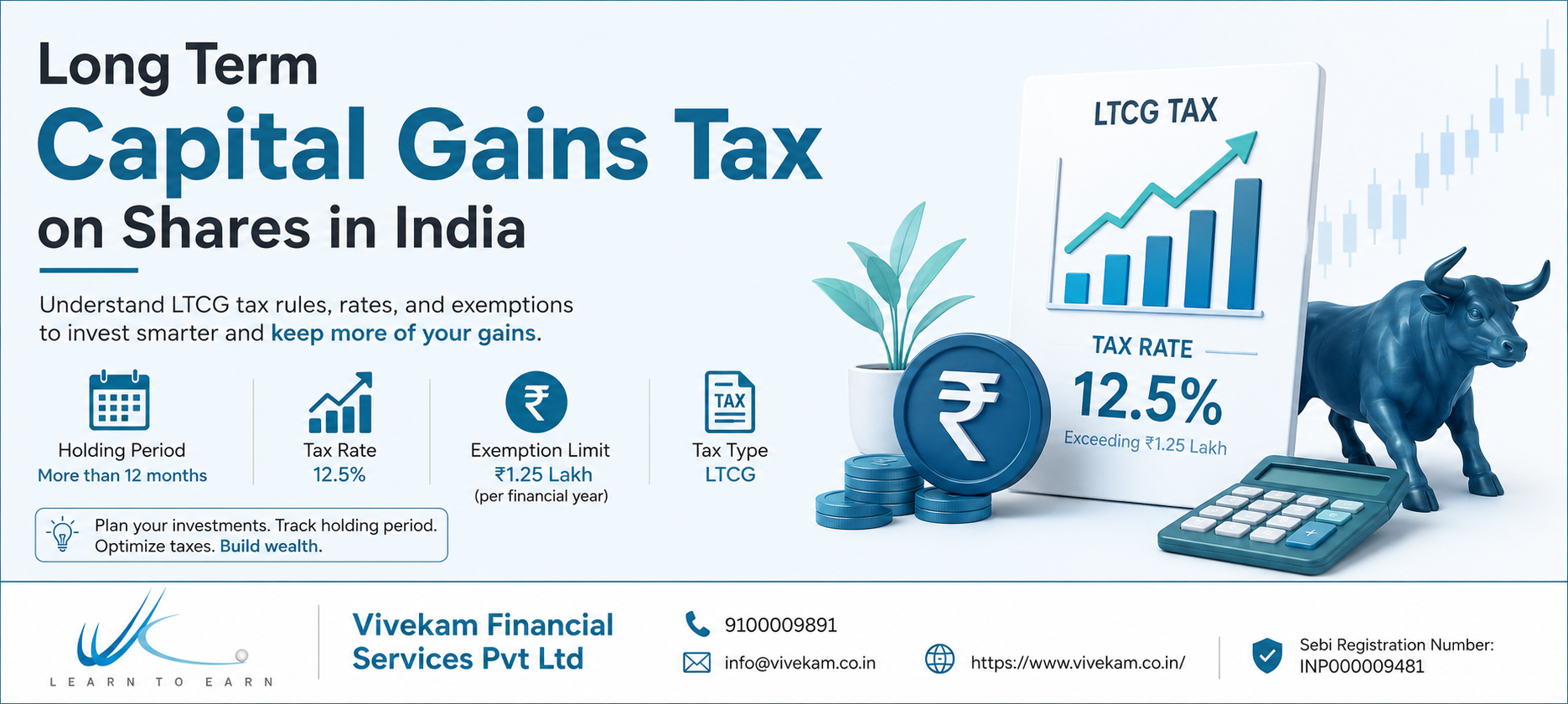
Here is the rule as it stands for FY 2025-26 (AY 2026-27), and it remains unchanged following Budget 2026:
- LTCG tax rate on listed equity shares and equity-oriented mutual funds: 12.5%, applicable on gains exceeding the exemption threshold, with no indexation benefit.
- LTCG exemption limit: Rs. 1.25 lakh per financial year. Gains up to this amount are entirely tax-free.
- Holding period for “long-term” classification: more than 12 months for listed shares and equity mutual funds.
- Cess: 4% applies on top of the tax calculated (Health and Education Cess), and a surcharge applies if your total income crosses the relevant thresholds.
This is a jump from the pre-July 2024 regime, where the rate was 10% on gains above Rs. 1 lakh. Budget 2024 raised both the rate and the exemption ceiling in the same stroke — a change that sounds like a wash but usually isn’t, because the increase in tax rate typically outweighs the modest bump in exemption for anyone with meaningful gains.
One more point that trips up experienced investors: Section 87A rebate does not apply to LTCG on equity. Even if your total taxable income is below Rs. 12 lakh and you’d otherwise owe zero tax under the rebate provisions, LTCG above Rs. 1.25 lakh is still taxed. This is a specific carve-out in the law, not an oversight, and it has been litigated and clarified enough times that there’s no ambiguity left.
Short Term vs Long Term Capital Gains: Know the Difference
|
Parameter |
Short-Term Capital Gains (STCG) |
Long-Term Capital Gains (LTCG) |
|
Holding period |
12 months or less |
More than 12 months |
|
Tax rate (listed equity/equity MF) |
20% |
12.5% |
|
Exemption limit |
None |
Rs. 1.25 lakh per year |
|
Indexation benefit |
Not applicable |
Not applicable (removed for equity since July 2024) |
|
Set-off against other gains |
Can be set off against STCG and LTCG |
Can be set off against LTCG only (with limited exceptions) |
The STCG rate itself was hiked from 15% to 20% in Budget 2024 — a change that gets far less attention than the LTCG revision but hits active traders harder. If you’re churning your portfolio inside a year, that 5-percentage-point increase compounds fast.
How LTCG on Shares Is Calculated
The formula is straightforward once you strip away the noise:
LTCG = Full Value of Consideration (Sale Price) − Cost of Acquisition − Expenses Directly Related to the Sale
For shares purchased on or after February 1, 2018, the cost of acquisition is simply what you paid for them — no adjustment.
For shares purchased before January 31, 2018, there’s a grandfathering clause. Your cost of acquisition is the higher of:
- The actual purchase price, or
- The Fair Market Value (FMV) of the share as on January 31, 2018 (capped at the actual sale price, if the sale price is lower than the FMV).
This grandfathering provision exists specifically to shield gains that had already accrued before LTCG tax was reintroduced in 2018. If you’ve been holding blue-chip stocks since before that date, this calculation matters — it can materially reduce your taxable gain.
A worked example:
You bought 500 shares of a listed company in March 2020 at Rs. 400 each (total cost: Rs. 2,00,000). You sell them in June 2025 at Rs. 900 each (total sale value: Rs. 4,50,000). Brokerage and STT on the sale total Rs. 1,500.
- Sale consideration: Rs. 4,50,000
- Less: Cost of acquisition: Rs. 2,00,000
- Less: Selling expenses: Rs. 1,500
- Gross LTCG: Rs. 2,48,500
- Less: Exemption: Rs. 1,25,000
- Taxable LTCG: Rs. 1,23,500
- Tax payable: 12.5% of Rs. 1,23,500 = Rs. 15,437.50, plus applicable cess.
No indexation adjustment enters this calculation because indexation was withdrawn for equity LTCG effective July 23, 2024.
LTCG on Mutual Funds: It’s Not One Rule for All
This is where a lot of investors get careless, because “mutual fund” is treated as a single category when it isn’t.
- Equity-oriented mutual funds (funds with at least 65% allocation to equity): Taxed exactly like listed shares — 12.5% LTCG above Rs. 1.25 lakh exemption, 12-month holding period for long-term classification.
- Debt mutual funds (and any fund with less than 65% equity allocation): Since the amendment effective April 1, 2023, these no longer get LTCG treatment at all. Gains are added to your income and taxed at your applicable slab rate, regardless of how long you held the units. There is no indexation benefit and no separate LTCG rate — this is a full alignment with your income tax slab.
- Hybrid funds: Taxation depends entirely on the actual equity allocation of the specific scheme, so check the fund’s asset allocation before assuming a rate.
If you’re holding debt funds expecting indexed long-term treatment because that’s how it used to work, that benefit is gone for units acquired after April 1, 2023.
Capital Gains Tax on Equity Shares: Additional Rules That Matter
Set-off and carry forward: LTCG losses can only be set off against LTCG gains — not against STCG or other income heads. If you don’t have enough LTCG in the current year to absorb the loss, you can carry it forward for up to 8 assessment years, but only if you file your Income Tax Return before the due date. Miss the deadline, and you lose the carry-forward right permanently, even if the loss itself is genuine.
STT condition: The concessional LTCG/STCG rates on listed equity apply only where Securities Transaction Tax (STT) has been paid on the transaction. Off-market transfers or transactions where STT wasn’t applicable don’t automatically qualify for these rates — check this before assuming the equity tax regime applies.
Unlisted shares: Different rules apply. The holding period for long-term classification on unlisted shares is 24 months, not 12, and the STT condition for concessional rates doesn’t apply the same way.
Non-resident investors: NRIs are subject to the same 12.5% LTCG rate on listed equity, though TDS provisions and DTAA (Double Taxation Avoidance Agreement) benefits may alter the effective outcome — this needs case-specific evaluation, not a blanket assumption.
Tax on Share Market Income: Beyond Capital Gains
Capital gains aren’t the only tax exposure from equity investing. Dividend income is taxed at your applicable slab rate (dividends are no longer tax-free in the investor’s hands, and Dividend Distribution Tax was abolished back in FY 2020-21). If your trading activity is frequent and structured enough to resemble a business — high transaction volume, use of leverage, derivatives trading — the income may be classified as business income rather than capital gains, which changes the entire tax treatment, including the ability to claim business expenses. This classification is fact-specific and worth getting a professional opinion on if your trading pattern is aggressive.
Legitimate Ways to Reduce LTCG Liability
There’s no shortage of aggressive “tax hacks” floating around online. Stick to what’s actually codified in law:
- Use the full Rs. 1.25 lakh exemption every year. If you have unrealized gains, consider realizing gains up to the exemption threshold annually rather than letting them accumulate and pushing a future year’s gain well past the exemption.
- Tax-loss harvesting. Offsetting realized LTCG against LTCG losses in the same year is legal and straightforward — but do the arithmetic on transaction costs (STT plus brokerage) before assuming the harvesting saves you money on smaller trades.
- Section 54F (for gains from assets other than a residential house, reinvested into a residential property) offers exemption but comes with a 3-year lock-in condition — sell the new property early and the exemption reverses.
- Section 54EC bonds allow you to invest capital gains (from land/building, not equity) into specified bonds with a 5-year lock-in for exemption — note this route applies to specific asset classes, not equity shares directly.
There is no legal mechanism to avoid LTCG tax on listed equity shares beyond the annual exemption and loss set-off. Be skeptical of anyone claiming otherwise.
Frequently Asked Questions
- What is the current LTCG tax rate on shares in India?
12.5% on long-term capital gains exceeding Rs. 1.25 lakh in a financial year, applicable to listed equity shares and equity-oriented mutual funds, without indexation benefit. - What is the LTCG exemption limit for FY 2025-26?
Rs. 1.25 lakh per financial year. This is the total exemption across all your LTCG from equity shares and equity mutual funds combined, not per transaction or per stock. - Is indexation available for LTCG on shares?
No. Indexation benefit for equity shares and equity mutual funds was withdrawn effective July 23, 2024, alongside the rate increase from 10% to 12.5%. - How is the holding period calculated for LTCG on shares?
From the date of purchase (or allotment) to the date of sale. If this period exceeds 12 months for listed shares, the gain qualifies as long-term. - Does the Rs. 12 lakh income tax rebate under Section 87A apply to LTCG?
No. LTCG on equity is explicitly excluded from the Section 87A rebate, so you’ll owe LTCG tax on gains above Rs. 1.25 lakh regardless of your total income level. - Are debt mutual funds taxed the same as equity mutual funds?
No. Debt mutual fund gains (units acquired after April 1, 2023) are taxed entirely at your income tax slab rate, with no separate LTCG rate and no indexation, irrespective of the holding period. - Can LTCG losses be set off against short-term capital gains?
No. LTCG losses can only be set off against LTCG gains, not against STCG or other income. Carry-forward is permitted for up to 8 assessment years, contingent on timely ITR filing. - What happened to shares bought before January 31, 2018?
They’re covered under the grandfathering clause — cost of acquisition is taken as the higher of actual purchase price or the FMV as on January 31, 2018 (subject to a cap based on actual sale price). - Did Budget 2026 change the LTCG rate on shares?
No. Budget 2026 left the LTCG framework for equity unchanged — the 12.5% rate, the Rs. 1.25 lakh exemption, and the 12-month holding period all continue to apply for FY 2026-27.
Conclusion
The rules on long-term capital gains tax on shares in India are not complicated once you separate what changed in 2024 from what didn’t. The rate is 12.5%, the annual exemption is Rs. 1.25 lakh, indexation is off the table for equity, and the Section 87A rebate doesn’t rescue you from LTCG liability. Debt funds no longer get LTCG treatment at all. None of this is negotiable or subject to interpretation — it’s codified, and the Income Tax Department applies it uniformly.
Where investors actually lose money isn’t in the tax rate itself — it’s in poor timing of gains realization, missed exemption utilization, sloppy record-keeping on acquisition cost for pre-2018 holdings, and late ITR filing that forfeits loss carry-forward rights. Get the mechanics right, plan your realizations around the exemption threshold, and keep your documentation clean. That’s the entire game.
This article is for informational purposes and reflects tax rules applicable as of FY 2025-26 (AY 2026-27), including Budget 2026 provisions. Tax laws are subject to amendment; consult a qualified chartered accountant or tax advisor for guidance specific to your financial situation before filing.