Nifty 50 Weightage 2026: Top Stocks and Sector-Wise Breakdown
What Is the Nifty 50 Index?
The Nifty 50 index is India’s benchmark stock market index representing the 50 largest and most actively traded companies on the National Stock Exchange (NSE).
But here’s what many blogs fail to explain:
The Nifty 50 is not just a stock list. It is essentially a real-time scoreboard of India’s economy.
When banks rally, the index rises.
When IT stocks crash, the index weakens.
When Reliance moves, the whole market reacts.
That’s why every serious investor tracks the Nifty 50 companies closely.
The index covers major sectors including:
- Banking
- Information Technology
- Oil & Gas
- FMCG
- Telecom
- Pharma
- Infrastructure
- Automobile
Because these sectors represent the backbone of India’s economy, the Nifty 50 stocks are heavily used by:
- Mutual funds
- Foreign investors
- ETFs
- Hedge funds
- Pension funds
How Nifty 50 Weightage Is Calculated
Most articles oversimplify this section with one boring sentence.
Let’s make it practical.
The Nifty 50 weightage depends on something called free-float market capitalization.
That means only publicly tradable shares count toward the calculation.
The Formula
Weightage=Free Float Market Capitalization of CompanyTotal Free Float Market Cap of Nifty 50×100\text{Weightage} = \frac{\text{Free Float Market Capitalization of Company}}{\text{Total Free Float Market Cap of Nifty 50}} \times 100Weightage=Total Free Float Market Cap of Nifty 50Free Float Market Capitalization of Company×100
Why This Matters
Imagine:
- Reliance Industries has massive public ownership
- A smaller company has fewer tradable shares
Even if both companies are profitable, Reliance receives higher Nifty index weightage because it influences the market more.
This is why:
- Reliance Industries
- HDFC Bank
- ICICI Bank
- Infosys
- TCS
…often dominate index movement.
One big move in these stocks can outweigh gains in 20 smaller companies.
Importance of Nifty Index Weightage
Here’s where most beginner investors misunderstand the market.
They assume:
“If many stocks rise, the index should rise too.”
Wrong.
If heavyweight stocks fall sharply, the entire Nifty 50 index can drop even if several smaller stocks are green.
That’s because:
- Weightage determines influence
- Not all stocks affect the index equally
Example
If:
- HDFC Bank falls 4%
- Reliance falls 3%
…the market may decline significantly.
But if a low-weightage stock rises 8%, the impact might barely matter.
This is why understanding Nifty 50 companies’ weightage is crucial.
Nifty 50 Companies List Overview
The Nifty 50 companies list includes India’s strongest blue-chip businesses.
These firms are selected based on:
- Liquidity
- Market capitalization
- Trading volume
- Financial stability
- Sector representation
Some major Nifty 50 companies include:
Company | Sector | Why It Matters |
Reliance Industries | Oil & Gas | India’s largest conglomerate |
HDFC Bank | Banking | Private banking leader |
ICICI Bank | Banking | Rapid digital growth |
Infosys | IT | Global tech services |
TCS | IT | India’s IT giant |
ITC | FMCG | Defensive stock favorite |
Bharti Airtel | Telecom | Telecom expansion |
SBI | Banking | Largest PSU bank |
Larsen & Toubro | Infrastructure | Infra growth exposure |
The index evolves over time. Companies with declining performance may be removed, while emerging leaders are added.
That constant reshuffling keeps the Nifty 50 index relevant.
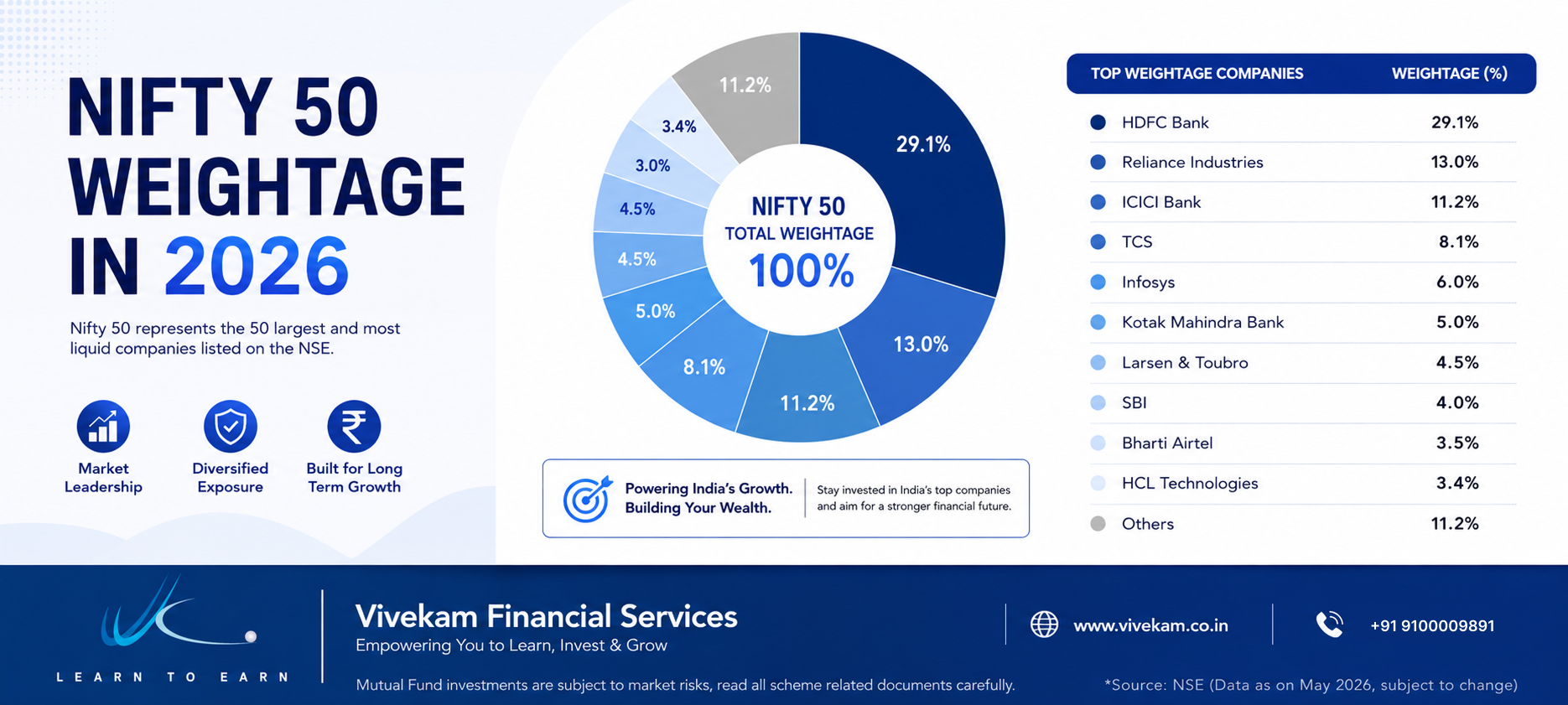
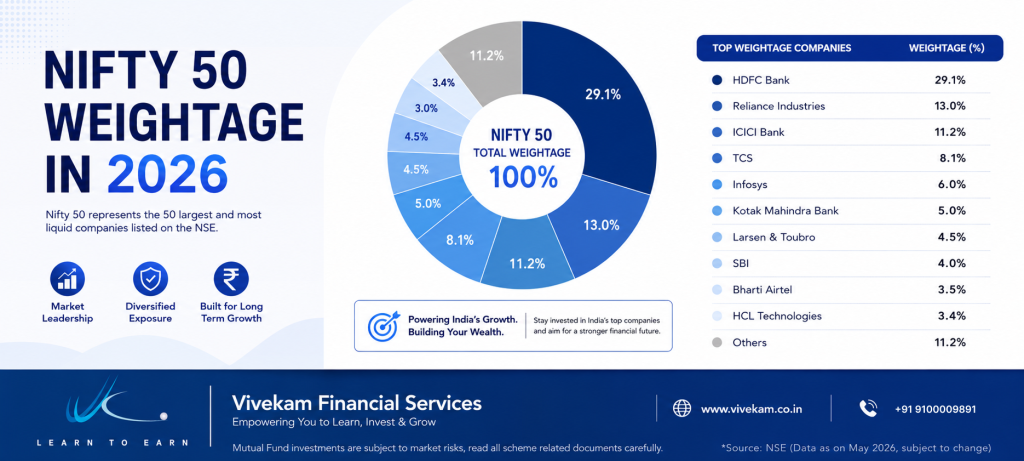
Highest Weightage Stocks in Nifty 50
The highest weightage stocks in Nifty 50 have extraordinary influence over market direction.
These are not just “popular stocks.”
They are market-moving giants.
Reliance Industries
Reliance Industries remains one of the most dominant stocks in the index.
Why Reliance Commands Huge Weightage
- Massive market capitalization
- Retail dominance
- Telecom leadership through Jio
- Energy and petrochemical strength
- Aggressive expansion strategy
When Reliance rallies, the Nifty 50 index often follows.
HDFC Bank
HDFC Bank continues to hold major influence over the banking sector.
Key Reasons for High Weightage
- Strong loan growth
- Large institutional ownership
- Stable profitability
- Trusted retail banking franchise
Banking is India’s largest sector in the index, making HDFC Bank incredibly important.
ICICI Bank
ICICI Bank has transformed from a cyclical banking stock into a market heavyweight.
Growth Drivers
- Digital banking leadership
- Better asset quality
- Higher profitability
- Expanding customer base
Its rising market cap keeps increasing its Nifty 50 weightage.
Infosys
Infosys remains a cornerstone of India’s IT industry.
Why Infosys Matters
- Strong global demand
- AI and cloud exposure
- Dollar revenue advantage
- Stable cash generation
Infosys significantly influences the technology portion of the Nifty 50 sectors.
Tata Consultancy Services (TCS)
Tata Consultancy Services is still one of India’s most valuable companies.
Why TCS Stays Dominant
- Enterprise software contracts
- Consistent earnings
- Massive global presence
- Investor confidence
TCS and Infosys together heavily shape the IT sector movement in the index.
Nifty Sector Weightage 2026
Understanding Nifty sector weightage is more important than memorizing all 50 stocks.
Why?
Because sectors drive market cycles.
Estimated Nifty Sector Allocation 2026
Sector | Approximate Weightage |
Banking & Financial Services | 35%+ |
Information Technology | 14%+ |
Oil & Gas | 12%+ |
FMCG | 9%+ |
Automobile | 6%+ |
Telecom | 5%+ |
Pharma | 4%+ |
Infrastructure | 4%+ |
This tells us one thing clearly:
Banking practically controls the Indian stock market.
Banking Sector
The banking sector dominates the Nifty 50 sectors because finance powers economic growth.
Top banking contributors:
- HDFC Bank
- ICICI Bank
- SBI
- Axis Bank
- Kotak Mahindra Bank
If banks rally:
- Nifty usually rallies
If banks crash:
- The market often weakens sharply
Simple.
Information Technology
IT remains India’s global growth engine.
Major IT firms include:
- Infosys
- TCS
- HCLTech
- Wipro
- Tech Mahindra
This sector benefits from:
- Foreign revenue
- AI transformation
- Cloud adoption
- Digital outsourcing demand
Oil & Gas
Oil & Gas still carries major Nifty index weightage due to India’s energy demand.
Major contributors:
- Reliance Industries
- ONGC
- BPCL
Energy remains critical despite renewable expansion.
FMCG
FMCG stocks offer defensive stability.
Top names:
- ITC
- Hindustan Unilever
- Nestlé India
These companies perform relatively better during uncertain economic conditions.
Automobile Sector
The auto sector is evolving rapidly because of:
- EV adoption
- Rising disposable income
- Infrastructure growth
Key companies:
- Tata Motors
- Maruti Suzuki
- Mahindra & Mahindra
The sector may gain higher weightage over the next decade.
Why Sector Weightage Matters
Many investors obsess over stock picking but ignore sector allocation.
That’s a mistake.
Sector Trends Often Matter More Than Individual Stocks
For example:
- Rising interest rates may hurt banks
- Falling oil prices may impact energy firms
- Strong US demand can boost IT companies
Understanding Nifty sector weightage helps investors:
- Reduce risk
- Diversify portfolios
- Spot macro trends
- Avoid sector bubbles
Impact of Market Cap on Nifty 50 Stocks
The larger the company, the larger its impact.
That’s why mega-cap firms dominate the Nifty 50 index.
Three Market Cap Categories
Category | Description |
Large Cap | Stable industry leaders |
Mid Cap | Growth-focused firms |
Small Cap | High-risk emerging businesses |
The Nifty focuses mainly on large-cap stability.
That’s what makes it attractive for:
- SIP investors
- Retirement portfolios
- Long-term wealth building
Nifty 50 Index vs Sensex
People constantly compare the Nifty 50 index with the Sensex.
Here’s the simplified truth:
Feature | Nifty 50 | Sensex |
Exchange | NSE | BSE |
Companies | 50 | 30 |
Diversification | Higher | Lower |
Liquidity | Extremely High | High |
Sector Spread | Broader | Narrower |
For broader market representation, many investors prefer Nifty 50.
Best Strategies to Invest in Nifty 50
1. Index Funds
Best for:
- Passive investors
- Beginners
- Long-term wealth creation
Benefits:
- Low cost
- Diversification
- Simplicity
2. ETFs
Nifty ETFs provide:
- Real-time trading
- High liquidity
- Lower expense ratios
3. SIP Investing
SIP investing helps:
- Reduce timing risk
- Build discipline
- Smooth volatility
4. Long-Term Holding
Historically, India’s economy has expanded consistently over long periods.
That makes the Nifty 50 stocks attractive for patient investors.
Risks Associated With Nifty 50 Investing
No market index is risk-free.
Key Risks
- Global recession
- Inflation spikes
- Banking crises
- Geopolitical conflict
- Interest rate hikes
Another overlooked risk:
Sector concentration.
If banking underperforms, the entire index can struggle.
Future Outlook for Nifty 50 in 2026
India’s growth trajectory remains strong.
Major Growth Catalysts
- Manufacturing expansion
- Digital economy
- AI adoption
- Retail investing boom
- Infrastructure spending
Future changes in Nifty 50 companies weightage could include:
- Higher renewable energy allocation
- More telecom exposure
- Increased digital platform businesses
The index will continue evolving alongside India’s economy.
FAQs
1. What is the Nifty 50 index?
The Nifty 50 index tracks the top 50 large-cap companies listed on the NSE.
2. How is Nifty 50 weightage calculated?
It uses free-float market capitalization methodology.
3. Which stock has the highest weightage in Nifty 50?
Typically, Reliance Industries and HDFC Bank remain among the top contributors.
4. Why does banking dominate Nifty sector weightage?
Banking firms have enormous market capitalization and strong institutional ownership.
5. Is Nifty 50 better than Sensex?
Nifty 50 offers broader diversification because it includes more companies.
6. What is the safest way to invest in Nifty 50?
Index funds and SIP investing are popular lower-risk approaches for long-term investors.
Conclusion
The Nifty 50 Weightage 2026 reveals far more than just stock rankings.
It shows:
- Which sectors dominate India’s economy
- Which companies control market direction
- Where institutional money is flowing
- How investors can build smarter portfolios