
What is FINNIFTY and How Can You Invest in It?
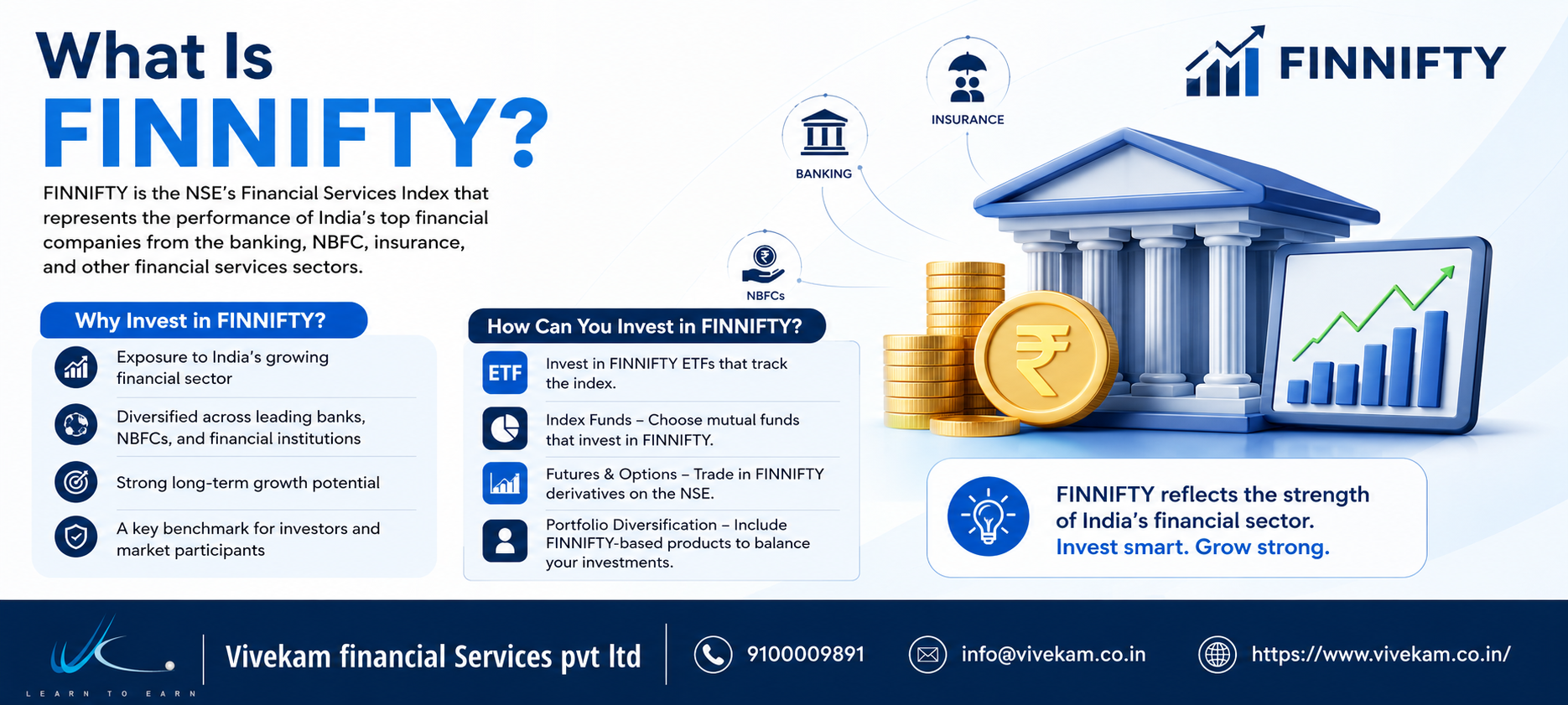
India’s financial sector is often called the backbone of the economy. Every loan issued, insurance policy sold, digital payment processed, or investment product distributed contributes to economic growth. To track the performance of this rapidly expanding segment, the National Stock Exchange (NSE) launched FINNIFTY, officially known as the Nifty Financial Services Index.
Today, FINNIFTY has become one of the most actively tracked sectoral indices in India. Traders use it for derivatives strategies, while long-term investors use it to gain diversified exposure to banks, insurance companies, housing finance firms, and non-banking financial companies (NBFCs).
If you’ve ever searched for the FINNIFTY share price, wanted to understand the FINNIFTY meaning, explored the FINNIFTY stocks list, or analyzed Finnifty historical data, this guide covers everything you need to know.
Understanding FINNIFTY Meaning
The FINNIFTY meaning is straightforward. It refers to the Nifty Financial Services Index, a sectoral index designed to represent the performance of leading financial companies listed on the National Stock Exchange of India.
Unlike broad market indices such as NIFTY 50, FINNIFTY focuses exclusively on businesses operating in the financial services ecosystem.
These include:
- Commercial banks
- Private sector banks
- Public sector banks
- Insurance companies
- Housing finance companies
- Asset management companies
- NBFCs
- Consumer finance providers
Rather than tracking a single company, FINNIFTY provides a snapshot of how India’s entire financial sector is performing.
What Is the Nifty Financial Services Index?
The Nifty Financial Services Index is a benchmark index maintained by NSE Indices Limited.
The objective of the index is to measure the performance of large and liquid financial companies listed on the NSE.
Financial services represent one of the largest sectors in the Indian stock market. In many periods, financial stocks account for over one-third of the total market capitalization of major benchmark indices.
The FINNIFTY index helps investors:
- Measure sector performance
- Compare portfolio returns
- Build passive investment strategies
- Trade financial-sector derivatives
- Track market sentiment toward financial institutions
Because the financial sector is closely linked to economic activity, FINNIFTY often serves as a leading indicator of economic health.
Why Was FINNIFTY Created?
Before FINNIFTY was introduced, investors mainly relied on broad indices or Bank Nifty to gauge financial-sector performance.
However, banking represents only one part of the financial ecosystem.
The financial sector also includes:
- Insurance providers
- NBFCs
- Asset managers
- Housing finance companies
- Consumer lending firms
The creation of FINNIFTY solved this problem by offering broader financial sector representation.
Key objectives included:
- Capturing the full financial services ecosystem
- Supporting ETF and index fund development
- Providing a benchmark for fund managers
- Enabling more sophisticated derivatives trading
- Improving sector-level market analysis
How the FINNIFTY Index Works
The FINNIFTY index follows a free-float market capitalization weighting methodology.
This approach ensures that larger companies have a greater influence on index movements.
The index is reviewed periodically to maintain relevance and reflect changes within the financial sector.
Eligibility Criteria for Inclusion
Companies generally need to:
- Be listed on NSE
- Belong to the financial services sector
- Meet liquidity requirements
- Maintain adequate trading volume
- Satisfy free-float market capitalization standards
This selection process helps ensure that only significant and actively traded companies are included.
Free-Float Market Capitalization Method
Free-float market capitalization considers only shares available for public trading.
Promoter holdings, government ownership, and strategic stakes are excluded.
As a result, the index better reflects actual investor participation and market sentiment.
FINNIFTY Stocks List
The FINNIFTY stocks list consists of leading financial institutions spanning multiple subsectors.
While constituents may change during periodic reviews, major holdings frequently include:
Major Banking Stocks
- HDFC Bank
- ICICI Bank
- Axis Bank
- Kotak Mahindra Bank
- State Bank of India
- IndusInd Bank
These institutions often account for a substantial share of the index because of their large market capitalizations.
Insurance Companies
- HDFC Life Insurance
- SBI Life Insurance
- ICICI Prudential Life Insurance
Insurance penetration in India remains relatively low compared with developed markets, giving these companies long-term growth potential.
Housing Finance and NBFCs
- Bajaj Finance
- Bajaj Finserv
- Shriram Finance
- Cholamandalam Investment
These companies benefit from increasing consumer credit demand and financial inclusion initiatives.
Finnifty Weightage Stocks Explained
One of the biggest drivers of the FINNIFTY share price is the distribution of weightage among constituent companies.
Not all stocks impact the index equally.
The largest companies receive the highest allocations because of their free-float market capitalization.
Finnifty Components Weightage
The Finnifty components weightage determines how much influence each stock has on index movements.
A stock with a 20% weight will impact the index significantly more than one with a 2% allocation.
Generally:
|
Category |
Typical Weight Impact |
|
Large Private Banks |
Very High |
|
Major NBFCs |
High |
|
Insurance Companies |
Moderate |
|
Smaller Financial Firms |
Lower |
This structure means that large banks often drive short-term FINNIFTY performance.
Factors Affecting FINNIFTY Share Price
The FINNIFTY share price is influenced by several macroeconomic and company-specific factors.
RBI Interest Rate Decisions
Rate hikes can improve lending margins but may slow credit growth.
Rate cuts often stimulate borrowing and economic activity.
Credit Demand
Strong retail and corporate lending boosts financial sector earnings.
Asset Quality
Lower non-performing assets (NPAs) improve profitability and investor confidence.
Economic Growth
A growing economy increases demand for loans, insurance products, and wealth management services.
Government Policies
Financial inclusion programs, tax reforms, and regulatory changes can affect sector performance.
Foreign Institutional Investment
Global investors frequently allocate capital to financial stocks, making FINNIFTY sensitive to international flows.
FINNIFTY Historical Data and Performance
Studying Finnifty historical data provides valuable insights into how India’s financial sector has evolved.
Historically, FINNIFTY has benefited from:
- Rising banking penetration
- Rapid digitization
- Growth in retail lending
- Expansion of insurance coverage
- Increased mutual fund participation
Historical analysis reveals several important characteristics:
Cyclical Nature
Financial stocks often outperform during economic expansions and underperform during slowdowns.
Interest Rate Sensitivity
Changes in RBI policy have historically influenced sector valuations.
Recovery Potential
Financial companies frequently rebound strongly after economic downturns because of their central role in economic activity.
Investors commonly use Finnifty historical data to identify long-term trends, volatility patterns, and support-resistance levels.
Benefits of Investing in FINNIFTY
Diversified Financial Sector Exposure
Investors gain exposure to multiple financial subsectors through a single investment.
Participation in India’s Growth Story
Economic development often translates into increased financial activity.
Lower Stock-Specific Risk
Owning the index reduces dependence on any single company.
Institutional Quality Holdings
The index typically contains some of India’s strongest financial brands.
Risks Associated with FINNIFTY
Sector Concentration
The index is entirely dependent on financial companies.
Regulatory Risk
Changes in RBI or SEBI regulations can impact profitability.
Economic Cycles
Financial stocks are closely linked to economic performance.
Interest Rate Volatility
Unexpected monetary policy changes may affect valuations.
How to Invest in FINNIFTY
ETFs Tracking FINNIFTY
ETFs offer the simplest way to mirror index performance.
Benefits include:
- Low expense ratios
- Easy liquidity
- Diversification
- Transparency
Index Funds
Index funds are suitable for long-term investors who prefer SIP investing.
Advantages include:
- Passive management
- Lower turnover
- Consistent exposure
FINNIFTY Futures and Options
Advanced traders use FINNIFTY derivatives for:
- Hedging
- Income generation
- Directional trading
- Volatility strategies
Because derivatives involve leverage, risk management is essential.
Who Should Invest in FINNIFTY?
FINNIFTY may suit:
- Long-term investors
- ETF investors
- Sector-focused investors
- Traders seeking derivatives exposure
- Investors bullish on India’s financial sector
FINNIFTY vs NIFTY 50
|
Feature |
FINNIFTY |
NIFTY 50 |
|
Coverage |
Financial Sector |
Multiple Sectors |
|
Diversification |
Lower |
Higher |
|
Sector Exposure |
Focused |
Broad |
|
Volatility |
Higher |
Moderate |
|
Economic Sensitivity |
High |
Moderate |
FINNIFTY vs BANKNIFTY
|
Feature |
FINNIFTY |
BANKNIFTY |
|
Banks Included |
Yes |
Yes |
|
Insurance Included |
Yes |
No |
|
NBFCs Included |
Yes |
No |
|
Diversification |
Higher |
Lower |
|
Sector Representation |
Broad Financials |
Banking Only |
Investment Strategies for FINNIFTY
Systematic Investment Plans
Regular investments help reduce market timing risk.
Buy-and-Hold Investing
Ideal for investors who believe in India’s long-term financial growth.
Sector Rotation
Increase exposure when financial valuations become attractive.
Derivative Strategies
Experienced traders may use spreads, hedges, and option structures.
Frequently Asked Questions
What is FINNIFTY?
FINNIFTY is the NSE’s Nifty Financial Services Index tracking leading financial companies.
How many stocks are included in FINNIFTY?
The index consists of selected financial-sector companies meeting NSE eligibility criteria.
Where can I check the FINNIFTY share price?
The FINNIFTY share price can be tracked through NSE data feeds, broker platforms, and financial websites.
What are Finnifty weightage stocks?
These are constituent companies ranked according to free-float market capitalization.
How often are Finnifty components weightage reviewed?
NSE periodically reviews and rebalances constituents and weightages.
Can beginners invest in FINNIFTY?
Yes. ETFs and index funds provide beginner-friendly access.
Why is Finnifty historical data important?
It helps investors evaluate long-term performance, volatility, and market cycles.
Is FINNIFTY suitable for long-term investing?
For investors bullish on India’s financial sector, FINNIFTY can be an effective long-term exposure vehicle.
Conclusion
The FINNIFTY index has become one of India’s most important sectoral benchmarks, providing exposure to banks, insurance companies, NBFCs, and other financial institutions through a single investment framework. Understanding the FINNIFTY meaning, analyzing the FINNIFTY stocks list, evaluating Finnifty weightage stocks, monitoring the FINNIFTY share price, and reviewing Finnifty historical data can help investors make more informed decisions.
As India’s economy continues to formalize, digitize, and expand, the financial services sector is expected to remain a critical driver of growth. For investors seeking targeted exposure to this opportunity, FINNIFTY offers a compelling combination of diversification, liquidity, and long-term growth potential.