
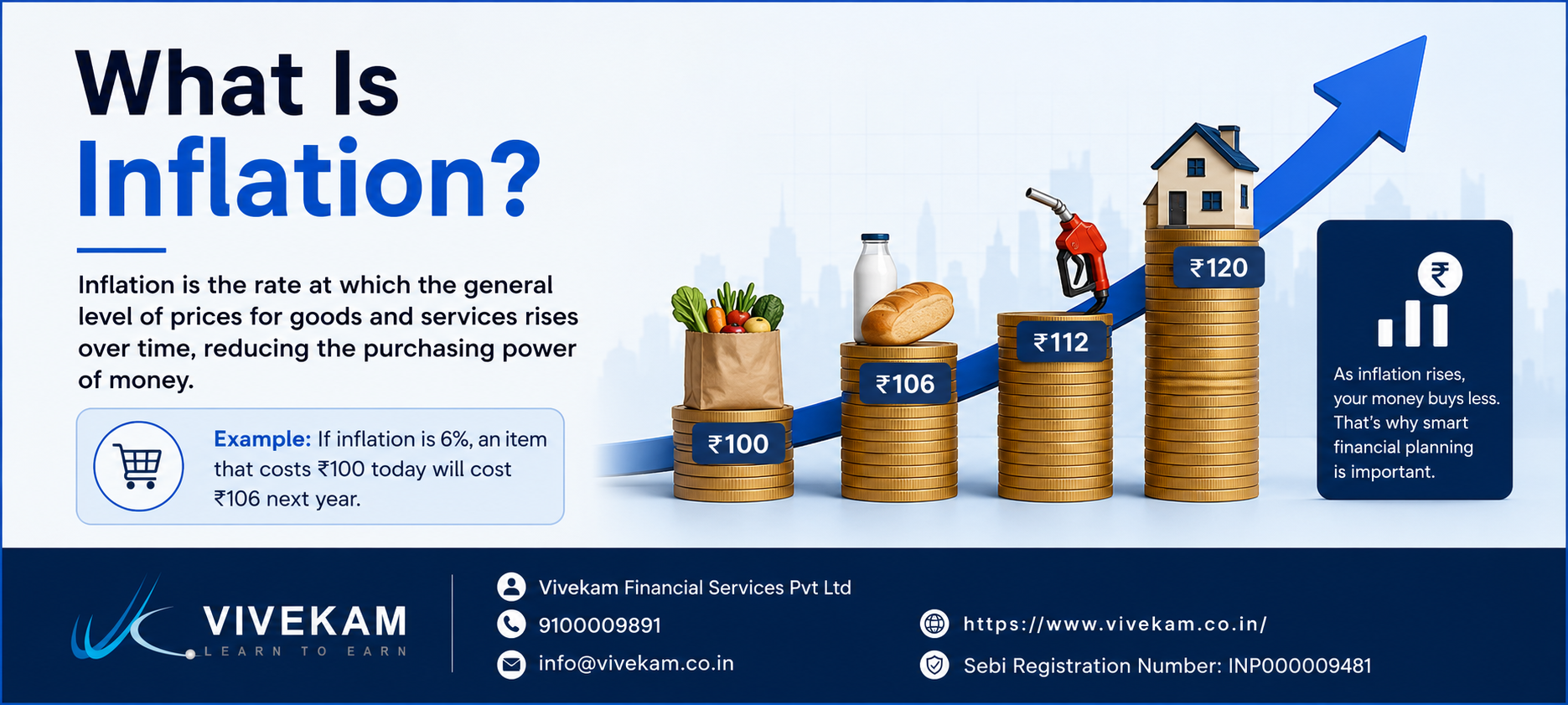
What Is Inflation? Meaning, Types, and Real-World Effects
What Is Inflation? A Straightforward Inflation Definition
The simplest inflation definition is this: inflation is the sustained increase in the general price level of goods and services in an economy over time, which results in a fall in the purchasing power of money. In other words, the same rupee, dollar, or euro buys you less tomorrow than it does today.
This is not the same as one product becoming more expensive. If the price of onions spikes because of a bad harvest, that is a supply disruption, not inflation. Inflation is a broad, economy-wide, sustained rise in prices across a basket of goods and services — food, fuel, housing, healthcare, education, and more — measured over months and years, not days.
How Does Inflation Work?
How does inflation work in practice? At its core, inflation is a story about the relationship between money and goods. When more money is chasing the same amount of goods, or when the cost of producing those goods rises, prices adjust upward.
Think of an economy as a marketplace. If the central bank prints more currency or lowers interest rates, more money circulates. If the number of goods and services available doesn’t grow at the same pace, that extra money bids up prices. Similarly, if the raw materials, wages, or energy needed to produce goods become more expensive, businesses pass those costs on to consumers through higher prices. Either way, the value of each unit of currency erodes a little more.
What Are the Causes of Inflation?
What are the causes of inflation? In my experience, almost every inflationary episode can be traced back to one or more of these root causes:
- Excess money supply – When a central bank injects too much liquidity into the economy without a matching increase in output, prices rise.
- Rising demand – When consumers and businesses spend faster than the economy can produce goods and services.
- Rising input costs – When the cost of labor, raw materials, or energy goes up, and producers pass those costs to buyers.
- Supply chain disruptions – Wars, pandemics, trade restrictions, or natural disasters that reduce the availability of goods.
- Currency depreciation – A weaker domestic currency makes imports costlier, feeding into higher retail prices.
- Expectations and wage-price spirals – When people expect prices to keep rising, they demand higher wages, and businesses raise prices further to cover those wages — a self-reinforcing loop.
Types of Inflation: The Categories Every Investor Should Know
Understanding the types of inflation is essential because each type has a different cause, and therefore a different remedy. The three classic categories are:
1. Demand-Pull Inflation
Demand-pull inflation happens when aggregate demand in an economy outpaces aggregate supply. Consumers have more money to spend — whether from wage growth, government stimulus, or easy credit — and they compete for a limited quantity of goods, pushing prices up. This is the “too much money chasing too few goods” scenario, and it is typically associated with strong economic growth and low unemployment.
2. Cost-Push Inflation
Cost-push inflation occurs on the supply side. When the cost of production rises — due to higher wages, costlier raw materials, or expensive energy — producers raise prices to protect their margins, even if consumer demand hasn’t changed. The oil price shocks of the 1970s are the textbook case of cost-push inflation: energy costs surged, and the price of nearly everything that depended on energy followed.
3. Built-In (Wage-Price) Inflation
This type stems from adaptive expectations. Workers expect prices to keep rising, so they negotiate higher wages. Employers, facing higher labor costs, raise prices. Employees then need even higher wages to keep pace, and the cycle continues. It is inflation that feeds on itself.
Hyperinflation: The Extreme Case
Hyperinflation is inflation that spirals out of control — typically defined as price increases exceeding 50% in a single month. It usually results from a total loss of confidence in a currency, often triggered by excessive money printing to finance government spending, combined with collapsing productive capacity. Historical examples include Germany’s Weimar Republic in the 1920s, Zimbabwe in the late 2000s, and Venezuela in the 2010s, where currencies became almost worthless within months. Hyperinflation is not a risk most economies face regularly, but it illustrates the extreme end of what happens when inflation is left unmanaged.
How Is Inflation Measured? How to Calculate Inflation
How is inflation measured, and how to calculate inflation in a way that’s meaningful? Economists and statistical agencies rely primarily on two indices:
- Consumer Price Index (CPI): Tracks the average change in prices paid by consumers for a fixed basket of goods and services — food, housing, clothing, transport, healthcare, and education. This is the most widely quoted inflation figure and the one that drives the current inflation rate in India.
- Wholesale Price Index (WPI): Tracks price changes at the wholesale or producer level, before goods reach the retail consumer.
The formula for calculating the inflation rate over a period is straightforward:
Inflation Rate (%) = [(CPI in Current Period − CPI in Previous Period) / CPI in Previous Period] × 100
For example, if the CPI was 100 last year and 104 this year, the inflation rate is 4%. Statistical agencies collect prices for hundreds of goods and services across urban and rural areas every month, weight them according to how much households actually spend on each category, and compile the index.
What Is the Inflation Rate?
What is the inflation rate? It is simply the percentage change in the price index over a specific time period — usually reported year-on-year (comparing this month’s prices to the same month a year ago) or month-on-month. A country’s central bank typically targets a specific inflation rate range because both very high and very low (or negative) inflation create economic problems.
Current Inflation Rate in India
As of the most recent official data available, the current inflation rate in India, measured by the Consumer Price Index (CPI) with base year 2024, stood at approximately 3.9% year-on-year for May 2026, according to provisional figures released by the Ministry of Statistics and Programme Implementation (MoSPI), Government of India. This followed readings of roughly 3.5% in April 2026 and 3.4% in March 2026, indicating a gradual firming of retail inflation after touching multi-year lows in late 2025. Food inflation, tracked separately through the Consumer Food Price Index, has generally moved in a similar range.
The Reserve Bank of India’s medium-term inflation target is 4%, with a tolerance band of 2% to 6%. Recent readings have stayed comfortably within this band, though investors should always check the latest MoSPI press release or RBI monetary policy statement for the most current figure, since these numbers are provisional on release and get revised in subsequent months.
What Are the Effects of Inflation? Effects of Inflation on Your Money
The effects of inflation touch nearly every part of financial life:
- Erosion of purchasing power: Money saved today buys less in the future if it isn’t invested to outpace inflation.
- Impact on savings and fixed income: Cash sitting in a low-interest savings account or a fixed deposit can actually lose real value if the interest rate earned is below the inflation rate.
- Rising cost of living: Household budgets for food, fuel, rent, and healthcare stretch thinner as prices climb.
- Interest rate changes: Central banks typically raise interest rates to cool inflation, which increases borrowing costs for home loans, car loans, and business credit.
- Impact on wages: If wages don’t rise as fast as prices, real income falls even if nominal salaries stay the same.
- Currency and trade effects: Higher domestic inflation compared to trading partners can weaken a currency and affect import/export competitiveness.
- Uneven impact across income groups: Lower-income households, who spend a larger share of income on necessities like food and fuel, are typically hit harder by inflation than wealthier households.
Inflation Examples From Real Life
Concrete inflation examples make the concept easier to grasp:
- Everyday example: A cup of tea that cost ₹5 a decade ago may cost ₹15-20 today — that gradual, cumulative rise across everyday goods is inflation at work.
- Demand-pull example: A post-pandemic recovery where pent-up consumer spending outpaced supply chains, pushing up prices for goods and travel.
- Cost-push example: Global crude oil price spikes driving up fuel, transport, and manufacturing costs, which then filter into the price of nearly every product.
- Hyperinflation example: Zimbabwe’s currency crisis, where by 2008 the government was issuing 100-trillion-dollar notes that still couldn’t buy basic groceries.
How to Control Inflation
How to control inflation is primarily the job of central banks and governments, using a mix of monetary and fiscal tools:
- Monetary policy tightening: Raising interest rates (the repo rate, in India’s case) makes borrowing costlier, which slows spending and cools demand-pull inflation.
- Reducing money supply: Central banks can reduce liquidity in the banking system through open market operations.
- Fiscal discipline: Governments can cut spending or raise taxes to reduce excess demand in the economy.
- Supply-side measures: Improving supply chains, boosting agricultural output, and easing import restrictions can address cost-push inflation directly.
- Currency management: Maintaining a stable exchange rate can prevent imported inflation from rising input costs.
How to Deal With Inflation as an Individual Investor
This is where my two decades in markets matter most, because central bank policy is out of your hands — but your personal response to inflation is not. Here’s how to deal with inflation at the household and portfolio level:
- Don’t let cash sit idle. Money in a low-yield savings account is quietly losing value every year inflation outpaces the interest rate.
- Invest in real assets and equities. Historically, equities, real estate, and other real assets have outpaced inflation over long time horizons, though they carry their own risks and volatility.
- Consider inflation-linked instruments. Instruments such as inflation-indexed bonds are specifically designed to protect principal and returns against rising prices.
- Diversify across asset classes. A mix of equity, debt, and real assets tends to weather inflationary periods better than concentration in any single asset.
- Review fixed-income holdings regularly. When inflation rises, previously attractive fixed-deposit or bond yields can quickly turn into negative real returns.
- Budget for rising costs, not current costs. Build a financial plan assuming prices will be higher in five, ten, and twenty years — because they almost certainly will be.
Frequently Asked Questions (FAQs)
- What is inflation, in one line? Inflation is a sustained, economy-wide rise in the price of goods and services, which reduces how much your money can buy over time.
- What is the inflation rate? The inflation rate is the percentage change in a price index, such as the CPI, over a given period — typically measured year-on-year or month-on-month.
- What are the main types of inflation? The three classic types are demand-pull inflation (too much demand chasing limited supply), cost-push inflation (rising production costs passed on to consumers), and built-in or wage-price inflation (a self-reinforcing wage-price spiral). Hyperinflation is the extreme, out-of-control version of these dynamics.
- What are the causes of inflation? Excess money supply, rising consumer demand, higher input and labor costs, supply chain disruptions, currency depreciation, and shifting price expectations are the primary causes.
- How is inflation measured, and how do you calculate it? Inflation is measured using indices like the Consumer Price Index (CPI) and Wholesale Price Index (WPI). It’s calculated as: [(Current Period CPI − Previous Period CPI) / Previous Period CPI] × 100.
- What is the current inflation rate in India? As of the latest available official MoSPI data (May 2026), India’s CPI-based inflation rate stood at roughly 3.9% year-on-year, within the RBI’s 2%–6% tolerance band. Always check the latest MoSPI or RBI release for the most current figure, since this number is provisional and gets revised.
- What are the effects of inflation on personal finances? Inflation erodes purchasing power, reduces the real return on savings and fixed deposits, raises the cost of living, often pushes up interest rates and borrowing costs, and can outpace wage growth if incomes don’t keep up.
- How can inflation be controlled? Primarily through monetary policy (interest rate changes, managing money supply), fiscal discipline (government spending and taxation), and supply-side fixes such as improving production and supply chains.
- How should an individual investor deal with inflation? By avoiding excess idle cash, investing in equities, real assets, and inflation-linked instruments, diversifying across asset classes, and planning finances around future — not current — price levels.
Conclusion
Inflation is not an abstract economic statistic — it is a quiet, constant force acting on every rupee you earn, save, and invest. Understanding what inflation is, the different types of inflation, what causes it, how it’s measured, and how it affects your money is the first step toward protecting your wealth against it. Whether it’s demand-pull inflation from a booming economy, cost-push inflation from rising input costs, or the extreme case of hyperinflation, the underlying lesson is the same: prices rarely stand still, and neither should your financial planning.
The investors who build lasting wealth are rarely the ones who react to inflation headlines — they are the ones who treat inflation as a permanent feature of the economic landscape, track the current inflation rate as part of their regular financial review, and structure their savings and investments to consistently outpace it.
This article is for educational purposes and reflects publicly available economic data at the time of writing. Inflation figures are provisional and subject to revision by official statistical agencies; readers should verify the latest figures from the Ministry of Statistics and Programme Implementation (MoSPI) or the Reserve Bank of India before making financial decisions.