

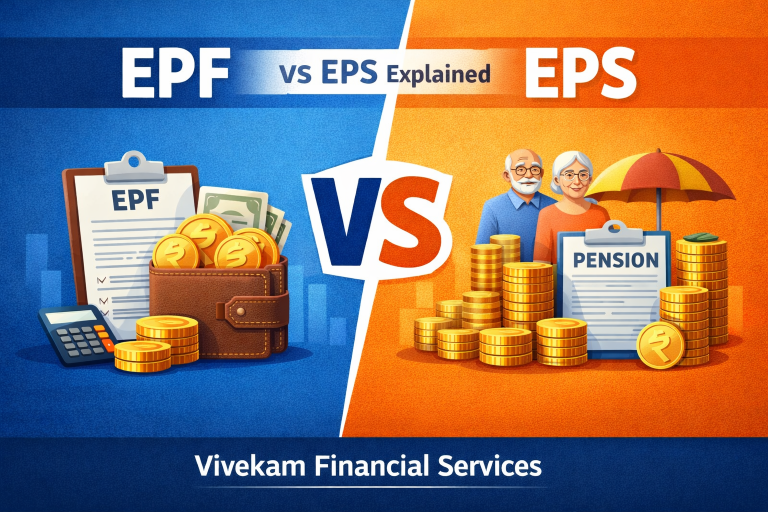
If you’re a salaried employee in India, chances are EPF vs EPS shows up on your payslip—but understanding it feels harder than it should be. Most people know money gets deducted every month, but very few truly understand What is EPF?, What is EPS?, and how these schemes actually shape retirement.
This guide on EPF vs EPS Explained: Benefits, Eligibility & Withdrawal Rules cuts through the confusion and explains everything—clearly, practically, and without jargon.
 EPF vs EPS: A Quick Overview
|
Feature |
EPF (Employees’ Provident Fund) |
EPS (Employees’ Pension Scheme) |
|
Purpose |
Long-term retirement savings |
Monthly pension after retirement |
|
Contribution |
Employee + Employer |
Employer only |
|
Interest |
EPF interest rate |
EPS interest rate (formula-based) |
|
Withdrawal |
Partial & full allowed |
Restricted |
|
Tax Benefit |
Mostly tax-free |
Pension taxable |
What is EPF? (Employees’ Provident Fund)
What is EPF?
EPF is a mandatory retirement savings scheme where both you and your employer contribute 12% of your basic salary plus DA every month. Over time, this builds a sizeable retirement corpus.
Key Features of EPF
- Government-backed and low-risk
- Compounded annual interest
- Partial withdrawals allowed
- Strong tax advantages
EPF Interest Rate
The EPF interest rate is declared annually and compounds over time. This compounding is what turns small monthly deductions into a powerful retirement fund.
EPF Calculation
- Employee contribution: 12%
- Employer contribution: 12%
- Interest applied yearly on total balance
EPF Benefits
- Lump-sum amount at retirement
- Emergency financial support
- Safe alternative to market-linked investments
EPF Eligibility
- Mandatory for employees earning up to ₹15,000
- Optional but allowed for higher salaries
EPF Withdrawal
Yes, EPF Withdrawal (withdrawal) is flexible:
- Medical emergencies
- House purchase or construction
- Education or marriage
- Unemployment
EPF Rules
- Tax-free after 5 years of service
- PAN required to avoid TDS
What is EPS? (Employees’ Pension Scheme)
What is EPS?
EPS is designed to give you a monthly pension for life, not a lump sum. It is funded entirely by the employer’s contribution.
Key Features of EPS
- Guaranteed lifelong pension
- Spouse pension after death
- No employee contribution
EPS Interest Rate
Unlike EPF, EPS interest rate is not compounded. The pension depends on salary and service length.
EPS Calculation
EPS calculation formula:
(Pensionable Salary × Pensionable Service) ÷ 70
EPS Benefits
- Monthly income after retirement
- Family pension protection
- No market risk
EPS Eligibility
- Minimum 10 years of service
- Retirement age: 58
EPS withdrawal
- Less than 10 years: lump sum
- More than 10 years: pension only
EPS rules
- Early pension allowed at 50 (reduced)
- No full withdrawal after eligibility
EPF vs EPS: Key Differences Explained
|
Aspect |
EPF |
EPS |
|
Nature |
Savings |
Pension |
|
Returns |
Interest-based |
Formula-based |
|
Liquidity |
High |
Low |
|
Risk |
Very low |
Zero market risk |
EPF vs EPS benefits
Comparing EPF vs EPS benefits isn’t about choosing one—it’s about understanding their roles.
- EPF = Wealth creation
- EPS = Income stability
Together, they form a complete retirement solution.
EPF Withdrawal vs EPS Withdrawal
- EPF Withdrawal: Flexible and need-based
- EPS withdrawal: Limited and rule-driven
Knowing this difference avoids unpleasant surprises later.
 Frequently Asked Questions (FAQs)
1. What is EPF vs EPS in simple terms?
EPF is your retirement savings; EPS is your pension.
2. Is EPS mandatory with EPF?
Yes. You cannot opt out of EPS if you’re in EPF.
3. How does EPS calculation work?
EPS calculation uses salary and service—not interest.
4. Is EPF interest rate guaranteed?
It’s government-backed but declared yearly.
5. Can I withdraw EPS like EPF?
Only if service is under 10 years.
6. Which is better—EPF or EPS?
Both serve different purposes and work best together.
 Conclusion:
EPF vs EPS Explained: Benefits, Eligibility & Withdrawal Rules isn’t just theory—it directly affects your financial future. EPF builds your retirement wealth, while EPS ensures you never run out of monthly income.
Understand both early, track them regularly, and retirement won’t feel like a gamble—it’ll feel planned.