
What Are REIT Mutual Funds? Meaning, Benefits & Tax Rules in India
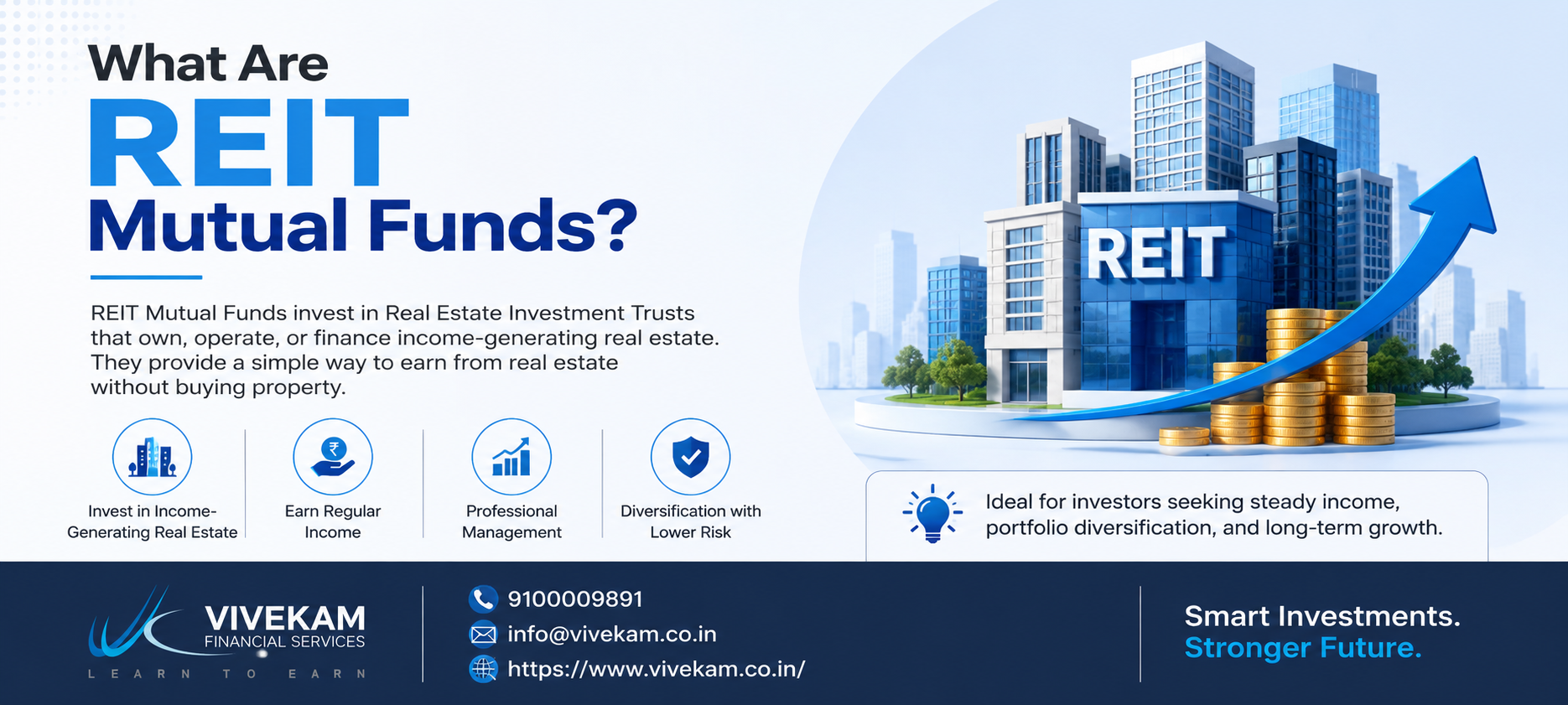
What Are REIT Mutual Funds?
For decades, investing in real estate in India was considered a game reserved for those with deep pockets. Buying a residential apartment, commercial office, or retail property required substantial capital, extensive paperwork, and ongoing maintenance responsibilities. As a result, many retail investors found it difficult to participate in one of the world’s most popular asset classes.
Today, that has changed significantly with the emergence of REITs India and REIT mutual funds.
A REIT investment allows investors to gain exposure to premium income-generating commercial real estate without purchasing an entire property. Instead of spending crores on office buildings or commercial complexes, investors can buy units of Real Estate Investment Trusts (REITs) and benefit from rental income and potential capital appreciation.
The introduction of REITs has democratized real estate investing in India. Whether you’re a beginner looking to diversify your portfolio or an income-focused investor seeking regular cash flows, understanding what is REIT, how REIT mutual funds India operate, and the latest REIT taxation rules can help you make more informed investment decisions.
In this comprehensive guide, we’ll explore everything from the types of REITs available globally to the best REITs to invest in India, along with practical examples, advantages, risks, and taxation considerations.
Introduction to REITs and REIT Mutual Funds
Real Estate Investment Trusts, commonly known as REITs, are investment vehicles that own, operate, or finance income-generating real estate assets. They function similarly to mutual funds by pooling money from multiple investors and deploying that capital into professionally managed real estate portfolios.
Instead of purchasing a property outright, investors buy units of a REIT and become partial owners of a diversified real estate portfolio.
Typical assets owned by REITs include:
- Grade-A office buildings
- Business parks
- Shopping malls
- Warehouses and logistics hubs
- Hotels and hospitality assets
- Healthcare facilities
- Data centers
The primary objective of a REIT is to generate steady income through rent and distribute a significant portion of that income to investors.
REIT mutual funds, on the other hand, invest in REIT units rather than directly owning real estate properties. This offers investors another route to gain exposure to commercial real estate while benefiting from professional fund management.
As commercial real estate continues to grow in India, both REITs and REIT mutual funds are becoming increasingly relevant for long-term portfolio diversification.
What is REIT? Understanding the Basics
If you’re wondering what is REIT, the simplest definition is this:
A Real Estate Investment Trust (REIT) is a company or trust that owns and manages income-producing real estate and distributes earnings to investors.
REITs were designed to provide ordinary investors with access to large-scale commercial real estate investments that would otherwise be difficult or impossible to afford individually.
Imagine owning a small stake in a premium office complex leased to multinational corporations. While buying such a property directly could require hundreds of crores of rupees, a REIT allows investors to participate with a much smaller amount.
How REITs Work
The operational model of REITs is relatively straightforward:
- Investors purchase REIT units.
- The REIT raises capital from thousands of investors.
- Funds are used to acquire and manage commercial properties.
- Tenants pay rent to occupy these properties.
- Rental income is collected and distributed to investors.
- Property values may appreciate over time, creating additional gains.
For example, if a REIT owns multiple office parks with occupancy rates above 85%, it can generate stable rental income from corporate tenants. This income is then distributed among unit holders according to their ownership stake.
This structure transforms commercial real estate into an accessible and liquid investment option.
Key Features of REITs
Several characteristics make REITs unique compared to traditional real estate ownership:
Feature | Description |
Professional Management | Managed by experienced real estate professionals |
Liquidity | Listed REITs can be traded on stock exchanges |
Diversification | Exposure to multiple properties rather than a single asset |
Income Generation | Regular distributions from rental income |
Transparency | Subject to strict disclosure requirements |
Accessibility | Lower investment threshold compared to direct property ownership |
These features explain why REITs have become a popular choice among investors seeking exposure to real estate without the operational challenges of property ownership.
Evolution of REITs India
Although REITs have existed globally for decades, their introduction to India is relatively recent.
The Securities and Exchange Board of India (SEBI) introduced the REIT framework in 2014 to encourage transparency, attract institutional investment, and provide retail investors access to commercial real estate opportunities.
The first listed REIT in India launched in 2019, marking a significant milestone for the country’s capital markets.
Regulatory Framework by SEBI
To protect investors and maintain transparency, SEBI has established several rules governing REITs.
Key requirements include:
- At least 80% of assets must be invested in completed, income-generating properties.
- REITs must maintain strict disclosure standards.
- Regular financial reporting is mandatory.
- Cash flows must be distributed to investors periodically.
- Independent valuation mechanisms must be followed.
These regulations help ensure that REIT investors receive exposure to operational commercial assets rather than speculative real estate projects.
Growth of the Indian REIT Market
The Indian REIT sector has witnessed impressive growth due to several factors:
- Expansion of the commercial office market
- Rising institutional participation
- Increasing investor awareness
- Strong demand for Grade-A office spaces
- Growth of multinational corporate tenants
As India’s economy continues to expand, demand for commercial infrastructure is expected to support the long-term growth of REITs India.
Many market participants view REITs as a bridge between traditional real estate investing and stock market investing.
Types of REITs
Understanding the various types of REITs is essential before making a REIT investment decision.
Each category operates differently and generates income from distinct sources.
Equity REITs
Equity REITs are the most common type of REIT globally and in India.
These REITs directly own and manage real estate properties.
Their income primarily comes from:
- Rental payments
- Lease renewals
- Property appreciation
Examples include office parks, shopping centers, industrial warehouses, and mixed-use developments.
Investors seeking regular income often prefer equity REITs because of their relatively stable cash flow generation.
Mortgage REITs
Mortgage REITs do not typically own properties directly.
Instead, they invest in:
- Real estate loans
- Mortgage-backed securities
- Property financing instruments
Revenue is generated through interest income rather than rental income.
Mortgage REITs are generally more sensitive to changes in interest rates and credit conditions.
Hybrid REITs
Hybrid REITs combine characteristics of both equity and mortgage REITs.
Their portfolios may include:
- Income-producing properties
- Real estate debt instruments
This diversified approach allows them to generate income from multiple sources while potentially reducing dependence on a single revenue stream.
Investors seeking broader real estate exposure often consider hybrid REIT structures attractive.
What Are REIT Mutual Funds?
While direct REIT investing has gained popularity, many investors prefer a diversified approach through REIT mutual funds.
A REIT mutual fund invests primarily in REIT units rather than directly owning physical real estate.
This creates an additional layer of diversification and professional oversight.
For investors unfamiliar with commercial property markets, REIT mutual funds can offer a simpler entry point.
Difference Between REITs and REIT Mutual Funds
Although both provide exposure to real estate, they operate differently.
Factor | REITs | REIT Mutual Funds |
Ownership | Direct ownership of REIT units | Indirect exposure through a mutual fund |
Management | Managed by REIT managers | Managed by fund managers |
Diversification | Limited to selected REITs | Diversified across multiple REITs |
Investment Approach | Self-directed | Professionally managed |
Risk Concentration | Higher | Potentially lower |
Why Investors Choose REIT Mutual Funds India
The popularity of REIT mutual funds India continues to rise because they offer several advantages:
- Professional portfolio management
- Easier diversification
- Lower research burden
- Convenient investment process
- Potential access through systematic investment plans (SIPs)
For investors who do not want to analyze individual REITs, mutual fund structures can provide a more hands-off approach.
Benefits of REIT Investment
A well-planned REIT investment can offer several advantages compared to traditional real estate ownership.
Regular Income Generation
One of the biggest attractions of REITs is their ability to generate recurring income.
Commercial properties typically produce rental cash flows from tenants under long-term lease agreements. These cash flows are distributed to investors periodically.
For income-focused investors, REITs can serve as a source of passive income without the headaches associated with managing tenants or maintaining properties.
Portfolio Diversification
Diversification remains one of the most effective risk-management tools in investing.
Because real estate often behaves differently from stocks and bonds, adding REIT exposure can help create a more balanced portfolio.
Benefits include:
- Reduced concentration risk
- Exposure to commercial property markets
- Potentially smoother long-term returns
- Alternative source of income
Liquidity and Accessibility
Traditional real estate transactions often involve lengthy processes and significant costs.
REITs offer much greater flexibility.
Investors can:
- Buy units through stock exchanges
- Sell holdings when needed
- Start with relatively small investment amounts
- Avoid large down payments
This accessibility has made REITs particularly attractive to younger investors.
Professional Management
Managing commercial real estate requires expertise in:
- Tenant acquisition
- Lease negotiations
- Property maintenance
- Asset valuation
- Capital allocation
REIT investors benefit from professional management teams that handle these responsibilities on their behalf.
As a result, investors gain exposure to institutional-quality real estate assets without becoming property managers themselves.
Risks Associated with REIT Investment
While a REIT investment offers numerous advantages, investors should understand that REITs are not risk-free. Like any market-linked asset, REIT returns can fluctuate based on economic conditions, interest rates, and property market performance.
Understanding these risks can help investors make informed decisions and set realistic expectations.
Market Risk
Listed REITs trade on stock exchanges, which means their prices can rise or fall daily based on investor sentiment.
Even if the underlying properties continue generating rental income, REIT unit prices may decline due to:
- Broader stock market corrections
- Economic uncertainty
- Reduced investor confidence
- Global financial market volatility
For example, during periods of market stress, REIT prices may temporarily fall even when occupancy rates remain strong.
Interest Rate Risk
Interest rates have a significant impact on REIT performance.
When interest rates rise:
- Borrowing costs increase
- Property financing becomes more expensive
- Investors may shift toward fixed-income investments
- REIT valuations may face pressure
Since commercial real estate projects often involve debt financing, sustained increases in interest rates can affect profitability.
Real Estate Sector Risk
Although REITs provide diversification across multiple properties, they remain linked to the performance of the real estate sector.
Potential challenges include:
- Falling rental demand
- Increased vacancy rates
- Economic slowdowns
- Changes in work culture
- Regulatory changes affecting commercial real estate
For instance, the rise of hybrid work models has changed office space demand dynamics globally. Investors should monitor these trends when evaluating REITs India.
Tenant Concentration Risk
Some REITs rely heavily on a limited number of large tenants.
If major tenants vacate properties or reduce office space requirements, rental income may decline.
Before investing, investors should examine:
- Tenant diversity
- Lease duration
- Occupancy levels
- Tenant credit quality
A well-diversified tenant base generally reduces concentration risk.
How to Invest in REITs
One of the most frequently searched questions is how to invest in REITs in India.
Fortunately, investing in REITs is much simpler than buying physical real estate.
Investors can choose between direct ownership of REIT units or indirect exposure through mutual funds.
Direct REIT Investment Through Stock Exchanges
Listed REITs trade on Indian stock exchanges just like shares.
To invest directly:
Step 1: Open a Demat and Trading Account
A Demat account is required to hold REIT units electronically.
Step 2: Research Available REITs
Analyze factors such as:
- Occupancy rates
- Distribution yields
- Asset quality
- Tenant profile
- Growth strategy
Step 3: Purchase REIT Units
Investors can buy units through stock exchanges during market hours.
Step 4: Monitor Performance
Key metrics include:
- Distribution yields
- Occupancy rates
- Net asset value
- Rental growth
- Debt levels
Investing Through REIT Mutual Funds
For investors seeking simplicity, REIT mutual funds India provide an alternative route.
Instead of selecting individual REITs, investors purchase units of a mutual fund that invests in multiple REITs.
Benefits include:
- Professional management
- Diversification
- Reduced research requirements
- Potential SIP investing options
This approach is particularly suitable for beginners or investors seeking broad exposure to the commercial real estate sector.
How Much Should You Invest?
There is no universal answer, but many financial planners suggest limiting sector-specific investments to a reasonable percentage of an overall portfolio.
A diversified portfolio may include:
- Equity mutual funds
- Debt instruments
- Gold
- REITs
- International investments
REITs can complement these asset classes rather than replace them.
Best REITs to Invest in India
Investors searching for the best REITs to invest in India often focus on factors such as asset quality, rental stability, occupancy levels, and distribution history.
India currently has a relatively small but growing listed REIT market.
Embassy Office Parks REIT
Embassy Office Parks REIT was India’s first listed REIT and remains one of the largest.
Key strengths include:
- Large commercial office portfolio
- Presence in major business hubs
- High-quality multinational tenants
- Long-term lease agreements
The REIT’s portfolio includes premium office spaces occupied by global corporations, making it a popular choice among income-focused investors.
Mindspace Business Parks REIT
Mindspace Business Parks REIT owns and manages commercial office properties across key Indian cities.
Highlights include:
- Grade-A office assets
- Strong tenant diversification
- Strategic locations
- Stable rental income streams
Its portfolio benefits from exposure to technology companies, financial institutions, and multinational corporations.
Brookfield India Real Estate Trust
Brookfield India Real Estate Trust focuses on institutional-quality commercial real estate assets.
Notable features include:
- Premium office properties
- High occupancy levels
- Long-term growth potential
- Diversified tenant profile
Brookfield’s global real estate expertise adds credibility to its management approach.
How to Evaluate the Best REITs
Instead of choosing solely based on recent returns, investors should examine:
Factor | Why It Matters |
Occupancy Rate | Higher occupancy generally supports rental income |
Tenant Quality | Strong tenants reduce default risk |
Distribution Yield | Indicates income generation potential |
Debt Levels | Excessive leverage increases risk |
Property Quality | Premium assets attract better tenants |
Growth Strategy | Influences future earnings potential |
Investors who focus on these fundamentals often make more informed REIT investment decisions.
REIT Taxation in India
Understanding REIT taxation is essential because taxes directly affect net returns.
Tax treatment can vary depending on the nature of distributions received and the holding period of the investment.
Tax on Dividends
REIT distributions may consist of multiple components, including:
- Dividend income
- Interest income
- Return of capital
The tax treatment of each component can differ.
Investors should review annual tax statements provided by REITs to understand the breakdown of distributions.
Capital Gains Tax Rules
Capital gains arise when investors sell REIT units at a profit.
The applicable tax depends on:
- Purchase price
- Sale price
- Holding period
Generally, tax rules distinguish between:
- Short-term capital gains
- Long-term capital gains
Investors should consult current tax regulations or professional advisors because taxation rules can evolve through government budgets and policy updates.
Tax Efficiency Considerations
When evaluating REIT taxation, investors should consider:
- Their income tax bracket
- Expected holding period
- Distribution yield
- Capital gains implications
A tax-efficient strategy can significantly improve long-term returns.
Example of REIT Income
Suppose an investor allocates ₹1,00,000 to a REIT generating a 6% annual distribution yield.
Potential annual distributions:
Investment | Yield | Annual Distribution |
₹1,00,000 | 6% | ₹6,000 |
Actual returns will vary based on market conditions, distributions, taxation, and capital appreciation.
REITs vs Physical Real Estate
Many investors compare REITs with traditional property ownership.
While both offer exposure to real estate, the investment experience differs significantly.
Factor | REITs | Physical Property |
Initial Investment | Low | High |
Liquidity | High | Low |
Management Effort | Minimal | Significant |
Diversification | Multiple Properties | Usually One Asset |
Transaction Costs | Lower | Higher |
Accessibility | Easy | Complex |
For investors seeking convenience and diversification, REITs often provide a practical alternative.
However, some investors still prefer physical property for greater control and emotional ownership.
REITs vs Traditional Mutual Funds
REITs and mutual funds serve different purposes within a portfolio.
Feature | REITs | Equity Mutual Funds |
Asset Class | Commercial Real Estate | Stocks |
Income Source | Rental Revenue | Corporate Earnings |
Risk Drivers | Property Market | Equity Market |
Yield Potential | Often Income-Oriented | Growth-Oriented |
Diversification | Real Estate Focus | Broad Market Exposure |
Rather than viewing them as competitors, investors can use both to create a more balanced portfolio.
Who Should Invest in REITs?
REITs may be particularly suitable for:
Income-Seeking Investors
Investors looking for regular cash flows may appreciate the distribution-oriented nature of REITs.
Diversification-Focused Investors
Adding commercial real estate exposure can reduce dependence on equity markets.
New Real Estate Investors
Those unable to purchase physical property can gain exposure to commercial real estate through REITs.
Long-Term Investors
Investors with multi-year horizons may benefit from both income generation and potential capital appreciation.
Who Should Avoid REITs?
REITs may not suit:
- Investors seeking guaranteed returns
- Those with very short investment horizons
- Individuals uncomfortable with market volatility
- Investors expecting rapid capital appreciation
Matching investment choices with financial goals remains essential.
Common Mistakes to Avoid
Investors often make avoidable mistakes when entering the REIT market.
Chasing Yield Alone
A very high yield may indicate underlying risks.
Always examine:
- Occupancy levels
- Tenant quality
- Debt burden
Ignoring Property Quality
Premium properties typically attract stronger tenants and generate more stable cash flows.
Overlooking REIT Taxation
Ignoring tax implications can lead to unexpected surprises during tax filing season.
Lack of Diversification
Concentrating investments in a single REIT increases risk.
Investing Without Research
Before investing, review:
- Financial reports
- Occupancy metrics
- Debt levels
- Growth strategy
Successful REIT investors focus on fundamentals rather than short-term market movements.
Frequently Asked Questions
1. What is REIT and how does it work?
A REIT is an investment vehicle that owns or finances income-generating real estate and distributes earnings to investors.
2. Are REITs India regulated by SEBI?
Yes. Listed REITs in India operate under SEBI regulations designed to protect investors and promote transparency.
3. How to invest in REITs in India?
Investors can purchase listed REIT units through stock exchanges using a Demat account or gain exposure through REIT mutual funds.
4. What are REIT mutual funds?
REIT mutual funds invest primarily in REIT units and provide diversified exposure to commercial real estate.
5. What are the main types of REITs?
The primary types of REITs include Equity REITs, Mortgage REITs, and Hybrid REITs.
6. Which are considered the best REITs to invest in India?
Embassy Office Parks REIT, Mindspace Business Parks REIT, and Brookfield India Real Estate Trust are among the most widely followed listed REITs.
7. Are REITs safer than stocks?
REITs and stocks carry different risks. REITs may offer relatively stable income, but they remain subject to market and economic fluctuations.
8. Can REITs generate passive income?
Yes. Many investors use REITs as a source of recurring income through periodic distributions.
9. What is the minimum amount needed for REIT investment?
The amount varies depending on market prices and regulatory requirements, but REITs generally require significantly less capital than direct real estate purchases.
10. How does REIT taxation work in India?
Tax treatment depends on the nature of distributions and capital gains. Investors should review current tax rules and seek professional advice when necessary.
Conclusion
The emergence of REITs India has transformed the way investors access commercial real estate. What was once an asset class reserved for institutions and wealthy individuals is now available to ordinary investors through listed REITs and REIT mutual funds.
Whether you’re exploring what is REIT, researching the different types of REITs, learning how to invest in REITs, or evaluating the best REITs to invest in India, these investment vehicles offer a compelling combination of accessibility, liquidity, diversification, and income generation.
Like any investment, a successful REIT investment requires careful analysis of property quality, tenant strength, distribution yields, growth prospects, and REIT taxation implications. Investors who approach REITs with a long-term perspective and realistic expectations can potentially benefit from India’s expanding commercial real estate market while avoiding many of the challenges associated with direct property ownership.
As commercial infrastructure continues to grow across major Indian cities, REITs are likely to remain an increasingly important component of diversified investment portfolios.