
What is Cash Reserve Ratio (CRR)? Definition, Formula & Importance
Introduction to CRR
Imagine every bank lending out every rupee deposited by customers. While this might boost lending in the short term, it would create serious financial risks during periods of heavy withdrawals or economic uncertainty.
To prevent such situations, central banks require commercial banks to maintain a portion of deposits as reserves. In India, this reserve requirement is known as the Cash Reserve Ratio (CRR).
The Cash Reserve Ratio plays a critical role in maintaining liquidity, controlling inflation, regulating credit growth, and ensuring stability in the financial system. Whenever the Reserve Bank of India changes CRR, the effects ripple across banks, businesses, borrowers, investors, and the overall economy.
Whether you’re a student preparing for banking exams, an investor tracking monetary policy, or someone curious about how interest rates work, understanding CRR is essential.
CRR Full Form and Meaning
The CRR full form is Cash Reserve Ratio.
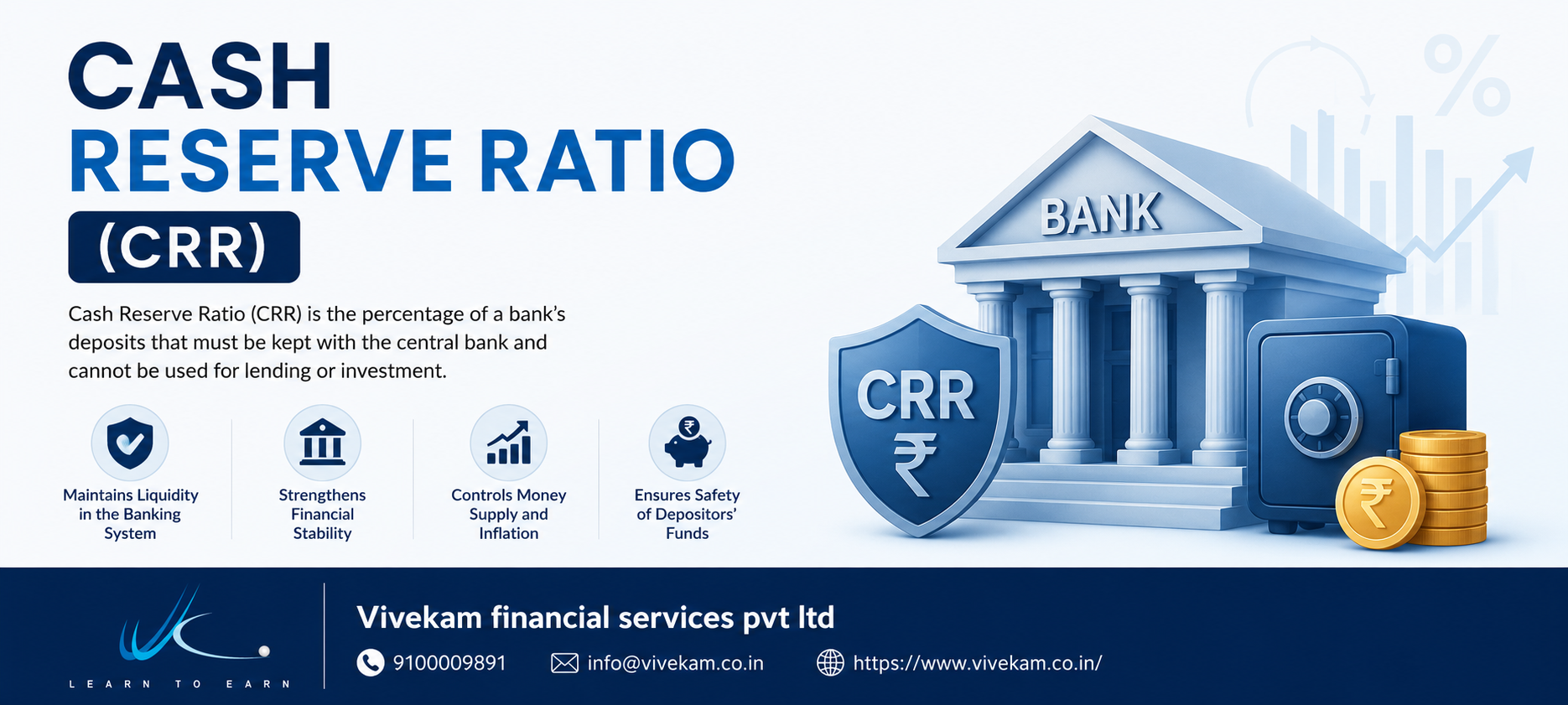
It represents the percentage of a bank’s total deposits that must be kept as cash reserves with the central bank. These funds cannot be used for lending, investing, or any other profit-generating activity.
In India, commercial banks are required to maintain this reserve with the Reserve Bank of India (RBI).
Quick Definition
Cash Reserve Ratio (CRR) is the minimum percentage of a bank’s Net Demand and Time Liabilities (NDTL) that must be maintained as cash with the Reserve Bank of India.
What is Cash Reserve Ratio?
The answer to what is cash reserve ratio can be understood through a simple example.
Suppose a bank receives deposits worth ₹1,000 crore.
If the RBI mandates a CRR of 4%, the bank must keep ₹40 crore with the RBI.
The remaining ₹960 crore can be used for:
- Home loans
- Personal loans
- Business loans
- Investments
- Banking operations
This requirement ensures banks always maintain a safety buffer.
Why Does RBI Use CRR?
The RBI uses CRR primarily to:
- Manage money supply
- Control inflation
- Stabilize banking liquidity
- Prevent excessive credit growth
- Strengthen depositor confidence
- Support monetary policy implementation
Without CRR, banks could lend aggressively, potentially creating inflationary pressure and systemic financial risks.
Cash Reserve Ratio Formula
The Cash Reserve Ratio formula helps determine how much money banks must maintain with the RBI.
Formula Explanation
CRR = (Cash Reserve Maintained with RBI ÷ Net Demand and Time Liabilities) × 100
Where:
Component | Meaning |
Cash Reserve | Cash maintained with RBI |
NDTL | Total demand and time liabilities |
Ratio | Percentage prescribed by RBI |
Practical Example of CRR Calculation
Assume a bank has:
Particulars | Amount |
Total Deposits (NDTL) | ₹20,000 Crore |
CRR Rate | 4% |
Calculation:
CRR Amount = ₹20,000 Crore × 4%
CRR Amount = ₹800 Crore
Therefore, the bank must maintain ₹800 crore with RBI and can deploy the remaining funds into loans and investments.
Objectives of Cash Reserve Ratio
The RBI doesn’t set CRR randomly. Every CRR adjustment serves a broader economic objective.
Liquidity Management
CRR helps regulate liquidity within the banking system.
When excess cash circulates in the economy, inflationary pressures increase. By raising CRR, RBI absorbs surplus liquidity from banks.
Inflation Control
One of the most important functions of CRR is inflation management.
Higher CRR means:
- Less lending
- Lower money supply
- Reduced consumer spending
As a result, inflationary pressures ease.
Monetary Stability
A stable financial system requires balanced credit growth. CRR prevents sudden surges in lending that could create asset bubbles and economic instability.
How CRR Works in the Banking System
Understanding how CRR functions helps explain why RBI announcements often influence markets.
Impact on Commercial Banks
When CRR increases:
- Banks must transfer more funds to RBI
- Available lending capital decreases
- Profitability may decline
- Liquidity tightens
When CRR decreases:
- Banks receive additional liquidity
- Credit availability increases
- Economic activity may accelerate
Impact on Lending Capacity
A higher CRR directly reduces the amount banks can lend.
For example:
CRR | Lending Capacity |
Lower CRR | Higher |
Higher CRR | Lower |
This simple mechanism makes CRR one of the most effective monetary policy tools available to the RBI.
Importance of Cash Reserve Ratio
The Cash Reserve Ratio serves as a foundation of modern banking regulation.
Economic Stability
CRR helps maintain equilibrium between growth and inflation.
Protection Against Liquidity Crises
Banks must always maintain reserves, reducing the likelihood of liquidity shortages.
Support for Monetary Policy
CRR complements:
- Repo Rate
- Reverse Repo Rate
- Open Market Operations
- Statutory Liquidity Ratio
Together, these tools help RBI steer the economy.
Public Confidence in Banks
Knowing that banks maintain mandatory reserves increases trust among depositors and investors.
CRR and SLR
The concepts of CRR and SLR are closely related but serve different purposes.
While CRR focuses on maintaining cash reserves with the RBI, SLR ensures banks hold sufficient liquid assets.
What is SLR?
SLR stands for Statutory Liquidity Ratio.
It requires banks to maintain a specified percentage of deposits in:
- Cash
- Gold
- Government securities
Unlike CRR, these assets remain under the control of banks.
Why Both CRR and SLR Exist
Together, CRR and SLR help:
- Maintain liquidity
- Improve solvency
- Protect depositors
- Regulate credit creation
Difference Between CRR and SLR
Understanding the Difference Between CRR and SLR is critical for banking professionals and competitive exam aspirants.
Basis | CRR | SLR |
Full Form | Cash Reserve Ratio | Statutory Liquidity Ratio |
Maintained With | RBI | Commercial Banks |
Form of Holding | Cash Only | Cash, Gold, Government Securities |
Interest Earnings | No Interest | Potential Returns |
Main Purpose | Liquidity Control | Solvency Protection |
Controlled By | RBI | RBI Guidelines |
Key Insight
CRR removes liquidity from the banking system, whereas SLR ensures banks maintain enough liquid assets to meet obligations.
CRR vs SLR
The debate around CRR vs SLR often confuses new learners because both are reserve requirements.
Similarities
Both:
- Are mandatory
- Regulated by RBI
- Affect lending capacity
- Support financial stability
Differences
The most important distinction is ownership and usability.
CRR funds are parked with RBI and cannot be used by banks.
SLR assets remain with banks and can generate returns through government securities.
Advantages of CRR
The Advantages of CRR extend beyond banking institutions and benefit the wider economy.
1. Controls Inflation
CRR helps reduce excess liquidity and inflationary pressure.
2. Strengthens Financial Discipline
Banks maintain mandatory reserve standards.
3. Enhances Banking Stability
Maintaining reserves lowers systemic risk.
4. Supports Monetary Policy
RBI can quickly influence liquidity by changing CRR.
5. Improves Public Trust
Depositors gain confidence knowing banks maintain reserves.
Disadvantages of CRR
Despite its benefits, there are notable Disadvantages of CRR.
1. Reduces Bank Profitability
Funds held under CRR do not generate income.
2. Restricts Credit Growth
Higher CRR means fewer loans.
3. Can Increase Interest Rates
Reduced liquidity may push lending rates upward.
4. May Slow Economic Growth
Businesses and consumers may find borrowing more expensive.
5. Opportunity Cost for Banks
Large reserve balances represent idle capital.
Factors Affecting CRR Changes
RBI evaluates several economic indicators before changing CRR.
These include:
- Inflation trends
- GDP growth
- Banking liquidity
- Credit expansion
- Fiscal policy conditions
- Global economic developments
- Exchange rate pressures
CRR changes are usually announced during monetary policy reviews.
Role of RBI in Determining CRR
The Reserve Bank of India regularly reviews economic conditions and determines appropriate CRR levels.
Its objectives include:
- Price stability
- Sustainable growth
- Financial sector resilience
- Efficient liquidity management
Impact of CRR on Borrowers and Depositors
For Borrowers
When CRR rises:
- Loan availability decreases
- Home loan rates may increase
- Business financing becomes costlier
For Depositors
Higher reserves contribute to a safer banking system.
For Investors
Changes in CRR often influence:
- Banking stocks
- Bond yields
- Market liquidity
Real-World Examples of CRR Adjustments
Historically, the RBI has adjusted CRR multiple times to manage changing economic conditions.
During periods of excessive liquidity, CRR increases have helped absorb surplus funds.
During economic slowdowns, CRR reductions have injected liquidity into the banking system, encouraging lending and supporting growth.
This demonstrates how the Cash Reserve Ratio remains one of the RBI’s most flexible and powerful monetary policy tools.
Frequently Asked Questions
1. What is Cash Reserve Ratio?
Cash Reserve Ratio is the percentage of bank deposits that must be maintained as cash with RBI.
2. What is the CRR full form?
CRR stands for Cash Reserve Ratio.
3. What is the Cash Reserve Ratio formula?
CRR = (Cash Reserve with RBI ÷ NDTL) × 100
4. What is the Difference Between CRR and SLR?
CRR is maintained with RBI in cash, while SLR is maintained by banks in approved liquid assets.
5. Why is CRR important?
It helps control inflation, regulate liquidity, and strengthen banking stability.
6. What are the Advantages of CRR?
Inflation control, financial stability, liquidity regulation, and stronger monetary policy implementation.
7. What are the Disadvantages of CRR?
Reduced lending capacity, lower bank profitability, and slower credit growth.
8. How does CRR affect home loans?
Higher CRR can reduce loan availability and potentially increase borrowing costs.
Conclusion
The Cash Reserve Ratio (CRR) is much more than a banking regulation. It is a powerful monetary policy instrument that directly influences liquidity, inflation, lending activity, and economic stability.
Understanding what is cash reserve ratio, the CRR full form, the Cash Reserve Ratio formula, CRR and SLR, the Difference Between CRR and SLR, and the broader CRR vs SLR comparison provides valuable insight into how modern economies manage money supply and financial stability.
Although the Advantages of CRR include inflation control and stronger banking resilience, the Disadvantages of CRR remind us that excessive reserve requirements can limit lending and economic expansion. Striking the right balance is therefore crucial, making CRR one of the most important tools in a central bank’s policy arsenal.