
What is Statutory Liquidity Ratio — Formula, Limits & Current Rate
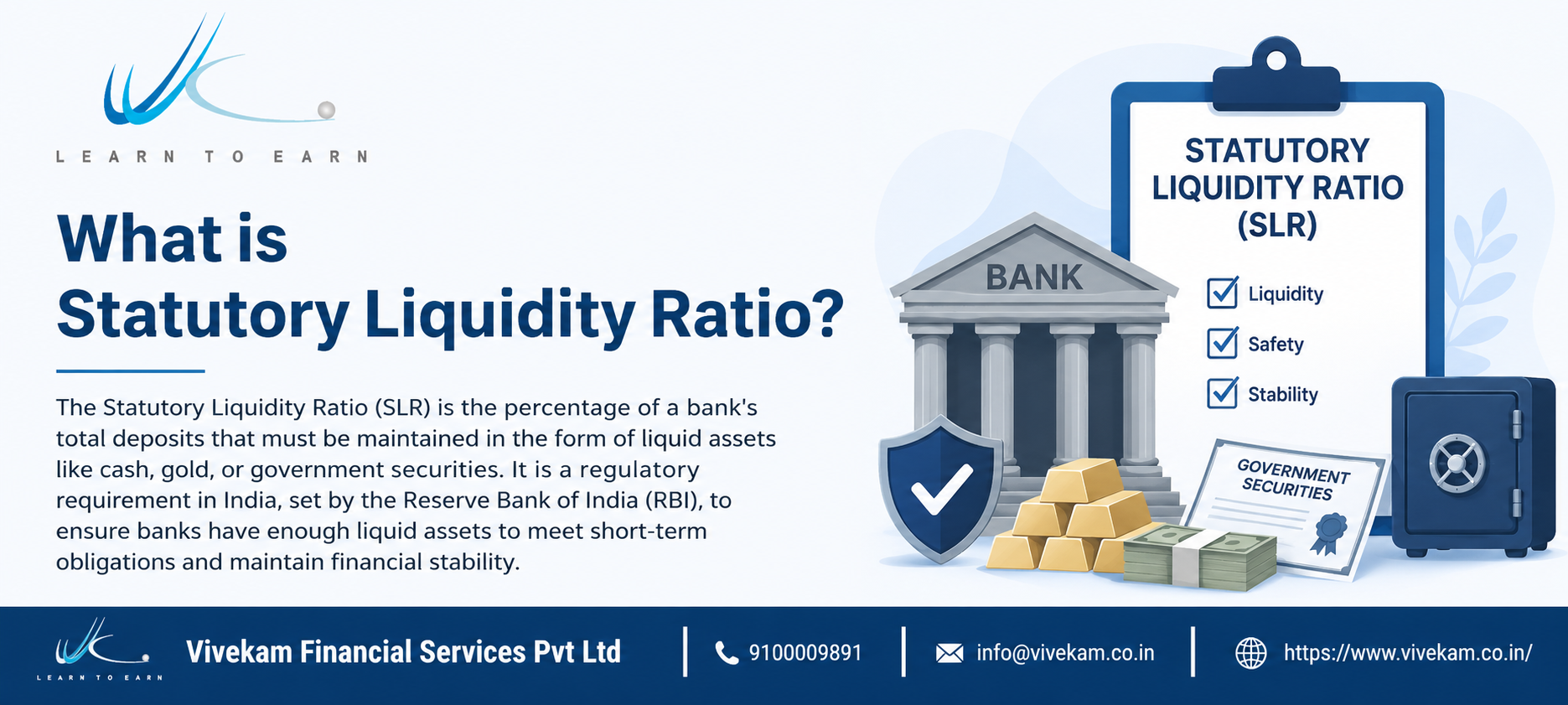
What is Statutory Liquidity Ratio?
Imagine a bank receives ₹100 crore in deposits from customers. Can the bank lend the entire amount to borrowers?
The answer is no.
Under regulations issued by the Reserve Bank of India (RBI), banks must keep a certain percentage of their deposits in highly liquid assets before lending money. This mandatory reserve is known as the Statutory Liquidity Ratio (SLR).
Understanding what is statutory liquidity ratio is important because it directly affects banking liquidity, loan availability, financial stability, and monetary policy. The SLR helps ensure that banks always have sufficient liquid resources to meet customer withdrawals and financial obligations.
In simple terms, SLR acts as a financial safety cushion for the banking system.
Understanding SLR Full Form
The SLR full form is Statutory Liquidity Ratio.
Let’s break it down:
- Statutory means required by law.
- Liquidity refers to assets that can easily be converted into cash.
- Ratio means a percentage of a bank’s liabilities.
Therefore, the Statutory Liquidity Ratio is the minimum percentage of deposits that banks must maintain in liquid assets as mandated by the RBI.
SLR Meaning in Banking
The SLR meaning in banking refers to the proportion of a bank’s Net Demand and Time Liabilities (NDTL) that must be maintained in approved liquid assets.
These liquid assets typically include:
- Cash
- Gold
- Government securities
- Treasury Bills
- State Development Loans
- Central Government Bonds
The purpose of maintaining these assets is to ensure that banks remain financially stable and capable of meeting withdrawal demands during periods of financial stress.
What is SLR?
Many students, investors, and banking aspirants often ask: What is SLR?
SLR is a prudential regulation imposed by the RBI requiring commercial banks to maintain a prescribed percentage of their deposits in liquid assets.
Unlike customer deposits that may be lent to borrowers, SLR assets must remain available to support liquidity and solvency requirements.
Why is SLR Important?
SLR serves several important functions:
- Protects depositors
- Ensures banking stability
- Controls excessive lending
- Supports government borrowing programs
- Helps manage inflation
- Strengthens financial discipline
Without SLR requirements, banks could potentially lend too much money, increasing risks within the financial system.
History of Statutory Liquidity Ratio in India
The Statutory Liquidity Ratio was introduced under the Banking Regulation Act, 1949.
Historically, India maintained significantly higher SLR requirements than many countries.
During the early 1990s, SLR exceeded 38%, reflecting tighter government control over banking resources.
Over time, economic reforms led to gradual reductions in SLR to improve lending efficiency and encourage economic growth.
Historical Trend of SLR in India
Year | Approximate SLR Rate |
1990 | 38.5% |
1997 | 25% |
2010 | 24% |
2015 | 21.5% |
2019 | 18.75% |
Current | 18% |
The gradual reduction reflects India’s shift toward a more market-oriented banking system.
Objectives of Statutory Liquidity Ratio
The RBI uses SLR as a powerful tool to achieve several economic and financial objectives.
Ensuring Bank Solvency
One of the primary objectives of SLR is maintaining bank solvency.
By requiring banks to hold liquid assets, the RBI ensures that financial institutions remain capable of meeting obligations even during economic uncertainty.
Controlling Credit Growth
SLR also helps regulate lending activity.
When the RBI increases the SLR rate:
- Banks have less money available for lending.
- Credit growth slows.
- Money supply contracts.
When the RBI lowers the SLR rate:
- Banks can lend more.
- Investment rises.
- Economic activity increases.
Supporting Government Borrowing
Since government securities form a major portion of SLR assets, banks become significant investors in government debt.
This helps governments raise funds efficiently for infrastructure and public development projects.
SLR Formula
Understanding the SLR formula is essential for banking professionals and exam aspirants.
SLR Formula
SLR = (Liquid Assets ÷ Net Demand and Time Liabilities) × 100
Where:
- Liquid Assets = Cash + Gold + Approved Government Securities
- NDTL = Net Demand and Time Liabilities
The resulting percentage must meet or exceed the RBI-prescribed SLR requirement.
SLR Calculation
Many learners struggle with SLR calculation because they are unfamiliar with NDTL.
Let’s simplify the process.
Step 1: Calculate Liquid Assets
Suppose a bank holds:
- Cash: ₹200 crore
- Gold: ₹100 crore
- Government Securities: ₹600 crore
Total Liquid Assets = ₹900 crore
Step 2: Calculate NDTL
Assume:
- Demand Deposits: ₹2,500 crore
- Time Deposits: ₹2,500 crore
Total NDTL = ₹5,000 crore
Step 3: Apply the Formula
SLR = (900 ÷ 5000) × 100
SLR = 18%
Therefore, the bank’s SLR equals 18%.
Common Mistakes in SLR Calculation
- Ignoring certain liabilities
- Including non-approved securities
- Incorrectly calculating NDTL
- Using market value instead of prescribed valuation methods
For banking exams, understanding each component is just as important as memorizing the formula.
Components Included in SLR
The RBI allows only specific assets to qualify toward SLR maintenance.
Cash
Cash held by banks can contribute toward SLR requirements.
Gold
Physical gold owned by banks qualifies as a liquid asset.
Government Securities
These constitute the largest portion of SLR holdings.
Examples include:
- Treasury Bills
- Government Bonds
- State Development Loans
- Dated Securities
Government securities are preferred because they carry minimal default risk.
SLR Rate and Limits
The SLR rate is determined by the RBI based on economic conditions.
The central bank reviews liquidity requirements periodically and adjusts the rate when necessary.
Factors Influencing SLR Rate
- Inflation levels
- Economic growth
- Banking sector liquidity
- Monetary policy objectives
- Financial stability concerns
Changes in SLR can significantly influence lending and investment activities throughout the economy.
Current SLR Rate in India
The Current SLR in India is 18% of Net Demand and Time Liabilities (NDTL).
This means commercial banks must maintain liquid assets equivalent to at least 18% of their total NDTL.
The RBI reviews this requirement periodically and may revise it depending on prevailing economic conditions.
Why Does RBI Change the SLR Rate?
The RBI may increase SLR when:
- Inflation rises sharply
- Excessive lending occurs
- Financial risks increase
The RBI may reduce SLR when:
- Economic growth slows
- Businesses require more credit
- Liquidity support becomes necessary
As a result, the current SLR serves as an important indicator of RBI’s monetary policy stance.
Impact of SLR on Banks
The Statutory Liquidity Ratio directly influences banking operations.
Higher SLR
A higher SLR means:
- Reduced lending capacity
- Increased investment in government securities
- Lower liquidity available for commercial loans
Lower SLR
A lower SLR results in:
- Greater credit availability
- Increased lending activity
- Improved economic growth prospects
Banks continuously monitor SLR changes because they affect profitability and balance-sheet management.
Impact of SLR on Customers
Although SLR primarily affects banks, customers experience indirect consequences.
Loan Availability
Lower SLR often leads to:
- Easier loan approvals
- Increased business financing
- More housing loans
Interest Rates
Changes in SLR can influence lending rates by affecting the availability of funds within the banking system.
Economic Growth
Lower reserve requirements generally encourage investment and job creation.
Difference Between CRR and SLR
Understanding the Difference Between CRR and SLR is critical for banking exams and finance interviews.
Feature | CRR | SLR |
Full Form | Cash Reserve Ratio | Statutory Liquidity Ratio |
Maintained With | RBI | Bank Itself |
Eligible Assets | Cash Only | Cash, Gold, Securities |
Interest Earned | No | Possible on Securities |
Purpose | Liquidity Control | Liquidity and Solvency |
Lending Impact | High | Moderate |
Custody | RBI | Commercial Bank |
Regulatory Tool | Monetary Tool | Prudential Tool |
Key Difference Between CRR and SLR
The main difference is that CRR reserves are maintained with the RBI in cash form, whereas SLR reserves are maintained by banks in approved liquid assets.
How RBI Uses SLR During Inflation and Recession
During High Inflation
The RBI may increase the SLR rate.
Result:
- Less lending
- Reduced money supply
- Controlled inflation
During Economic Slowdown
The RBI may reduce the SLR rate.
Result:
- Increased lending
- Higher investments
- Economic recovery support
This flexibility makes SLR a valuable monetary policy instrument.
Advantages of SLR
The Statutory Liquidity Ratio offers several benefits.
Financial Stability
Banks maintain adequate liquidity buffers.
Depositor Protection
Customers gain confidence in the banking system.
Risk Reduction
SLR prevents excessive risk-taking by banks.
Inflation Control
The RBI can regulate credit expansion effectively.
Government Funding Support
Banks invest significantly in government securities.
Limitations of SLR
Despite its benefits, SLR has certain drawbacks.
Reduced Lending Capacity
Higher SLR limits the amount available for lending.
Lower Bank Profitability
Government securities generally yield lower returns than commercial loans.
Potential Credit Constraints
Businesses may face difficulty obtaining financing when SLR requirements are high.
SLR and Monetary Policy
SLR forms an important part of India’s monetary policy framework alongside:
- Repo Rate
- Reverse Repo Rate
- Cash Reserve Ratio (CRR)
- Marginal Standing Facility (MSF)
Together, these tools help the RBI manage liquidity, inflation, and economic growth.
SLR for Banking Exams
For SBI PO, IBPS PO, RBI Grade B, NABARD, and SSC examinations, candidates should remember:
- SLR full form: Statutory Liquidity Ratio
- Current SLR: 18%
- Maintained in cash, gold, and approved securities
- Formula: Liquid Assets ÷ NDTL × 100
- Controlled by RBI
- Important Difference Between CRR and SLR
These points frequently appear in competitive examinations.
Frequently Asked Questions
What is statutory liquidity ratio?
The Statutory Liquidity Ratio is the minimum percentage of NDTL that banks must maintain in liquid assets such as cash, gold, and government securities.
What is the SLR full form?
SLR stands for Statutory Liquidity Ratio.
What is the current SLR in India?
The current SLR in India is 18% of NDTL.
What is the SLR formula?
SLR = (Liquid Assets ÷ Net Demand and Time Liabilities) × 100
How is SLR calculation performed?
Add all approved liquid assets, divide by NDTL, and multiply by 100.
Who decides the SLR rate?
The Reserve Bank of India determines and revises the SLR rate.
Is SLR applicable to all banks?
Yes, scheduled commercial banks must comply with RBI-prescribed SLR requirements.
What happens if a bank fails to maintain SLR?
Banks may face regulatory penalties and supervisory actions from the RBI.
What is the difference between CRR and SLR?
CRR is maintained with the RBI in cash form, while SLR is maintained by banks in cash, gold, and approved securities.
Why is SLR important?
SLR protects depositors, ensures liquidity, promotes financial stability, and supports effective monetary policy implementation.
Conclusion
The Statutory Liquidity Ratio (SLR) is much more than a regulatory percentage. It is a cornerstone of India’s banking framework that safeguards depositors, strengthens financial institutions, and supports economic stability.
Whether you’re trying to understand what is SLR, preparing for a banking examination, studying monetary policy, or learning about the Indian financial system, knowing the SLR full form, SLR meaning, SLR formula, SLR calculation, SLR rate, Current SLR, and the Difference Between CRR and SLR is essential.
As economic conditions evolve, the RBI will continue using the Statutory Liquidity Ratio as a key tool for managing liquidity, controlling inflation, and ensuring long-term financial stability.