
Internal Rate of Return (IRR): Definition, Formula & How It Works
What Is IRR?
Whether you’re evaluating a real estate deal, comparing startup investments, or deciding whether a business expansion is worth the cost, one financial metric appears almost everywhere: IRR.
But what is IRR, and why do investors, CFOs, financial analysts, and private equity firms rely on it so heavily?
The internal rate of return (IRR) is the annualized rate of return that an investment is expected to generate over its lifetime. It takes into account both the amount and timing of future cash flows, making it significantly more sophisticated than simple profit calculations.
In practical terms:
IRR tells you the annual growth rate an investment is expected to achieve.
For example, if a commercial property investment has an IRR of 15%, that means the projected cash flows from the property are expected to generate an average annual return of approximately 15%.
This makes IRR one of the most powerful tools in:
- Capital budgeting
- Business project evaluation
- Venture capital analysis
- Real estate investing
- Private equity acquisitions
- Corporate finance planning
Unlike basic return metrics, IRR recognizes that money received today is worth more than money received years from now. This principle is known as the time value of money, and it forms the foundation of modern financial analysis.
IRR Full Form and Meaning
The IRR full form is Internal Rate of Return.
The term can be broken down into three parts:
Term | Meaning |
Internal | Based on project cash flows |
Rate | Expressed as a percentage |
Return | Profit generated over time |
The word “internal” is particularly important because IRR focuses solely on the cash flows generated by the investment itself rather than external market conditions.
When investors calculate IRR, they’re effectively asking:
“What annual return rate does this investment generate based on its projected cash flows?”
This allows different investment opportunities to be compared using a standardized metric.
For example:
Investment | IRR |
Apartment Building | 11% |
Solar Energy Project | 14% |
SaaS Startup | 28% |
Manufacturing Expansion | 17% |
At first glance, the SaaS startup appears most attractive because it offers the highest projected return. However, as we’ll discuss later, a higher IRR doesn’t always mean a better investment.
Understanding the Internal Rate of Return
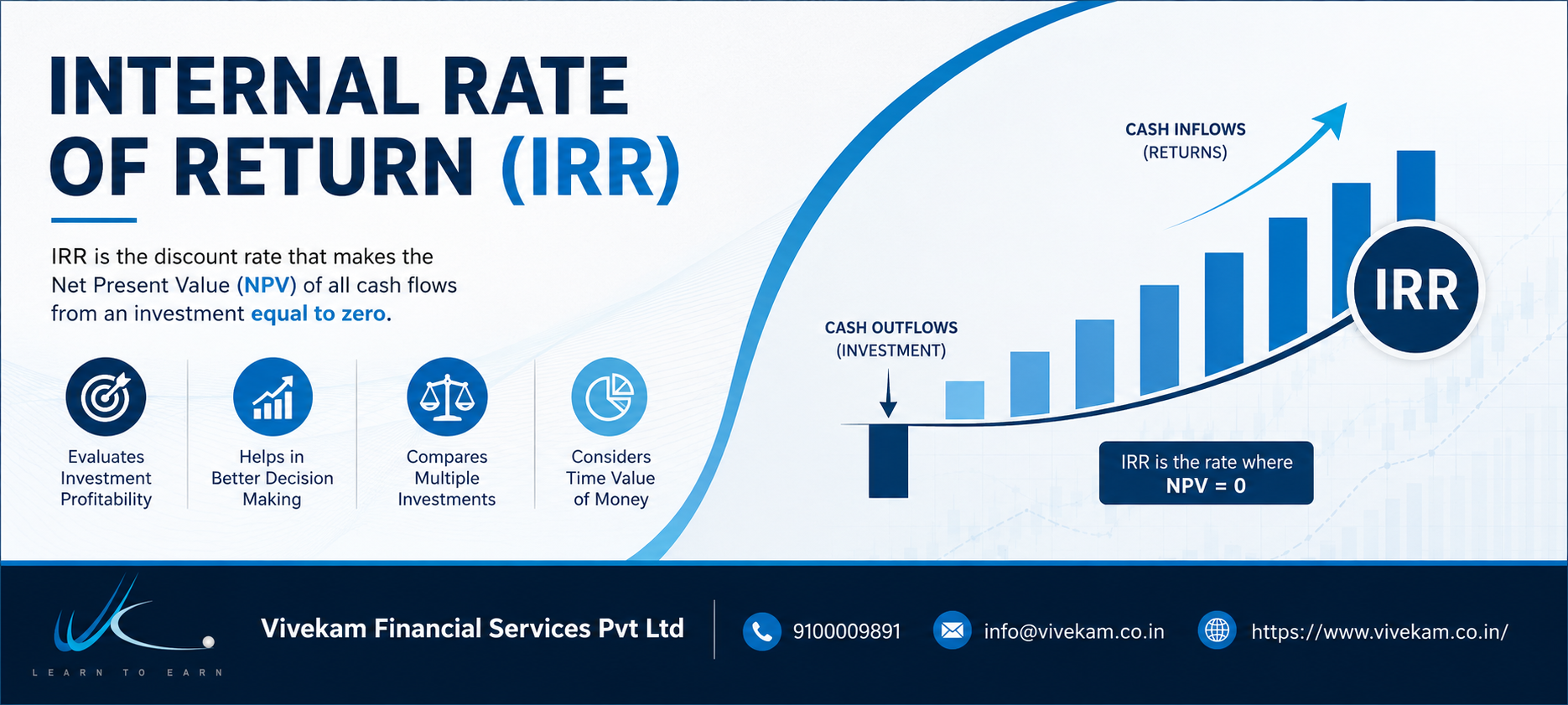
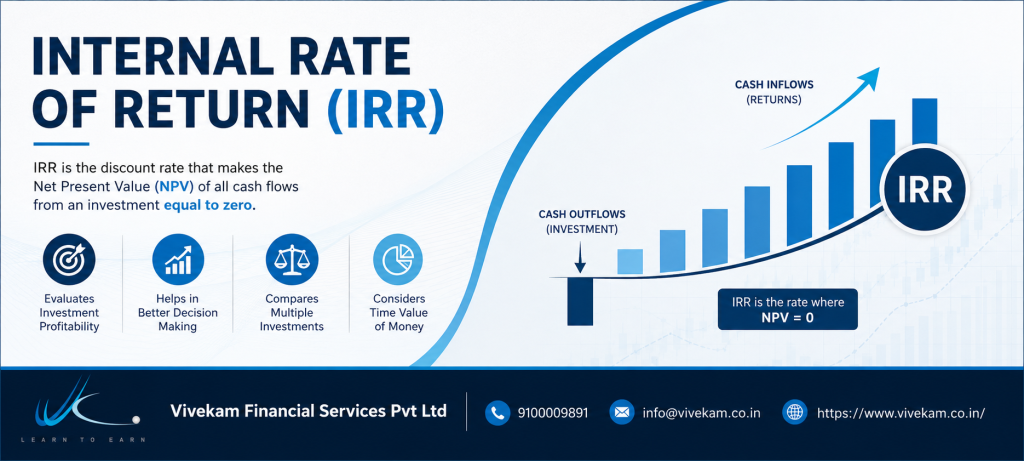
The internal rate of return is often described as the discount rate that causes a project’s net present value (NPV) to equal zero.
While technically correct, this definition can feel intimidating.
Let’s simplify it.
Imagine investing ₹1,00,000 today.
Over the next five years, that investment generates a series of cash inflows.
IRR calculates the annual percentage return that connects today’s investment cost with all future cash inflows.
Think of IRR as a financial translator.
Instead of forcing investors to compare complex streams of future cash flows, IRR converts everything into a single percentage that is easy to understand.
Why Timing Matters
Consider two investments:
Investment A
- Invest ₹10,00,000
- Receive ₹15,00,000 after five years
Investment B
- Invest ₹10,00,000
- Receive ₹15,00,000 after three years
Both produce the same profit.
However, Investment B generates cash much sooner.
IRR captures this advantage because earlier cash flows increase investment value.
This timing factor is one reason IRR is preferred over simpler profitability metrics.
Why IRR Matters in Investment Decisions
Investors constantly face difficult choices.
Should they buy real estate?
Launch a new product?
Acquire another company?
Invest in a startup?
IRR helps answer these questions by measuring expected profitability relative to investment cost.
Key Benefits of IRR
1. Enables Investment Comparison
Projects often vary significantly in size and duration.
IRR creates a common basis for comparison.
2. Accounts for Time Value of Money
Future cash flows are discounted appropriately.
3. Supports Capital Budgeting
Companies can rank projects based on expected returns.
4. Provides Clear Decision Criteria
Many organizations establish minimum required returns called hurdle rates.
For example:
Project Type | Required Return |
Government Bonds | 5% |
Corporate Projects | 10% |
Real Estate | 12% |
Venture Capital | 20%+ |
If a project’s IRR exceeds the hurdle rate, it may qualify for approval.
5. Widely Accepted Across Industries
IRR is used globally by:
- Banks
- Investment funds
- Corporations
- Real estate developers
- Venture capital firms
This universal acceptance increases its usefulness.
IRR Definition Explained in Simple Terms
The formal IRR definition is:
The discount rate that makes the net present value of all future cash flows equal to zero.
Although technically accurate, most investors find the following explanation easier:
IRR is the annual rate of return an investment is expected to generate.
At the IRR:
- Present value of future cash inflows equals investment cost.
- Net present value equals zero.
- The investment earns exactly the calculated return.
A Practical Analogy
Imagine depositing money into a savings account.
If the account grows from ₹1,00,000 to ₹2,00,000 over several years, there is an implied annual growth rate behind that increase.
IRR identifies a similar annual growth rate for investments with multiple cash flows occurring over time.
The higher the IRR:
- The faster the investment grows.
- The more attractive the project generally appears.
However, experienced investors know that risk and cash flow reliability matter just as much as the IRR itself.
The IRR Formula
The IRR formula originates from discounted cash flow (DCF) analysis.
Mathematically:
[
NPV = \sum \frac{CF_t}{(1+IRR)^t} – Initial Investment
]
When:
[
NPV = 0
]
The discount rate becomes the Internal Rate of Return.
Components of the IRR Formula
Component | Description |
Initial Investment | Money invested at the beginning |
Cash Flow (CF) | Future income generated |
T | Time period |
IRR | Discount rate being solved |
Unlike ROI formulas, the IRR formula cannot usually be solved manually using basic algebra.
Instead, analysts rely on:
- Financial calculators
- Excel
- Google Sheets
- Investment software
- Financial modeling tools
Why the Formula Matters
Many investors focus only on the final IRR percentage.
Smart investors also evaluate the assumptions behind the formula:
- Are cash flow estimates realistic?
- Are future revenues achievable?
- Are operating costs accurately projected?
Even the most precise formula produces misleading results when assumptions are unrealistic.
How IRR Calculation Works
Understanding IRR calculation helps investors interpret results more effectively.
Manual Calculation Method
Historically, IRR calculation involved trial and error.
The process looked like this:
- Select a discount rate.
- Calculate NPV.
- Observe whether NPV is positive or negative.
- Adjust the discount rate.
- Repeat until NPV reaches zero.
Before computers, this process could take hours.
Today, software performs these calculations instantly.
Excel IRR Function
Excel remains one of the most popular tools for calculating IRR.
Suppose your cash flows are:
Year | Cash Flow |
0 | -100000 |
1 | 25000 |
2 | 30000 |
3 | 35000 |
4 | 40000 |
5 | 45000 |
The formula is:
=IRR(A1:A6)
Excel automatically identifies the discount rate that produces an NPV of zero.
XIRR for Irregular Cash Flows
Many real-world investments generate cash flows at irregular intervals.
For these situations, analysts often use XIRR.
Unlike standard IRR, XIRR incorporates actual dates rather than assuming equal periods between cash flows.
This provides more accurate results for:
- Real estate investments
- Startup funding rounds
- Private equity deals
- Dividend-paying investments
- Construction projects
Because cash flow timing significantly impacts returns, XIRR is frequently preferred by professionals.
Internal Rate of Return Example
Understanding an internal rate of return example is often the fastest way to grasp how IRR works in real-world investing.
Step-by-Step Example
Imagine you’re evaluating a small commercial property.
Initial Investment: ₹10,00,000
Projected cash flows:
Year | Cash Flow |
1 | ₹1,50,000 |
2 | ₹1,80,000 |
3 | ₹2,00,000 |
4 | ₹2,20,000 |
5 | ₹13,00,000 (including sale proceeds) |
After entering these cash flows into Excel’s IRR function, the result is approximately:
IRR = 17.2%
What Does This Mean?
The property is expected to generate an annualized return of roughly 17.2%.
If your required rate of return is:
- 10% → Excellent investment
- 15% → Attractive investment
- 20% → Potentially insufficient
This example demonstrates why IRR is a decision-making tool rather than a standalone answer.
Startup Investment Example
Suppose an investor contributes ₹5,00,000 to a startup.
Five years later, their equity stake is worth ₹20,00,000.
The resulting IRR may exceed 30%.
This is one reason venture capital firms focus heavily on IRR when evaluating portfolio performance.
However, higher returns usually come with higher risk.
Advantages of Using IRR
The popularity of IRR stems from several important benefits.
1. Considers the Time Value of Money
One of the biggest strengths of IRR is that it recognizes that money received today is more valuable than money received in the future.
Unlike simple ROI calculations, IRR discounts future cash flows appropriately.
2. Easy Comparison Between Projects
Businesses frequently compare projects of different sizes and durations.
IRR provides a common percentage-based metric.
3. Supports Capital Budgeting
Corporate finance departments rely on IRR when deciding which projects deserve funding.
4. Widely Understood
Investors, lenders, executives, and analysts all recognize IRR as a standard performance measure.
5. Focuses on Profitability
IRR helps identify investments capable of generating strong long-term returns.
6. Useful Across Industries
IRR can evaluate:
- Real estate projects
- Manufacturing expansions
- Startup investments
- Infrastructure projects
- Renewable energy investments
- Acquisitions
Its flexibility makes it one of finance’s most versatile metrics.
Limitations of IRR
Despite its popularity, IRR has significant limitations that investors should understand.
1. Multiple IRRs Can Occur
Projects with unconventional cash flow patterns can generate multiple IRR values.
This can create confusion and lead to incorrect decisions.
2. Unrealistic Reinvestment Assumptions
Traditional IRR assumes that future cash flows are reinvested at the same IRR.
In reality, this is often unrealistic.
For example:
A project generating a 35% IRR may not provide opportunities to reinvest future cash flows at 35%.
3. Doesn’t Measure Total Value Created
A smaller project may produce a higher IRR while generating less overall profit.
Example:
Project | IRR | Profit |
A | 25% | ₹2 lakh |
B | 18% | ₹20 lakh |
Although Project A has a higher IRR, Project B creates significantly more value.
4. Sensitive to Cash Flow Estimates
Small forecasting errors can dramatically alter IRR results.
5. Can Favor Short-Term Projects
Projects returning capital quickly often produce higher IRRs even if long-term projects generate greater total wealth.
This is why experienced investors rarely rely solely on IRR.
IRR vs NPV
One of the most important finance debates involves IRR vs NPV.
While both metrics use discounted cash flow analysis, they answer different questions.
What Is NPV?
Net Present Value measures the total value created by a project after accounting for the time value of money.
Formula:
[
NPV = Present\ Value\ of\ Cash\ Inflows – Investment\ Cost
]
Key Differences Between IRR and NPV
Factor | IRR | NPV |
Output | Percentage | Currency Amount |
Measures | Return Rate | Value Creation |
Best For | Comparing Efficiency | Maximizing Wealth |
Reinvestment Assumption | Same IRR | Cost of Capital |
Reliability | Good | Often Superior |
Why Many Experts Prefer NPV
Financial academics generally consider NPV more reliable because:
- It measures actual wealth creation.
- It avoids multiple IRR issues.
- It handles complex projects more effectively.
When to Use IRR
Use IRR when:
- Comparing profitability percentages.
- Screening investment opportunities.
- Communicating results to stakeholders.
When to Use NPV
Use NPV when:
- Making final investment decisions.
- Comparing mutually exclusive projects.
- Maximizing shareholder value.
The best investors use both.
IRR vs ROI
Another common comparison is IRR vs ROI.
Although both measure investment performance, they are not interchangeable.
What Is ROI?
ROI stands for Return on Investment.
Formula:
[
ROI = \frac{Profit}{Investment} \times 100
]
Example
Investment: ₹1,00,000
Profit: ₹50,000
ROI:
50%
Simple.
However, ROI ignores timing.
Whether the profit arrives in one year or ten years, ROI remains 50%.
This creates a major limitation.
IRR vs ROI Comparison
Feature | IRR | ROI |
Time Value of Money | Yes | No |
Annualized Return | Yes | No |
Handles Multiple Cash Flows | Yes | Limited |
Accuracy | Higher | Lower |
Complexity | Moderate | Simple |
Which Is Better?
For quick evaluations:
ROI works well.
For serious investment analysis:
IRR provides significantly more insight.
Most professional investors rely on IRR rather than ROI for major decisions.
Factors Affecting IRR
Several variables can dramatically influence IRR results.
Cash Flow Timing
Earlier cash inflows generally increase IRR.
Investment Duration
Longer projects may generate lower IRRs despite higher total profits.
Initial Investment Size
Large capital requirements can affect return calculations.
Revenue Growth
Faster growth typically improves IRR.
Operating Costs
Higher expenses reduce cash flow and lower IRR.
Exit Value
In real estate and private equity, sale proceeds often have a major impact on IRR.
Economic Conditions
Interest rates, inflation, and market conditions influence investment performance.
Because IRR depends heavily on assumptions, investors should regularly stress-test their forecasts.
Industry Benchmarks: What Is a Good IRR?
Many investors ask:
“What is a good IRR?”
The answer depends on the industry and risk level.
Investment Type | Typical Target IRR |
Government Bonds | 3%–6% |
Corporate Projects | 8%–15% |
Commercial Real Estate | 10%–18% |
Private Equity | 15%–25% |
Venture Capital | 25%–40%+ |
General guideline:
- Below 8% → Often considered weak
- 8%–12% → Acceptable
- 12%–20% → Strong
- Above 20% → Excellent (often higher risk)
Higher isn’t always better if the underlying risk is excessive.
Common Mistakes When Using IRR
Investors frequently misuse IRR.
Ignoring Risk
A 30% IRR from a highly speculative startup may be less attractive than a 12% IRR from a stable property investment.
Overestimating Cash Flows
Optimistic forecasts often inflate IRR.
Ignoring NPV
Projects should be evaluated using both metrics.
Comparing Projects of Different Sizes
A higher IRR doesn’t necessarily mean greater profits.
Focusing Only on the Number
Understanding assumptions is just as important as the result itself.
Successful investors evaluate the entire investment story, not just the headline IRR.
Best Practices for Investors Using IRR
IRR is a powerful metric, but its effectiveness depends on how it is used. Experienced investors rarely rely on a single number when making investment decisions.
Use IRR Alongside NPV
One of the best practices in investment analysis is to evaluate both IRR and NPV together.
IRR tells you:
- How efficiently capital is working.
NPV tells you:
- How much value is being created.
A project with a lower IRR may generate significantly more wealth than a project with a higher IRR.
Stress-Test Your Assumptions
IRR is only as accurate as the cash flow projections behind it.
Before approving any investment, ask:
- What happens if revenues are 20% lower?
- What if costs increase?
- What if the project takes longer than expected?
Running multiple scenarios provides a more realistic view of potential outcomes.
Consider Risk Adjustments
A 25% IRR from a risky startup should not automatically beat a 12% IRR from a stable commercial property.
Always evaluate:
- Market risk
- Economic risk
- Operational risk
- Industry risk
- Liquidity risk
Focus on Cash Flow Quality
Strong IRRs based on unrealistic assumptions often lead to disappointing results.
Look for:
- Predictable revenue streams
- Sustainable margins
- Realistic growth forecasts
- Proven business models
The quality of cash flows often matters more than the projected IRR itself.
XIRR vs IRR
Many investors eventually encounter a related metric called XIRR.
While both measure investment performance, they handle cash flows differently.
What Is XIRR?
XIRR stands for Extended Internal Rate of Return.
It is designed for investments where cash flows occur on irregular dates.
IRR vs XIRR
Feature | IRR | XIRR |
Assumes Equal Time Periods | Yes | No |
Uses Actual Dates | No | Yes |
Accuracy for Real Investments | Moderate | High |
Commonly Used For | Simple Projects | Real-World Investments |
Example
Standard IRR assumes:
- January 1
- January 1
- January 1
XIRR can calculate returns for:
- January 12
- April 27
- September 18
- December 4
Because real investments rarely generate perfectly timed cash flows, many financial professionals prefer XIRR whenever actual dates are available.
MIRR Explained
Another improvement on traditional IRR is MIRR.
What Is MIRR?
MIRR stands for Modified Internal Rate of Return.
It was developed to address one of IRR’s biggest weaknesses:
The assumption that all cash flows can be reinvested at the same IRR.
Why MIRR Matters
Suppose a project produces an IRR of 35%.
Traditional IRR assumes all interim cash flows can also earn 35%.
In reality, investors may only be able to reinvest those funds at:
- 6%
- 8%
- 10%
MIRR uses a more realistic reinvestment rate.
As a result:
- MIRR is often lower than IRR.
- MIRR may provide a more realistic profitability estimate.
- MIRR helps compare projects more accurately.
Many corporate finance teams include MIRR in their investment evaluation process.
Real-World Applications of IRR
One reason the internal rate of return remains popular is its broad applicability.
Real Estate Investing
Real estate investors use IRR to evaluate:
- Rental properties
- Apartment complexes
- Commercial buildings
- Land development projects
The metric helps account for:
- Rental income
- Operating expenses
- Financing costs
- Property appreciation
- Sale proceeds
Corporate Finance
Companies use IRR when assessing:
- New factories
- Product launches
- Equipment purchases
- Technology upgrades
Projects with IRRs exceeding the firm’s hurdle rate are often approved.
Private Equity
Private equity firms rely heavily on IRR to evaluate acquisitions.
Fund managers frequently report:
- Gross IRR
- Net IRR
- Portfolio IRR
to investors.
Venture Capital
Startups often involve uncertain cash flows and long investment horizons.
VC firms use IRR to compare opportunities and assess overall portfolio performance.
Frequently Asked Questions
1. What is IRR in simple terms?
IRR is the annual percentage return an investment is expected to generate based on its projected cash flows.
2. What is the IRR full form?
The IRR full form is Internal Rate of Return.
3. Why is IRR important?
IRR helps investors compare opportunities and determine whether a project generates sufficient returns relative to risk.
4. What is a good IRR?
A good IRR depends on the investment type and risk level. Many investors consider:
- 8–12% acceptable
- 12–20% strong
- Above 20% excellent
provided the risks are manageable.
5. Is a higher IRR always better?
No.
A higher IRR may come with:
- Greater risk
- Smaller project size
- Less reliable cash flows
Investors should evaluate the complete investment picture.
6. What is the difference between IRR and NPV?
IRR measures return as a percentage.
NPV measures value creation in monetary terms.
Many experts prefer using both together.
7. What is the difference between IRR and ROI?
ROI measures total profitability.
IRR measures annualized profitability while considering the time value of money.
8. Can IRR be negative?
Yes.
A negative IRR generally indicates that the investment is expected to destroy value rather than create it.
9. Should startups use IRR?
Yes.
However, startup cash flows are often unpredictable, so IRR should be supplemented with additional valuation methods.
10. Is XIRR more accurate than IRR?
In most real-world situations, yes.
Because XIRR uses actual dates, it typically provides a more accurate representation of investment performance.
Conclusion
The Internal Rate of Return (IRR) remains one of the most valuable tools in modern finance. Whether you’re analyzing a rental property, evaluating a corporate expansion, comparing startup investments, or assessing a private equity opportunity, understanding IRR can significantly improve decision-making.
By mastering the IRR definition, understanding what is IRR, applying the IRR formula, performing accurate IRR calculation, and studying a realistic internal rate of return example, investors gain a deeper understanding of investment performance than simple profit metrics can provide.
However, IRR should never be viewed in isolation.
The strongest investment decisions come from combining:
- IRR
- NPV
- ROI
- XIRR
- Risk analysis
- Cash flow forecasting
When used correctly, the internal rate of return helps investors allocate capital more effectively, identify high-potential opportunities, and avoid costly mistakes.
Ultimately, the goal isn’t simply to find the highest IRR—it’s to find investments that create sustainable, long-term value while delivering returns that justify the risks involved. Investors who understand this distinction are far more likely to achieve consistent financial success over time.