
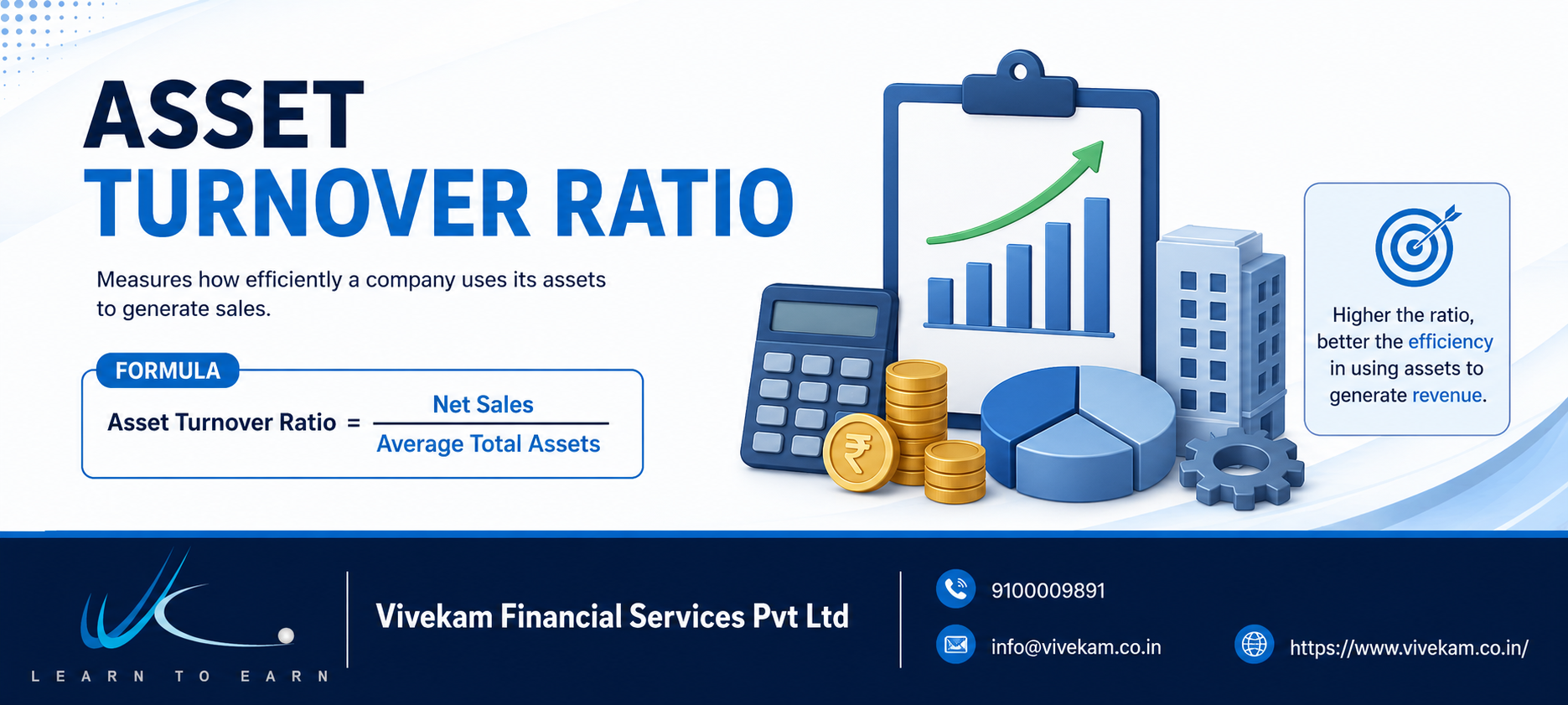
Asset Turnover Ratio Explained: Formula and Calculation
Every business invests money in assets—cash, inventory, machinery, buildings, vehicles, or technology—with one goal in mind: generating revenue. But simply owning valuable assets doesn’t guarantee strong financial performance. The real question is how effectively those assets contribute to sales.
That’s where the asset turnover ratio becomes invaluable.
This financial metric measures how efficiently a company converts its investments in assets into revenue. Investors use it to evaluate operational efficiency, lenders rely on it to assess business performance, and management teams monitor it to identify opportunities for improving productivity.
Whether you’re a finance student, business owner, investor, accountant, or preparing for interviews, understanding the asset turnover ratio formula is essential because it reveals how well a company utilizes its resources compared to competitors.
In this comprehensive guide, you’ll learn:
- What is asset turnover ratio?
- How to calculate asset turnover ratio
- Asset turnover ratio formula
- Total asset turnover ratio
- Fixed asset turnover ratio
- Fixed asset turnover ratio formula
- Net asset turnover ratio
- Asset turnover ratio example
- How to calculate turnover from balance sheet
- Good asset turnover ratio
- Common mistakes and practical interpretation
By the end of this guide, you’ll know not only how to calculate the ratio but also how to interpret it like a financial analyst.
What Is Asset Turnover Ratio?
One of the simplest ways to judge a company’s operational efficiency is to measure how effectively it turns assets into revenue. The asset turnover ratio does exactly that.
The ratio compares a company’s net sales with its average total assets during a reporting period. Rather than focusing on profits, it evaluates how productive a company’s assets are in generating income.
Imagine two retail businesses operating in the same city:
- Company A owns assets worth $10 million and generates $30 million in annual sales.
- Company B owns the same amount of assets but generates only $15 million in sales.
Although both businesses have identical asset bases, Company A is using its resources far more efficiently. The asset turnover ratio captures this difference in a single number, making it easier for investors and managers to compare performance.
Unlike profitability ratios such as net profit margin or return on equity (ROE), the asset turnover ratio focuses solely on revenue generation. A company can have impressive sales but still struggle with profitability if expenses are too high. That’s why financial analysts often use the asset turnover ratio alongside metrics like return on assets (ROA), operating margin, and return on invested capital (ROIC) to gain a complete picture of business performance.
Key Characteristics
- Measures operational efficiency.
- Indicates how effectively management uses assets.
- Useful for comparing companies within the same industry.
- Commonly used in financial statement analysis.
- Valuable for trend analysis over multiple years.
What Does the Ratio Tell You?
A higher ratio generally indicates that the business generates more revenue from each dollar invested in assets. Conversely, a lower ratio may suggest underutilized assets, inefficient operations, or excess investments that are not producing sufficient sales.
However, context matters. Asset-intensive industries naturally have lower turnover ratios than service-based businesses. Comparing a manufacturing company with a software company using this metric alone would produce misleading conclusions because their asset requirements differ significantly.
Why Asset Turnover Ratio Matters
The asset turnover ratio is more than just a number in a financial report—it reflects how efficiently a company converts its investments into revenue. Businesses spend significant amounts on equipment, inventory, buildings, and technology. If these assets fail to generate proportional sales, capital remains tied up without delivering adequate returns.
For investors, a consistently improving asset turnover ratio often signals effective management and disciplined capital allocation. It suggests the company is expanding revenue without making excessive investments in additional assets.
For lenders and creditors, the ratio offers insight into operational strength. Companies that efficiently use their assets are generally better positioned to generate cash flow, service debt, and sustain long-term growth.
Management teams also use the metric to evaluate strategic decisions. For example, purchasing new machinery or opening additional locations should ideally increase sales enough to justify the added investment. Monitoring changes in the asset turnover ratio helps determine whether these investments are delivering expected results.
Why Financial Analysts Use It
The ratio is commonly applied to:
- Compare operational efficiency across competitors.
- Identify trends in asset utilization over time.
- Evaluate management’s effectiveness in deploying capital.
- Support investment decisions.
- Assess the impact of capital expenditures.
- Benchmark performance against industry averages.
Industries Where It Is Most Useful
The asset turnover ratio is particularly valuable for businesses with substantial investments in physical assets, including:
- Manufacturing
- Retail
- Wholesale distribution
- Transportation and logistics
- Hospitality
- Automotive production
- Consumer goods
In contrast, software companies, consulting firms, and digital service providers often require fewer tangible assets, making the ratio less informative when comparing them with capital-intensive industries.
Asset Turnover Ratio Formula
The asset turnover ratio formula measures the relationship between a company’s revenue and its average total assets over a specific period.
The standard formula is:
Asset Turnover Ratio = Net Sales ÷ Average Total Assets
Where:
- Net Sales represent total revenue after deducting returns, allowances, and discounts.
- Average Total Assets are calculated by averaging the beginning and ending total assets for the reporting period.
Using average assets instead of ending assets provides a more accurate reflection of the resources employed throughout the year, especially for businesses that acquire or dispose of significant assets during the reporting period.
Breaking Down the Formula
Net Sales
Net sales are reported on the income statement and reflect the actual revenue earned from customers after adjustments for returns and discounts.
Example:
Gross Sales: $12,500,000
Less Sales Returns: $300,000
Less Discounts: $200,000
Net Sales = $12,000,000
Average Total Assets
Average total assets smooth out fluctuations caused by purchases, depreciation, or asset disposals.
Formula:
Average Total Assets = (Beginning Total Assets + Ending Total Assets) ÷ 2
Example:
Beginning Assets = $8 million
Ending Assets = $10 million
Average Assets = $9 million
Final Calculation
Net Sales = $18 million
Average Assets = $9 million
Asset Turnover Ratio = 18 ÷ 9 = 2.0
This means the company generated $2 in revenue for every $1 invested in assets during the reporting period.
Why Analysts Prefer Average Assets
Suppose a company purchases a new factory near the end of December. Using only the year-end asset value would overstate the asset base because the factory contributed little to annual sales. Averaging beginning and ending assets provides a fairer representation of asset utilization across the year.
How to Calculate Asset Turnover Ratio
Understanding how to calculate asset turnover ratio is straightforward once you know where to find the required numbers in a company’s financial statements. The calculation involves combining information from both the income statement and the balance sheet.
Rather than memorizing the formula, it’s better to understand the logic behind it. The ratio answers one simple question:
How much revenue did the company generate for every dollar invested in assets?
The higher the answer, the more efficiently the business is using its resources.
Step 1: Find Net Sales
The first figure you’ll need is Net Sales, which appears on the company’s income statement.
Net sales represent the revenue earned after deducting:
- Sales returns
- Customer allowances
- Trade discounts
Using net sales instead of gross sales provides a more accurate picture of the actual revenue generated from business operations.
Example
Gross Sales: $15,500,000
Sales Returns: $300,000
Discounts Allowed: $200,000
Net Sales = $15,000,000
Step 2: Find Total Assets
Next, locate the company’s balance sheet.
You’ll need:
- Beginning Total Assets
- Ending Total Assets
These figures include everything the company owns, such as:
- Cash and cash equivalents
- Accounts receivable
- Inventory
- Property, plant, and equipment (PP&E)
- Vehicles
- Buildings
- Machinery
- Investments
- Intangible assets, where applicable
Step 3: Calculate Average Total Assets
Using average assets provides a more balanced measure because businesses often buy or sell assets throughout the year.
Formula
Average Total Assets = (Beginning Total Assets + Ending Total Assets) ÷ 2
Example
Beginning Assets = $8,000,000
Ending Assets = $10,000,000
Average Total Assets = ($8,000,000 + $10,000,000) ÷ 2
Average Total Assets = $9,000,000
Step 4: Apply the Formula
Now divide net sales by average total assets.
Formula
Asset Turnover Ratio = Net Sales ÷ Average Total Assets
Calculation
Net Sales = $15,000,000
Average Assets = $9,000,000
Asset Turnover Ratio = 1.67
How to Interpret the Result
An asset turnover ratio of 1.67 means the business generated $1.67 in sales for every $1 invested in assets.
By itself, this figure doesn’t tell the whole story. The real value comes from comparing it against:
- Previous years
- Industry averages
- Direct competitors
- Company growth trends
For example:
|
Company |
Asset Turnover Ratio |
Interpretation |
|
Company A |
0.75 |
Assets are underutilized or sales are relatively low. |
|
Company B |
1.30 |
Average efficiency for many industries. |
|
Company C |
2.10 |
Strong asset utilization and efficient operations. |
A consistently rising ratio often indicates improving operational efficiency, while a declining ratio may signal slowing sales, overinvestment in assets, or operational inefficiencies.
How to Calculate Turnover from Balance Sheet
One of the most common questions among students and business owners is how to calculate turnover from balance sheet.
The short answer is:
You cannot calculate the asset turnover ratio using only the balance sheet.
That’s because the ratio combines data from two financial statements:
- Income Statement – for Net Sales
- Balance Sheet – for Total Assets
Here’s how the process works.
Information Required
From the Income Statement
Locate:
- Net Sales
- Revenue (if net sales are not separately reported)
From the Balance Sheet
Locate:
- Beginning Total Assets
- Ending Total Assets
Step-by-Step Example
Suppose a company’s financial statements show:
Income Statement
Net Sales = $24,000,000
Balance Sheet
Beginning Total Assets = $18,000,000
Ending Total Assets = $22,000,000
Average Total Assets
= ($18,000,000 + $22,000,000) ÷ 2
Average Assets = $20,000,000
Now calculate:
Asset Turnover Ratio
= $24,000,000 ÷ $20,000,000
= 1.20
This means every dollar invested in assets generated $1.20 in annual sales.
Where Are Total Assets Located?
Most balance sheets follow this structure:
Current Assets
- Cash
- Accounts Receivable
- Inventory
- Short-term Investments
- Prepaid Expenses
Non-Current Assets
- Property
- Plant
- Equipment
- Machinery
- Vehicles
- Land
- Buildings
- Intangible Assets
At the bottom of these sections, you’ll find Total Assets, which is the figure needed for the calculation.
Common Beginner Mistakes
Many first-time learners make these errors:
- Using gross sales instead of net sales.
- Using ending assets rather than average assets.
- Mixing quarterly revenue with annual asset values.
- Comparing companies from completely different industries.
- Ignoring significant asset acquisitions during the reporting period.
Avoiding these mistakes ensures a more accurate assessment of business efficiency.
Asset Turnover Ratio Example
Let’s walk through a detailed asset turnover ratio example to understand not just the calculation but also the interpretation.
Example 1: Manufacturing Company
XYZ Manufacturing reports the following financial information:
Income Statement
Net Sales = $36 million
Balance Sheet
Beginning Total Assets = $20 million
Ending Total Assets = $24 million
Step 1: Calculate Average Assets
Average Assets
= ($20M + $24M) ÷ 2
= $22 million
Step 2: Calculate the Ratio
Asset Turnover Ratio
= $36M ÷ $22M
= 1.64
Interpretation
XYZ Manufacturing generates $1.64 in revenue for every dollar invested in assets.
For many manufacturing businesses, a ratio between 1.0 and 2.0 is generally considered healthy, suggesting efficient use of production facilities and equipment.
Example 2: Retail Business
ABC Retail reports:
Net Sales = $120 million
Average Total Assets = $40 million
Asset Turnover Ratio
= 120 ÷ 40
= 3.0
Retail businesses often achieve much higher asset turnover because they rely on high inventory turnover and rapid sales cycles rather than heavy investments in fixed assets.
Example 3: Utility Company
Revenue = $15 billion
Average Assets = $50 billion
Asset Turnover Ratio
= 0.30
At first glance, this may appear low. However, utility companies operate with expensive infrastructure such as power plants, transmission lines, and substations. A lower ratio is normal for capital-intensive industries.
Comparing the Examples
|
Industry |
Asset Turnover Ratio |
Typical Interpretation |
|
Manufacturing |
1.64 |
Healthy operational efficiency |
|
Retail |
3.00 |
Excellent asset utilization |
|
Utilities |
0.30 |
Normal due to heavy infrastructure investments |
This comparison highlights why industry context is essential when evaluating the ratio.
Total Asset Turnover Ratio
The total asset turnover ratio measures how effectively all assets owned by a business generate revenue.
Unlike specialized versions of the ratio, it considers the company’s entire asset base, including:
- Cash
- Inventory
- Accounts receivable
- Property
- Machinery
- Buildings
- Equipment
- Land
- Investments used in operations
Because it encompasses all assets, it provides a broad view of operational efficiency.
Total Asset Turnover Ratio Formula
The total asset turnover ratio formula is:
Total Asset Turnover Ratio = Net Sales ÷ Average Total Assets
Although the formula is identical to the standard asset turnover ratio, the term “total” emphasizes that every operating asset is included in the calculation.
Why Analysts Prefer the Total Asset Turnover Ratio
Financial analysts frequently use this metric because it:
- Evaluates management’s effectiveness in using company resources.
- Identifies long-term efficiency trends.
- Supports valuation models.
- Complements profitability ratios such as Return on Assets (ROA).
- Helps compare competitors within the same industry.
A business that steadily increases its total asset turnover ratio over several years often demonstrates improving operational efficiency and disciplined capital allocation.
Fixed Asset Turnover Ratio
While the total asset turnover ratio evaluates all assets, the fixed asset turnover ratio focuses specifically on long-term physical assets.
These include:
- Manufacturing plants
- Machinery
- Equipment
- Buildings
- Production lines
- Warehouses
Current assets like cash, inventory, and receivables are excluded because the goal is to measure how efficiently expensive, long-term investments generate revenue.
This ratio is particularly useful for industries where substantial capital expenditures are required.
Common examples include:
- Manufacturing
- Mining
- Airlines
- Construction
- Telecommunications
- Energy
Fixed Asset Turnover Ratio Formula
The fixed asset turnover ratio formula is:
Fixed Asset Turnover Ratio = Net Sales ÷ Average Net Fixed Assets
Example
Net Sales = $48 million
Average Net Fixed Assets = $16 million
Fixed Asset Turnover Ratio
= 48 ÷ 16
= 3.0
This indicates the company generated $3 in sales for every $1 invested in fixed assets.
A higher ratio generally reflects better utilization of machinery and production facilities, but it should always be interpreted alongside factors such as asset age, maintenance requirements, and industry norms.
Net Asset Turnover Ratio
The net asset turnover ratio is a more refined efficiency metric that focuses on net operating assets rather than total assets.
Instead of including every asset on the balance sheet, it isolates the assets directly involved in generating operating revenue.
A common approach is:
Net Operating Assets = Operating Assets − Operating Liabilities
The ratio is then calculated as:
Net Asset Turnover Ratio = Net Sales ÷ Average Net Operating Assets
Analysts often use this measure to gain a clearer understanding of operational performance because it excludes financing-related items that may distort comparisons.
For example, two companies with similar sales may report different total asset values due to excess cash reserves or investment portfolios. By focusing on operating assets, the net asset turnover ratio provides a more meaningful assessment of how efficiently core business operations generate revenue.
Good Asset Turnover Ratio
One of the most frequently asked questions is, “What is a good asset turnover ratio?” The answer isn’t as straightforward as a single benchmark because the ideal ratio varies widely across industries.
A retailer with an asset turnover ratio of 3.0 might be performing exceptionally well, while a utility company with the same ratio would be almost unheard of due to its massive investment in infrastructure. The key is to compare companies operating under similar business models and capital requirements.
General Asset Turnover Ratio Benchmarks
|
Asset Turnover Ratio |
Interpretation |
|
Less than 0.50 |
Low asset utilization; assets may be underused or sales are weak. |
|
0.50–1.00 |
Acceptable for many capital-intensive industries. |
|
1.00–2.00 |
Good operational efficiency for many manufacturers and distributors. |
|
Above 2.00 |
Excellent efficiency, commonly seen in retail and consumer goods. |
These benchmarks should be treated as general guidelines rather than strict rules.
Industry Comparisons
Retail
Retailers typically have high asset turnover ratios because they rely on fast inventory turnover and frequent customer purchases.
Typical Range: 2.0–4.0
Large supermarket chains and discount retailers often exceed these values due to high sales volumes and efficient inventory management.
Manufacturing
Manufacturers invest heavily in factories, machinery, and production equipment, leading to moderate asset turnover ratios.
Typical Range: 1.0–2.0
A ratio above the industry average may indicate efficient production planning and strong demand for products.
Utilities
Electricity, water, and gas providers require substantial investments in infrastructure.
Typical Range: 0.25–0.70
Lower ratios are normal because these businesses prioritize long-term asset investments over rapid sales growth.
Software and Technology
Technology companies often operate with fewer tangible assets, making comparisons based solely on asset turnover less meaningful.
Ratios can vary significantly depending on the company’s business model, subscription revenue, and intangible asset base.
What Influences a Good Asset Turnover Ratio?
Several factors determine whether a ratio should be considered strong or weak:
- Industry characteristics
- Business maturity
- Asset age
- Revenue growth
- Capital expenditure strategies
- Operational efficiency
- Inventory management
- Seasonal sales patterns
A newly established manufacturing company, for example, may report a lower ratio initially because it has invested heavily in new equipment that has not yet reached full production capacity.
Why Trends Matter More Than a Single Number
A single year’s ratio offers only a snapshot of performance. Reviewing trends over multiple years provides far more meaningful insights.
For example:
|
Year |
Asset Turnover Ratio |
|
2022 |
1.20 |
|
2023 |
1.35 |
|
2024 |
1.48 |
|
2025 |
1.63 |
This steady improvement suggests that the company is generating increasing revenue without proportionally increasing its asset base—a positive sign of improving operational efficiency.
Factors Affecting Asset Turnover Ratio
The asset turnover ratio is influenced by a combination of operational, financial, and industry-specific factors. Understanding these drivers helps explain why the ratio changes over time and why businesses in different sectors report vastly different values.
1. Industry Type
Industry is one of the biggest determinants of asset turnover.
Capital-intensive businesses—such as airlines, mining companies, utilities, and manufacturers—require significant investments in property, equipment, and infrastructure. As a result, they often report lower asset turnover ratios.
In contrast, businesses that rely less on physical assets, such as retailers or digital platforms, typically generate higher ratios.
2. Sales Growth
Revenue growth directly affects the ratio.
If sales increase while total assets remain relatively stable, the asset turnover ratio improves because each dollar invested in assets generates more revenue.
3. Capital Expenditures
Purchasing new machinery, opening additional stores, or expanding production facilities increases total assets.
Initially, these investments may reduce the ratio because the assets are added before they begin contributing to higher sales. Over time, if the investments are successful, the ratio should recover and improve.
4. Asset Utilization
Idle equipment, vacant buildings, or excess inventory reduce efficiency.
Businesses that maximize the use of their existing assets generally achieve higher turnover ratios without requiring significant additional investment.
5. Inventory Management
Efficient inventory control contributes to stronger asset turnover.
Excess inventory ties up capital and increases storage costs, while insufficient inventory may lead to lost sales. Maintaining optimal inventory levels helps improve both operational efficiency and revenue generation.
6. Economic Conditions
External factors such as economic downturns, inflation, or supply chain disruptions can reduce sales while assets remain unchanged.
In these situations, the asset turnover ratio may decline even if management is operating efficiently.
7. Depreciation Policies
Accounting methods also influence the ratio.
As fixed assets depreciate over time, their book values decrease. If revenue remains stable, the asset turnover ratio may increase even though the company’s actual operational efficiency has not changed.
This is why analysts consider the age of assets and accounting policies when interpreting the metric.
Advantages and Limitations
Like any financial ratio, the asset turnover ratio has strengths and weaknesses. It should be evaluated alongside other performance indicators rather than used in isolation.
Advantages
Measures Operational Efficiency
The ratio provides a straightforward way to assess how effectively a company uses its assets to generate revenue.
Supports Competitive Analysis
It allows investors and managers to compare companies operating within the same industry.
Highlights Management Performance
A consistently improving ratio often reflects better resource allocation and operational decision-making.
Easy to Calculate
The required information is readily available in standard financial statements, making the ratio accessible to investors, students, and business owners.
Complements Other Financial Ratios
When combined with metrics such as Return on Assets (ROA), Gross Profit Margin, Operating Margin, and Return on Equity (ROE), the asset turnover ratio contributes to a more comprehensive evaluation of business performance.
Limitations
Industry Differences
Comparing companies from different industries can produce misleading conclusions because asset requirements vary widely.
Ignores Profitability
A company may generate strong sales while earning very little profit due to high operating expenses or thin margins.
Accounting Differences
Different depreciation methods, asset valuation policies, and accounting standards can affect the ratio without reflecting actual operational performance.
Seasonal Variations
Retailers and tourism businesses often experience seasonal fluctuations in sales, making single-period ratios less representative.
One-Time Transactions
Major asset acquisitions or disposals during the reporting period can temporarily distort the ratio.
How to Improve Asset Turnover Ratio
Improving the asset turnover ratio requires increasing revenue, optimizing asset utilization, or both. Businesses can adopt several strategies to enhance operational efficiency.
Increase Sales Without Significant Asset Growth
Boosting revenue through marketing initiatives, product expansion, or improved customer retention allows businesses to generate more sales from existing assets.
Optimize Inventory Levels
Implementing effective inventory management systems helps reduce excess stock while ensuring products remain available to meet customer demand.
Dispose of Underutilized Assets
Selling or leasing idle equipment, unused facilities, or obsolete inventory can improve the ratio by reducing the asset base.
Improve Production Efficiency
Investing in process improvements, employee training, and preventive maintenance can increase output without requiring substantial additional assets.
Adopt Technology and Automation
Modern technologies, including enterprise resource planning (ERP) systems, automation, and data analytics, can streamline operations and enhance asset utilization.
Strengthen Receivables Management
Faster collection of accounts receivable improves cash flow and reduces the amount of capital tied up in current assets.
Common Mistakes
Even experienced analysts can misinterpret the asset turnover ratio if they overlook important considerations. Avoid these common mistakes:
- Comparing businesses across different industries.
- Using ending total assets instead of average total assets.
- Confusing gross sales with net sales.
- Ignoring major asset acquisitions or disposals during the reporting period.
- Evaluating a single year’s ratio without reviewing historical trends.
- Assuming that a higher ratio always indicates superior performance.
A high ratio may sometimes result from aging assets, deferred maintenance, or underinvestment in capacity, all of which can create challenges for future growth.
Frequently Asked Questions
1. What is asset turnover ratio?
The asset turnover ratio measures how efficiently a company uses its assets to generate revenue. It compares net sales with average total assets over a specific period.
2. How to calculate asset turnover ratio?
Divide net sales by average total assets:
Asset Turnover Ratio = Net Sales ÷ Average Total Assets
Average total assets are calculated by adding beginning and ending total assets and dividing the result by two.
3. What is the difference between total asset turnover ratio and fixed asset turnover ratio?
The total asset turnover ratio considers all company assets, including current and non-current assets.
The fixed asset turnover ratio focuses only on long-term assets such as machinery, buildings, and equipment, making it particularly useful for evaluating capital-intensive businesses.
4. What is a good asset turnover ratio?
A good asset turnover ratio depends on the industry.
- Retail businesses often report ratios above 2.0.
- Manufacturers typically range between 1.0 and 2.0.
- Utilities commonly operate below 1.0 due to their significant infrastructure investments.
Comparing businesses within the same industry provides the most meaningful insights.
5. Can the asset turnover ratio be too high?
Yes. An unusually high ratio may indicate that a company is operating with insufficient assets, relying on outdated equipment, or delaying necessary investments. While high efficiency is desirable, underinvestment can limit future growth.
6. How does depreciation affect the asset turnover ratio?
Depreciation reduces the book value of fixed assets over time. As a result, older assets may increase the ratio even if operational efficiency remains unchanged. Analysts should consider asset age and depreciation policies when interpreting results.
7. Why is average total assets used instead of ending assets?
Average total assets provide a more accurate representation of the resources employed throughout the reporting period, especially when significant asset purchases or disposals occur during the year.
8. Is a higher asset turnover ratio always better?
Not necessarily. A higher ratio generally indicates efficient asset utilization, but it should be evaluated alongside profitability, cash flow, capital expenditure, and industry benchmarks to determine whether it reflects sustainable performance.
9. Which financial statements are needed to calculate the ratio?
The calculation requires information from both the income statement (net sales) and the balance sheet (beginning and ending total assets).
- Can small businesses use the asset turnover ratio?
Absolutely. Small businesses can use the asset turnover ratio to monitor operational efficiency, evaluate investments in equipment, and compare performance over time, just as larger corporations do.
Conclusion
The asset turnover ratio is one of the most practical financial metrics for evaluating how efficiently a business transforms its assets into revenue. While the calculation itself is straightforward, meaningful interpretation requires an understanding of industry dynamics, capital intensity, and long-term performance trends.
By mastering the asset turnover ratio formula, learning how to calculate asset turnover ratio, and understanding related concepts such as the total asset turnover ratio, fixed asset turnover ratio, fixed asset turnover ratio formula, and net asset turnover ratio, investors, managers, and business owners can make more informed decisions about operational efficiency and capital allocation.
Remember that no financial ratio should be analyzed in isolation. Combining the asset turnover ratio with profitability, liquidity, leverage, and cash flow metrics provides a more complete picture of a company’s financial health. Regularly tracking the ratio over multiple reporting periods and comparing it with industry peers will help identify strengths, uncover inefficiencies, and support better strategic decisions.
Whether you’re evaluating an investment opportunity, managing a growing business, or studying financial analysis, understanding what constitutes a good asset turnover ratio equips you with a valuable tool for assessing how effectively a company converts its resources into sustainable revenue and long-term growth.