What Are Futures and Options (F&O)? Meaning, Differences, and How They Work
What Is F&O? The Meaning Behind the Acronym
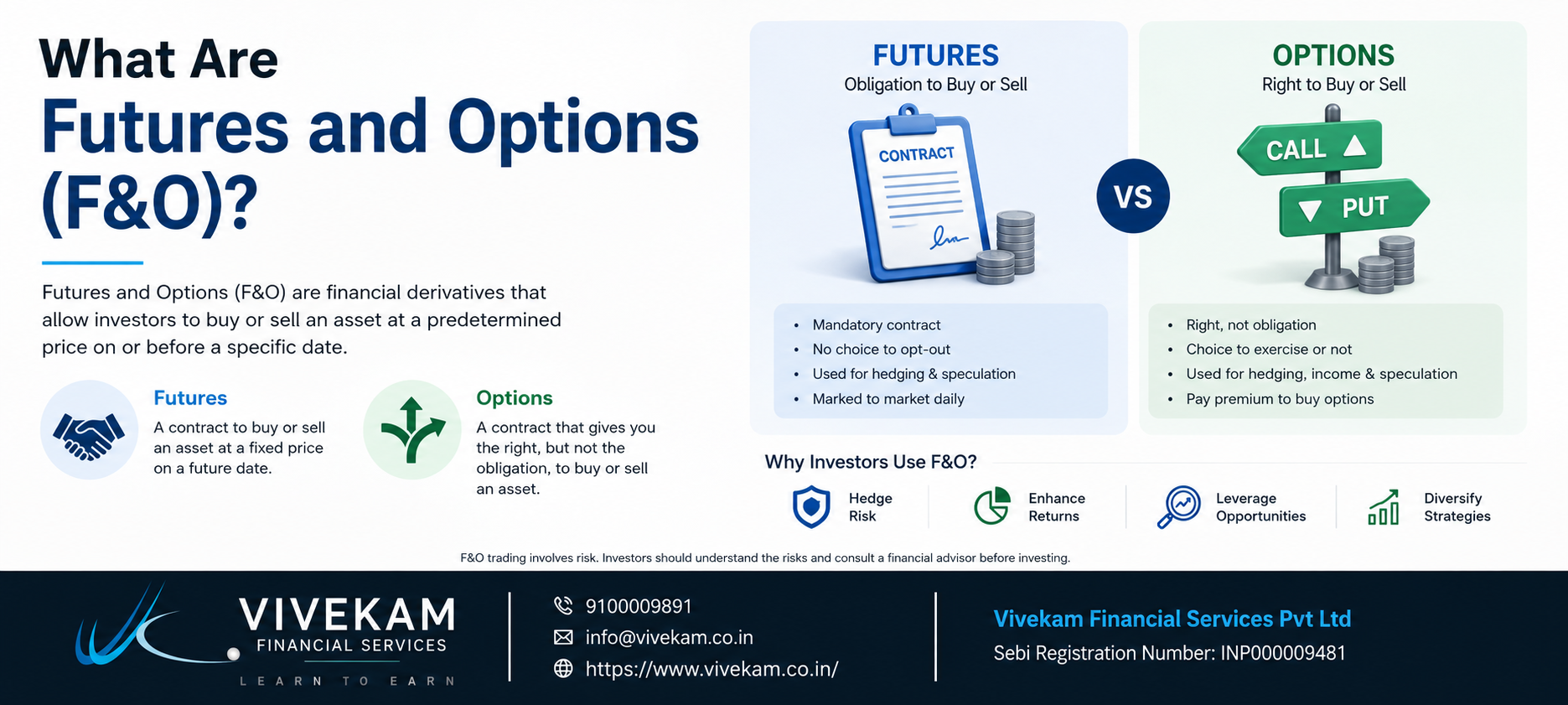
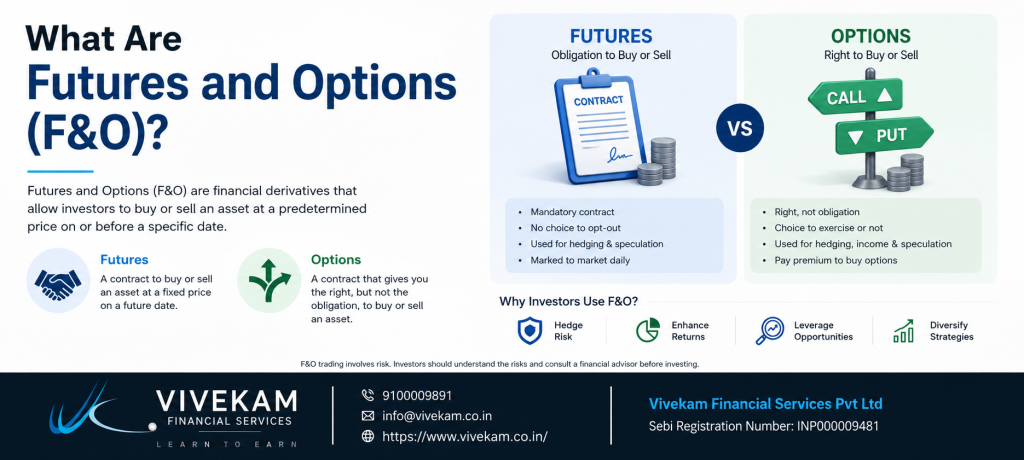
F&O stands for Futures and Options – two categories of financial derivatives. A derivative, by definition, is a contract whose value is “derived” from an underlying asset: a stock, an index, a commodity, a currency. You are not buying the asset itself. You are buying a contract that references it.
This distinction matters more than most beginners realize. When you buy a stock, you own a piece of a company. When you buy a futures or options contract on that stock, you own an agreement – one with an expiry date, a fixed lot size, and obligations that don’t disappear just because the market moved against you.
Derivatives trading exists for two legitimate reasons: hedging risk and speculating on price direction. Everything else – the leverage, the volume, the retail obsession with F&O stocks – is built on top of those two original purposes.
What Is Futures Trading?
Futures trading involves a standardized contract obligating two parties to transact an asset at a predetermined price on a specific future date. Both the buyer and the seller are locked in. Neither side gets to walk away without consequence.
Here’s the futures meaning in practical terms: if you buy one futures contract of a stock at ₹1,000 expiring at month-end, you are obligated to buy that stock at ₹1,000 on expiry, regardless of where the price actually lands. If the stock is at ₹1,200, you profit. If it’s at ₹800, you lose – and you don’t get to opt out.
Key characteristics of futures:
- Both parties carry an obligation, not a choice
- Standardized contract size, expiry, and settlement rules set by the exchange
- Margin-based trading, meaning you control a large position with a fraction of its value upfront
- Daily mark-to-market settlement, so gains and losses are adjusted to your account every single day until expiry or exit
That last point trips up more beginners than anything else. Futures don’t wait for expiry to hurt you. If the market moves against your position, your broker deducts the loss from your margin the same evening. Run out of margin, and you’ll get a call demanding more money or face forced liquidation.
What Is Options Trading?
Options trading meaning is fundamentally different, and this is where most of the confusion in F&O begins. An option gives the buyer a right, not an obligation, to buy or sell the underlying asset at a fixed price before or on expiry. The seller, on the other hand, is obligated to fulfill the contract if the buyer exercises that right.
This asymmetry is the entire point of options. The buyer pays a premium upfront for that right and can walk away if the trade doesn’t work out, losing only the premium. The seller collects that premium but carries open-ended risk if the market moves sharply against their position.
Call and Put Options Explained
There are only two types of options, and understanding call and put options correctly will save you from most beginner mistakes:
Call option: Gives the buyer the right to buy the underlying asset at a fixed price (the strike price) before expiry. You buy a call when you expect the price to rise. If the stock goes above your strike price plus the premium paid, you profit.
Put option: Gives the buyer the right to sell the underlying asset at a fixed price before expiry. You buy a put when you expect the price to fall. If the stock drops below your strike price minus the premium paid, you profit.
In both cases, the maximum loss for the option buyer is limited to the premium paid. The maximum loss for the option seller is theoretically unlimited on a call and substantial on a put. This is the single most misunderstood fact in retail options trading – people jump into selling options for the steady premium income without understanding what happens when the market moves violently against them.
Futures vs Options: The Real Differences
I’ve listed the surface-level differences already, but let’s go deeper, because this is where most explanations fall short.
Factor | Futures | Options |
Obligation | Both buyer and seller are obligated | Only the seller is obligated; buyer has a choice |
Upfront cost | Margin (percentage of contract value) | Premium (buyer) or margin (seller) |
Maximum loss (buyer) | Potentially unlimited | Limited to premium paid |
Maximum loss (seller) | Potentially unlimited | Potentially unlimited (calls) or substantial (puts) |
Profit potential | Unlimited, both directions | Unlimited for buyer, limited to premium for seller |
Time decay | Not applicable | Erodes option value daily as expiry nears |
Complexity | Relatively straightforward | Requires understanding of strike price, premium, and time decay |
The time decay point deserves attention. An option loses value every single day purely due to the passage of time, independent of what the underlying asset does. This is called theta decay, and it works against option buyers and in favor of option sellers. It’s one reason why buying options and being “right” about direction still isn’t enough – you also need the move to happen fast enough to outpace the daily erosion in premium.
Futures don’t have this problem. A futures contract’s value tracks the underlying asset closely, without an independent time-decay component eating into it.
How to Trade in F&O: The Practical Mechanics
If you’re asking how to trade in F&O, here is the sequence, without the marketing gloss:
- Open a trading account with F&O segment activated. Most brokers require additional documentation and a separate activation for derivatives trading beyond a basic equity account.
- Understand lot sizes. F&O stocks trade in fixed lot sizes set by the exchange, not individual shares. You cannot buy a single share’s worth of exposure; you buy in lots, which can mean a large capital commitment even for a “small” position.
- Check margin requirements. Futures require margin, typically 10-20% of the contract value depending on volatility (SPAN + exposure margin). Options buyers pay premium only; options sellers require margin similar to or higher than futures.
- Select your strategy based on view and risk appetite, not on what’s trending on social media. Buying calls or puts suits a directional view with defined risk. Selling options suits those with larger capital and a clear understanding of the unlimited-risk side of the trade. Futures suit those confident in direction with the capital to withstand margin calls.
- Set a stop-loss before entering, not after. Derivatives amplify both gains and losses through leverage. A 5% move in the underlying can translate into a 30-50% swing in your F&O position, depending on your leverage ratio.
- Track expiry dates religiously. Unlike stocks, F&O contracts expire – typically monthly or weekly depending on the instrument. Letting a position run into expiry without a plan is how a lot of retail capital disappears.
Options Trading for Beginners: What to Actually Watch Out For
If you are new to this and reading guides written by people who’ve never sat through a margin call, here’s what actually matters:
- Leverage cuts both ways. The same leverage that turns a small move into a large gain turns a small move against you into a large loss. Don’t confuse leverage with an edge – it’s a magnifier, not a strategy.
- Liquidity matters more than most beginners check. Illiquid options have wide bid-ask spreads, meaning you can lose money just entering and exiting the position, independent of market direction.
- Selling “safe” options is not safe. The premium-collection strategies marketed as steady income generators carry tail risk that shows up rarely but severely – and severely enough to erase months of gains in one session.
- Position sizing is not optional. Risking a large percentage of your capital on a single F&O trade because you’re “confident” is how experienced traders and beginners alike get wiped out. The market does not care about your conviction.
- Paper trade before committing real capital, and even then, treat your first few months of live trading as tuition, not profit generation.
Conclusion
Futures and options are tools, not shortcuts. Futures obligate both parties to a transaction at a fixed price and date; options give the buyer a right without obligation, in exchange for a premium, while the seller takes on the obligation. Both instruments use leverage, and leverage is precisely what makes F&O attractive to some and financially damaging to others – the mechanics don’t change based on who’s trading.
If you’re serious about F&O trading, understand margin requirements, lot sizes, expiry mechanics, and worst-case scenarios before you place a single trade. The people who survive in this segment long-term are not the ones who found a clever strategy – they’re the ones who respected the risk from day one.
Frequently Asked Questions
- What is the basic difference between futures and options? Futures obligate both the buyer and seller to complete the transaction at the agreed price on expiry. Options give the buyer the right, but not the obligation, to do so, while the seller remains obligated if the buyer exercises that right.
- What is F&O trading in simple terms? F&O trading refers to buying and selling futures and options contracts – financial instruments whose value is based on an underlying asset like a stock or index – typically for hedging risk or speculating on price movement.
- What is a call option and a put option? A call option gives the buyer the right to buy an asset at a fixed price before expiry, used when expecting the price to rise. A put option gives the buyer the right to sell at a fixed price before expiry, used when expecting the price to fall.
- Is F&O trading suitable for beginners? F&O trading carries higher risk than plain equity investing due to leverage, time decay, and obligation structures. Beginners should build a solid understanding of these mechanics, start with small positions, and ideally paper trade before committing real capital.
- How much capital is needed to start trading in F&O? This depends on the lot size and margin requirement of the specific contract you’re trading, which varies by stock or index and by current market volatility. Check the exchange-specified lot size and your broker’s margin requirement before assuming a number.
- What happens if an option expires without being exercised? If a call or put option is out-of-the-money at expiry, it lapses worthless, and the buyer loses the premium paid. If it’s in-the-money, most exchanges auto-exercise it unless the buyer has instructed otherwise.
- Can I lose more money than I invested in F&O trading? As an options buyer, your maximum loss is limited to the premium paid. As a futures trader or an options seller, losses are not capped at your initial investment and can exceed your margin, potentially requiring you to deposit additional funds.
- What is the difference between hedging and speculation in derivatives trading? Hedging uses derivatives to protect an existing position from adverse price movement, reducing risk. Speculation uses derivatives to bet on price direction for profit, which increases risk exposure rather than reducing it.
This article is for educational purposes only and does not constitute financial or investment advice. Futures and options trading involves substantial risk of loss and is not suitable for all investors. Consult a registered financial advisor before making trading decisions.