What Are Initial Public Offerings (IPOs) and How Do They Work?
What Is an IPO? (IPO Full Form and Meaning)
IPO full form: Initial Public Offering.
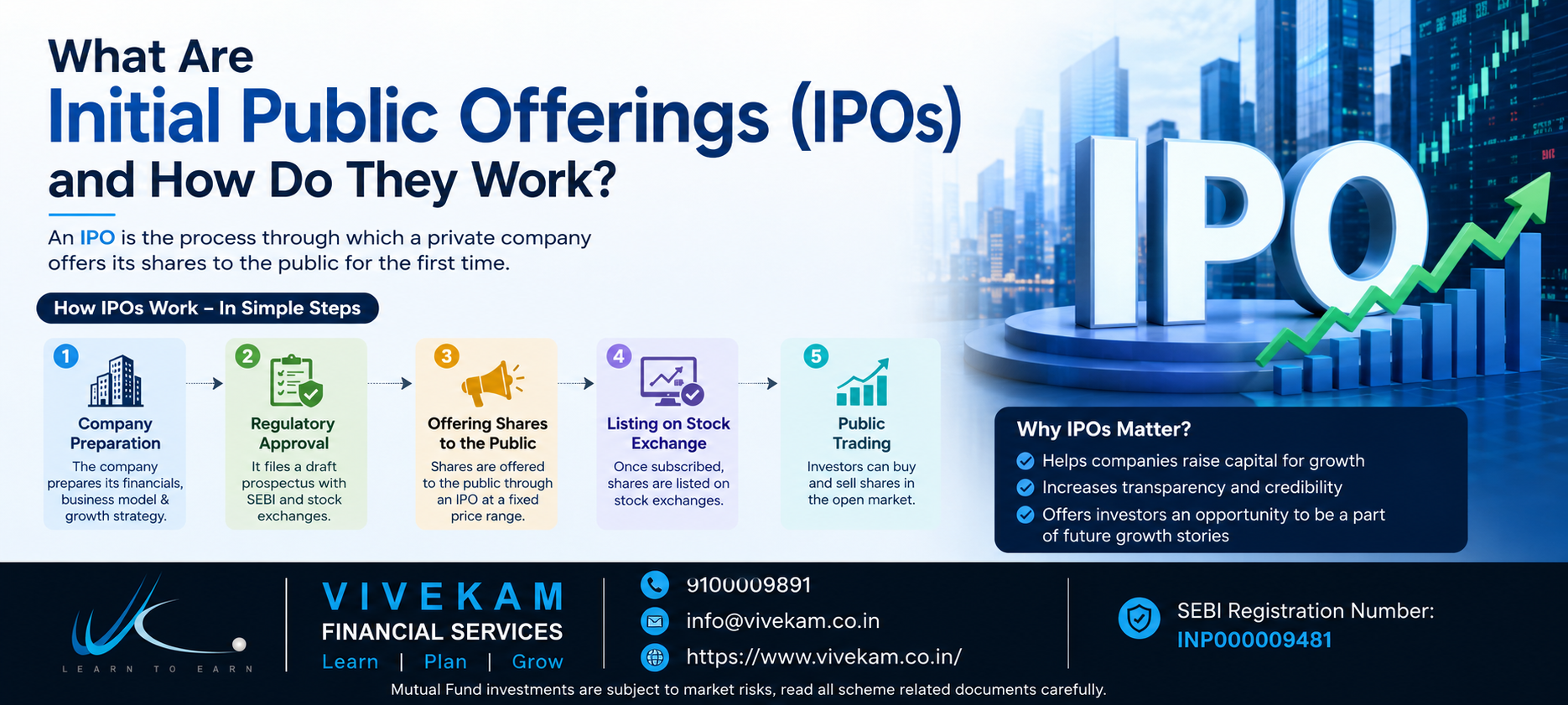
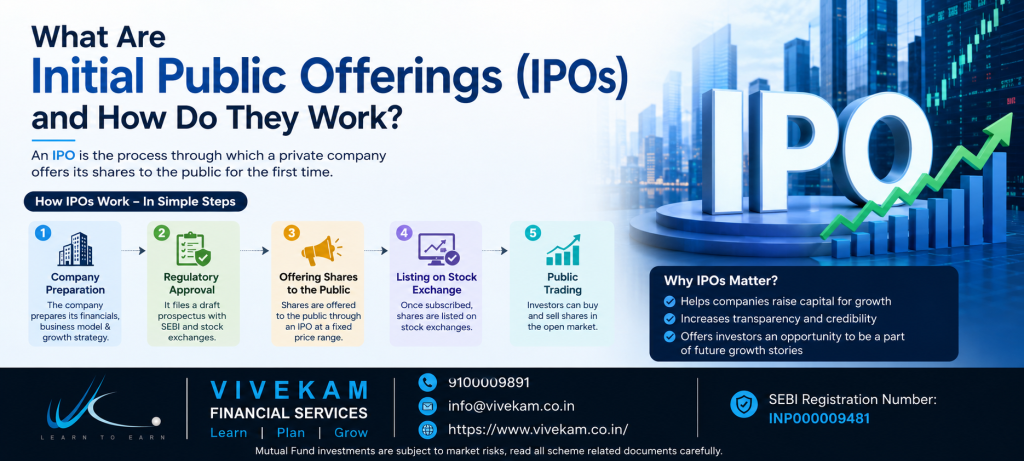
An Initial Public Offering is the process through which a privately held company offers its shares to the general public for the very first time, transforming from a private entity into a publicly traded company listed on a stock exchange.
So, what is IPO in practical terms? Think of it this way — before an IPO, a company’s ownership is restricted to founders, early employees, angel investors, and venture capital or private equity firms. Once the company goes public through an initial public offering, ordinary retail investors like you and me get the opportunity to buy a slice of that business by purchasing shares on the open market.
In my years of advising investors, I’ve found that people often confuse “going public” with “raising money.” That’s only half the picture. Yes, capital raising is a major driver, but an IPO also provides:
- Liquidity for founders and early investors who’ve had capital locked up for years
- Enhanced public visibility and brand credibility
- Access to future capital through follow-on offerings
- Currency for acquisitions, since publicly traded stock can be used to acquire other companies
- Employee incentive structures, as stock options become tradable and valuable
Why Do Companies Launch an Initial Public Offering?
Companies don’t go public on a whim. It typically follows years of private growth, and the decision is driven by a mix of strategic and financial motivations:
- Raising growth capital — funding expansion, R&D, debt repayment, or acquisitions without taking on more loans
- Providing an exit route for early investors and venture capital firms
- Improving the company’s bargaining power with lenders, given the transparency that comes with public listing
- Boosting brand trust, since publicly listed companies face stricter regulatory scrutiny
- Attracting and retaining talent through employee stock ownership plans (ESOPs) that become liquid post-listing
How Does the IPO Process Work? A Step-by-Step Breakdown
Understanding the IPO process demystifies a lot of the anxiety first-time applicants feel. Here’s how it unfolds, from boardroom decision to stock exchange debut.
Step 1: Hiring Underwriters (Merchant Bankers)
The company appoints investment banks or merchant bankers to manage the offering. These underwriters assess the company’s financial health, determine an appropriate valuation, and help structure the offer.
Step 2: Filing the Draft Red Herring Prospectus (DRHP)
The company files a detailed disclosure document with the market regulator (in India, this is SEBI; in the US, it’s the SEC). This document — the prospectus — includes financial statements, business risks, promoter details, and the intended use of proceeds. As a rule I give every investor: read the prospectus before you read any brokerage recommendation.
Step 3: Regulatory Review and Approval
The regulator examines the filing for completeness and compliance. Only after clearance does the company proceed toward listing.
Step 4: Marketing the IPO — The Roadshow
Company executives and underwriters pitch the offering to institutional investors, mutual funds, and large stakeholders to build demand ahead of the public offering.
Step 5: Price Band and Issue Size Determination
The company, in consultation with underwriters, sets a price band (in a book-built issue) or a fixed price (in a fixed-price issue), along with the total number of shares to be issued.
Step 6: The IPO Opens for Subscription
The IPO opens to the public for a specific window — usually three to five working days — during which investors across categories (retail, institutional, high-net-worth) can apply.
Step 7: IPO Allotment
Once the subscription window closes, shares are allotted based on demand and category-wise reservation. We’ll cover this in detail below, because it’s the step most investors misunderstand.
Step 8: IPO Listing on the Stock Exchange
The company’s shares finally begin trading on the stock exchange, and the market determines the stock’s price in real time from the very first tick.
Understanding IPO Allotment: Why You Don’t Always Get Shares
IPO allotment is the process of assigning shares to applicants after the subscription period ends. This is where inexperience shows the most — many first-timers assume applying guarantees shares. It doesn’t.
Here’s how allotment typically works:
- If the IPO is undersubscribed (demand is lower than shares on offer), every applicant usually receives the full number of shares requested.
- If the IPO is oversubscribed (demand exceeds shares on offer, which is common for high-profile listings), allotment is done through a lottery system for retail investors, ensuring fair and random distribution when demand vastly outstrips supply.
- Allotment is category-wise: Retail Individual Investors (RII), Non-Institutional Investors (NII), and Qualified Institutional Buyers (QIB) each have separate reserved portions, and oversubscription is calculated within each category independently.
My advice after watching countless allotment cycles: don’t over-leverage or borrow to apply for an IPO expecting guaranteed allotment. Oversubscription of 50x, 100x, or more is common for hyped listings, and the odds of allotment in such cases can be genuinely slim.
How to Apply for an IPO (Step-by-Step)
If you’re wondering how to apply for IPO shares, the process today is largely digital and driven by the ASBA (Application Supported by Blocked Amount) mechanism, which blocks funds in your bank account rather than debiting them upfront.
- Open a Demat and Trading account with a registered broker or depository participant — this is non-negotiable, as shares are credited electronically.
- Log into your bank’s net banking portal or broker’s app and locate the ASBA/IPO application section.
- Select the IPO you want to apply for from the list of currently open issues.
- Enter your bid details — the number of shares (in lots) and the price within the band you’re willing to pay.
- Authorize the blocking of funds via UPI or net banking; the money isn’t debited, only earmarked.
- Submit and track the application status — you’ll typically know your allotment status a few days after the subscription window closes.
- Check your Demat account on the listing date — allotted shares are credited automatically, and unblocked funds are released if you don’t receive an allotment.
How to Invest in IPO Wisely: A Veteran’s Checklist
Knowing how to invest in IPO offerings profitably requires more discipline than knowing the mechanics of applying. Here’s the checklist I’ve relied on for years:
- Read the prospectus, not just the news headlines. Understand revenue trends, debt levels, promoter holding, and the actual use of IPO proceeds.
- Understand why the company is raising money. Is it for expansion and debt reduction (generally healthier), or largely an exit route for existing investors (worth scrutinizing more closely)?
- Evaluate valuation versus industry peers. A hyped IPO isn’t automatically a good investment if it’s priced far above comparable listed companies.
- Watch subscription trends during the bidding window, especially demand from institutional investors, since QIB participation often signals informed confidence.
- Avoid herd mentality. Grey market premium (GMP) chatter and social media hype are not substitutes for fundamental analysis.
- Decide your holding horizon before applying. Are you looking for listing-day gains, or do you believe in the company’s long-term prospects? These require very different risk assessments.
IPO vs FPO: What’s the Difference?
Investors often mix up IPO vs FPO, but the distinction is straightforward once you see it side by side.
Aspect | IPO (Initial Public Offering) | FPO (Follow-on Public Offering) |
Definition | First-ever sale of shares to the public | Additional share sale by an already-listed company |
Company status | Private, transitioning to public | Already public |
Pricing certainty | Harder to value; relies on prospectus and comparables | Easier to value using existing market price as a reference |
Risk level | Generally higher, given limited trading history | Generally lower, since historical stock performance exists |
Purpose | Raise initial growth capital, provide investor exits | Raise further capital, reduce debt, fund new projects |
In short: an IPO is a company’s public market debut, while an FPO is a return trip to raise more capital after it’s already listed.
Benefits of IPO Investment
The benefits of IPO investing explain why retail interest remains consistently high, even amid market volatility:
- Early entry into growth stories. Investors get the chance to own a stake in a company at an early stage of its public life, before broader market participation potentially drives valuations higher.
- Portfolio diversification. IPOs often come from emerging sectors — technology, renewable energy, fintech — offering exposure that established portfolios may lack.
- Transparency and regulation. Public companies are legally required to disclose financials, governance practices, and material developments, offering more visibility than private investing.
- Liquidity. Once listed, shares can be bought and sold freely on the exchange, unlike private equity holdings that are often locked in for years.
- Potential listing-day gains. Strong IPOs with high demand sometimes list at a premium to their issue price, although this is never guaranteed and should never be the sole reason to apply.
The Risks Nobody Talks About Enough
After 20+ years in this business, I’d be doing you a disservice if I only highlighted the upside. IPOs carry real risks:
- Limited historical data makes valuation harder than for established listed companies.
- Volatility around listing is common, and stocks can list below their issue price.
- Information asymmetry — company insiders know more about the business than public investors do at the time of listing.
- Lock-in expiries for promoters and institutional investors can trigger selling pressure months after listing, affecting the stock price.
- Hype-driven pricing in bull markets can lead to overvalued offerings that correct sharply once initial euphoria fades.
Treat every IPO as you would any other investment decision: with due diligence, not fear of missing out.
Conclusion
An Initial Public Offering is one of the most significant events in a company’s lifecycle — and potentially in an investor’s portfolio too. But separating the noise from the substance is what separates informed investors from speculative ones. Understand the full IPO process, know how IPO allotment actually works, apply through the proper channels, and always anchor your decision in the company’s fundamentals rather than market hype or grey market premium chatter.
Whether you’re evaluating your first application or your fiftieth, the principles remain the same: read the prospectus, understand the business, size your investment sensibly, and never let excitement override analysis. That discipline, more than any single stock pick, is what compounds wealth over decades in the market.
Frequently Asked Questions (FAQs)
- What is the full form of IPO? IPO stands for Initial Public Offering — the process by which a private company offers its shares to the public for the first time.
- How do I apply for an IPO? You can apply through your bank’s net banking portal or your broker’s trading app using the ASBA facility, which blocks the required funds in your bank account until allotment is finalized.
- What happens if I don’t get IPO allotment? If you’re not allotted shares, the blocked funds in your bank account are automatically released, and no money is deducted from your account.
- Is IPO investment safe for beginners? IPO investing carries risk like any equity investment. Beginners should study the prospectus, understand the business model, and avoid investing purely based on hype or expected listing gains.
- What is the difference between IPO and FPO? An IPO is a company’s first-ever sale of shares to the public, while an FPO (Follow-on Public Offering) is an additional share sale by a company that is already publicly listed.
- How is IPO allotment decided when an issue is oversubscribed? When demand exceeds the shares on offer, allotment among retail investors is typically done through a computerized lottery system to ensure fair distribution.
- Can I sell IPO shares immediately after listing? Yes, once shares are credited to your Demat account on the listing date, they can be sold on the exchange like any other listed stock, subject to market hours and trading rules.
- What documents or accounts do I need before applying for an IPO? You need a Demat account, a linked trading account, and a bank account enabled for ASBA/UPI-based IPO applications.
- What is a price band in an IPO? A price band is the price range within which investors can bid for shares in a book-built IPO; the final issue price is determined based on demand within this range.
- Do all IPOs list at a profit? No. While some IPOs list at a premium to their issue price, others list at a discount or remain flat, depending on market conditions, valuation, and investor sentiment at the time of listing.
Disclaimer: This article is for educational purposes only and does not constitute investment advice. IPO investments are subject to market risks. Please consult a registered financial advisor and read the official prospectus carefully before investing.