
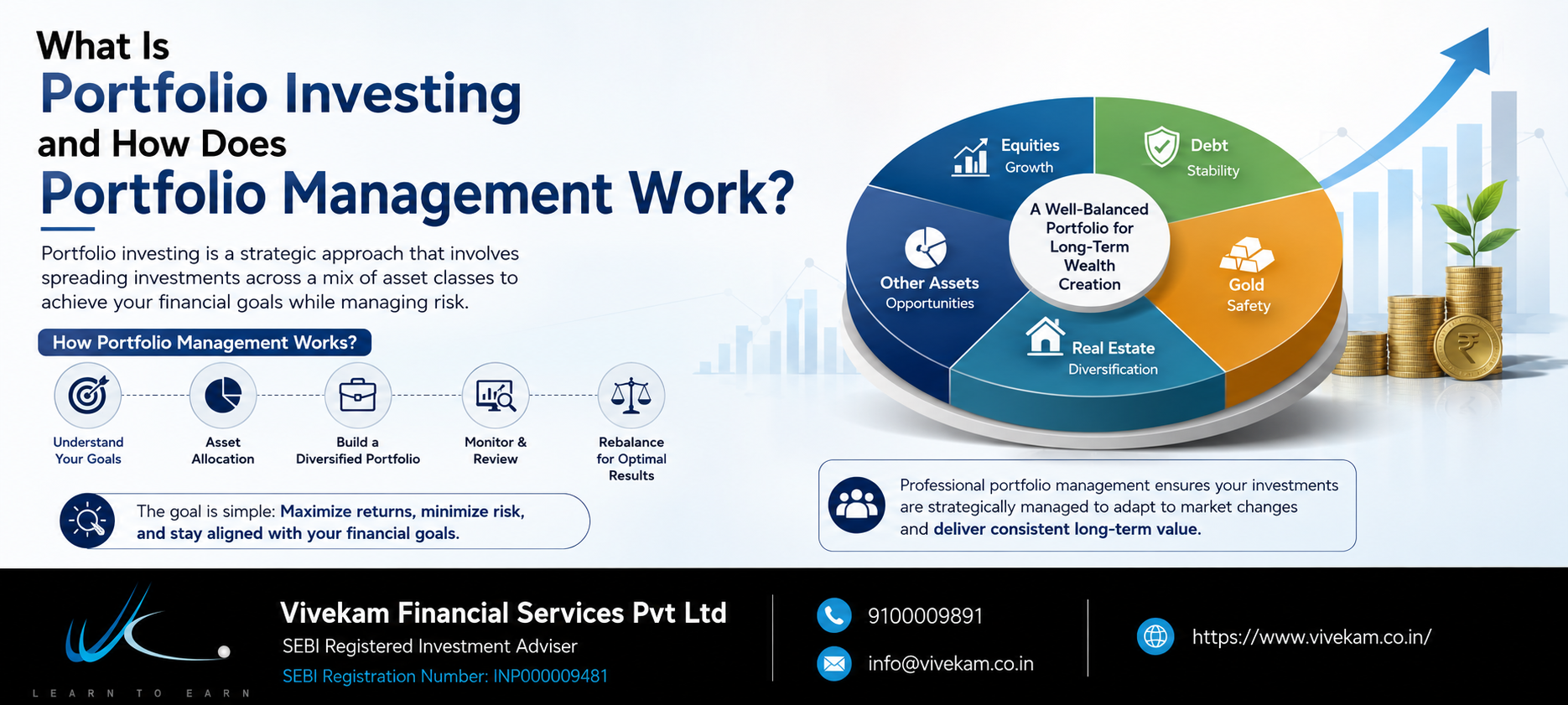
What Is Portfolio Investing and How Does Portfolio Management Work?
Portfolio Meaning: What Are We Actually Talking About?
A portfolio, in financial terms, is the complete collection of investments held by an individual or institution. That includes stocks, bonds, mutual funds, ETFs, real estate, cash equivalents, commodities, and alternative assets such as private credit or digital assets. The portfolio meaning isn’t about any one holding — it’s about the combination. Two investors can own the same ten stocks, but if they’re weighted differently, their portfolios — and their risk exposure — are entirely different.
A portfolio can be compared to a team: each holding plays a different role. Some generate steady, reliable output (bonds, dividend stocks). Others are higher-performing but more volatile (growth stocks, small caps). The objective isn’t to hold the single flashiest asset — it’s to combine assets that perform well together under different market conditions, so the portfolio as a whole doesn’t collapse when one part underperforms.
What Is Portfolio Investment?
Portfolio investment refers to the practice of allocating capital across a range of financial assets rather than concentrating it in one place. The concept is grounded in Modern Portfolio Theory, developed by economist Harry Markowitz in the 1950s, which demonstrated that a well-diversified mix of assets can produce a better risk-adjusted return than any single asset held in isolation.
Portfolio investment is not primarily about maximizing returns — it is about optimizing the relationship between risk and return. Chasing the highest possible return while ignoring risk can leave a portfolio exposed to losses it was never built to withstand. A properly constructed portfolio is designed so that when one asset class underperforms, another helps offset the impact.
This is the real function of diversification: not eliminating risk, but managing it deliberately.
Portfolio Management: The Engine Behind the Strategy
If portfolio investment is the what, portfolio management is the how. It is the ongoing, professional process of selecting, monitoring, and adjusting a mix of investments to meet an investor’s specific financial goals, time horizon, and risk tolerance.
Portfolio management is not a one-time event — it is a continuous discipline. Markets move, valuations shift, and personal circumstances change, so a strategy that was appropriate several years ago may no longer be suitable today.
Effective investment and portfolio management requires ongoing answers to four core questions:
- What is the investment objective, and by when must it be met?
- How much risk can the investor tolerate — financially and psychologically?
- What mix of assets achieves the objective most efficiently?
- When and how should that mix be adjusted over time?
The Portfolio Management Process: A Step-by-Step Breakdown
Every disciplined portfolio management process follows a version of the steps below.
1. Define Objectives and Constraints
Before capital is allocated, objectives must be defined — retirement in 30 years, a home purchase in 5, or capital preservation ahead of a business exit. Constraints such as liquidity needs, tax situation, time horizon, and legal restrictions also shape what allocation is appropriate.
2. Asset Allocation
This is widely regarded as the most important decision in the entire process. Research consistently shows that asset allocation — the split between equities, fixed income, cash, and alternatives — accounts for the large majority of a portfolio’s long-term return variability, more than individual security selection does.
3. Security Selection
Once allocation targets are set, specific investments are chosen within each asset class — individual stocks, bonds, index funds, or actively managed funds, depending on the strategy.
4. Portfolio Construction
The selected securities are combined and weighted, with attention paid to correlation between holdings. Two assets that appear “safe” individually but move in the same direction under stress do not provide meaningful diversification.
5. Monitoring and Review
Allocations drift over time. A portfolio that starts at 60% stocks and 40% bonds can drift to 75/25 after a strong equity run, quietly increasing risk exposure without any deliberate action being taken.
6. Rebalancing
Periodically — quarterly, annually, or when allocations drift beyond a set threshold — the portfolio is brought back to its target weights. This process systematically enforces buying underweighted assets and trimming overweighted ones.
Types of Portfolio Management
Broadly, types of portfolio management fall into four categories:
- Active Portfolio Management — A manager actively selects and trades securities, aiming to outperform a benchmark index through research, timing, and judgment.
- Passive Portfolio Management — Investments track a market index, such as the S&P 500, with minimal trading, aiming to match rather than beat market returns.
- Discretionary Portfolio Management — A professional manager makes investment decisions on the client’s behalf based on agreed objectives, without requiring approval for each trade.
- Non-Discretionary Portfolio Management — The advisor recommends trades, but the client retains final approval on every transaction.
Active vs Passive Portfolio Management
The active vs passive portfolio management debate is one of the most persistent in finance, and the answer depends on the asset class, time horizon, and investor behavior.
Active management aims to beat the market through security selection and market timing. It offers the potential for outperformance and the flexibility to respond to changing conditions, but it typically carries higher fees. Historical data consistently shows that the majority of active managers fail to beat their benchmark over long periods, particularly in highly efficient markets such as large-cap U.S. equities.
Passive management aims to match market performance through low-cost index funds and ETFs. It offers lower fees, greater tax efficiency, and removes the risk of manager error. Its limitation is that a passive strategy will never outperform the market — it delivers whatever the market delivers, in both strong and weak years.
Many long-term investors use a passive core supplemented with selective active positions in less efficient markets — such as small-cap stocks, emerging markets, or certain fixed-income segments — where skilled managers have historically had more opportunity to add value.
A Practical Portfolio Management Example
Consider a portfolio management example involving an investor, age 40, saving for retirement at 65, with moderate risk tolerance. A portfolio manager might construct the following allocation:
- 50% equities — split between domestic large-cap index funds and international developed markets, for long-term growth
- 30% fixed income — a mix of government and investment-grade corporate bonds, for stability and income
- 10% real estate — via REITs, for diversification and inflation protection
- 10% cash and alternatives — for liquidity and downside cushioning
Each year, the allocation is reviewed against the investor’s goals. If equities have risen and now represent 60% of the portfolio, some gains are trimmed and reallocated to bonds, restoring the original risk profile rather than allowing the recent winner to dominate. Repeated consistently over time, this disciplined rebalancing process is a key driver of long-term outcomes.
How to Build an Investment Portfolio
The following sequence outlines how to build an investment portfolio from the ground up:
- Determine the time horizon. Money needed within 3 years should not be invested the same way as money that will not be needed for 30 years.
- Assess actual risk tolerance — not a theoretical comfort level, but how the investor has historically reacted to a real market decline.
- Set a target asset allocation based on time horizon and risk tolerance, rather than short-term market trends.
- Choose low-cost, diversified building blocks, such as index funds and ETFs, as a foundation.
- Automate contributions. Consistent, regular investing tends to outperform attempts to time the market.
- Rebalance on a set schedule, not based on market sentiment.
- Review the plan periodically, particularly after major life changes such as a new job, marriage, a child, or an inheritance.
Frequently Asked Questions
What is the simple portfolio meaning in investing?
A portfolio is the full collection of assets an investor owns — stocks, bonds, funds, real estate, cash — treated as one combined unit. The portfolio meaning centers on the mix and weighting of these holdings, not any single investment on its own.
What is portfolio investment in one sentence?
Portfolio investment is the practice of spreading capital across multiple asset classes and securities to balance risk and return, rather than concentrating it in one holding.
What is the main goal of portfolio management?
The main goal of portfolio management is to build and maintain a mix of investments that matches an investor’s specific goals, time horizon, and risk tolerance, while managing risk through diversification, allocation, and periodic rebalancing.
What are the main types of portfolio management?
The four main types of portfolio management are active, passive, discretionary, and non-discretionary. Active and passive describe the investment style — trying to beat the market versus matching it — while discretionary and non-discretionary describe who makes the final trading decisions, the manager or the client.
Is active or passive portfolio management better?
Neither is universally superior — it depends on the asset class and the investor. Passive management tends to perform well in efficient markets, such as large-cap U.S. equities, due to lower costs, while active management can add more value in less efficient markets, such as small-caps or emerging markets. Many investors use a blend of both approaches.
How much money do I need to start building an investment portfolio?
There is no fixed minimum. Fractional shares and low-cost index funds and ETFs allow most brokerages to support building a diversified portfolio with a relatively small amount of capital. Consistency and proper allocation matter more than the starting amount.
How often should a portfolio be rebalanced?
Most investors rebalance quarterly or annually, or when an asset class drifts beyond a set threshold — commonly 5% from its target weight. The appropriate frequency depends on the strategy, but the key principle is following a set schedule rather than reacting to market headlines.
Can I manage my own investment portfolio, or do I need an advisor?
Many investors successfully manage their own portfolios, particularly using low-cost index funds as a foundation. An advisor can add value in more complex situations, such as tax planning, estate considerations, or maintaining discipline during volatile markets.
Conclusion
Portfolio investing and portfolio management are not about picking the single best-performing stock or timing the market perfectly — outcomes that are difficult to achieve consistently. They are about understanding the portfolio meaning at a structural level: investing is a system, not a series of isolated bets. Whether an investor chooses active or passive strategies, works with an advisor, or manages their own portfolio, the fundamentals of sound portfolio management remain constant — clear objectives, disciplined asset allocation, and regular rebalancing.
A portfolio built with these principles is designed to perform across market cycles, not just in favorable conditions. That structural discipline is what separates long-term investing from short-term speculation.