
What is CPI (Consumer Price Index) and How Does it Work?
Introduction
Ever notice your grocery bill creeping up even though your shopping list hasn’t changed? That’s inflation at work — and the number economists, governments, and central banks use to measure it is the Consumer Price Index (CPI).
CPI is arguably the single most-watched economic indicator in any country. It influences interest rates, salary hikes, pension payouts, and even how much you pay in taxes. This guide breaks down what CPI actually is, how it’s calculated, the CPI formula in plain language, and what the latest CPI inflation data in India is telling us right now.
What is CPI (Consumer Price Index)?
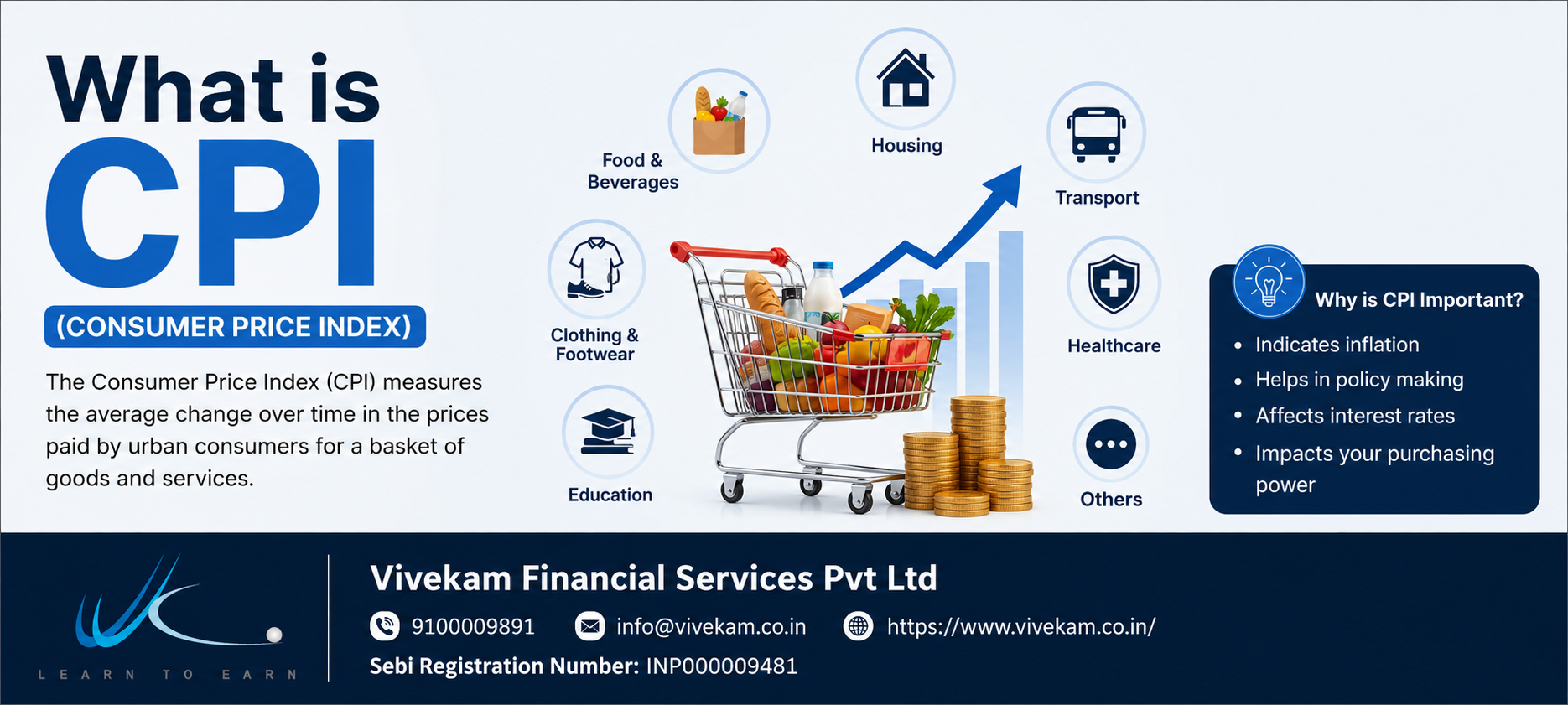
The Consumer Price Index (CPI) measures the average change over time in the prices consumers pay for a fixed “basket” of goods and services — things like food, housing, fuel, clothing, healthcare, and education.
Put simply, CPI answers one question: how much more (or less) does it cost today to buy the same things people bought a year ago?
The CPI index is the primary tool used to track retail inflation — the rate at which everyday prices rise for the average household — as opposed to wholesale or producer-level price changes.
Why CPI Matters More Than You Think
CPI isn’t just an economist’s number. It quietly shapes daily life in several ways:
- Salary and pension adjustments — dearness allowance, cost-of-living raises, and social security payouts are often linked to CPI.
- Interest rate decisions — central banks like the Reserve Bank of India (RBI) use CPI inflation as their primary policy target when deciding whether to raise, cut, or hold interest rates.
- Government budgeting — CPI affects tax slabs, subsidy calculations, and welfare scheme indexing.
- Investment returns — investors use CPI to calculate real returns (returns after adjusting for inflation).
- Business pricing and wage contracts — companies use CPI trends to plan pricing strategy and negotiate wage escalations.
How Does CPI Work?
CPI is built around a representative basket of goods and services — items a typical household buys regularly. This basket is usually grouped into categories such as:
- Food and beverages
- Housing and utilities
- Fuel and light
- Clothing and footwear
- Transport and communication
- Healthcare
- Education
- Personal care and miscellaneous services
Each category gets a weight based on how much of a typical household’s budget it represents — food and beverages traditionally carry one of the highest weights, since it’s the biggest single expense for most households.
Statistical agencies collect prices for these items every month from thousands of retail outlets, markets, and service providers across both urban and rural areas. These current prices are then compared against a base year (indexed to 100) to calculate how far prices have moved.
CPI Formula: How to Calculate Consumer Price Index
The basic CPI formula is:
CPI = (Cost of Basket in Current Period / Cost of Basket in Base Year) × 100
To get the CPI inflation rate — the percentage change in prices over time — the formula is:
CPI Inflation Rate = [(CPI in Current Period − CPI in Previous Period) / CPI in Previous Period] × 100
Step-by-Step: How to Calculate CPI
- Fix a base year and set its index value to 100.
- Define the basket of goods and services that represents typical household spending.
- Collect monthly prices for every item in the basket, across regions.
- Assign weights to each category based on its share of total household expenditure.
- Compute the weighted average price change relative to the base year.
- Calculate the index value using the CPI formula above.
- Compare index values across periods to arrive at the inflation rate.
This is essentially the process national statistical agencies — like India’s Ministry of Statistics and Programme Implementation (MoSPI) — follow to release CPI data every month.
Types of CPI
Not every CPI figure measures the same thing. The common variants are:
- CPI (Combined) — the headline number, covering both rural and urban consumers
- CPI (Rural) — tracks price changes specific to rural households
- CPI (Urban) — tracks price changes specific to urban households
- CFPI (Consumer Food Price Index) — a sub-index tracking only food and beverages
- Core CPI — excludes volatile food and fuel prices to reveal underlying, longer-term inflation trends
Current CPI Inflation Data: India (2026)
India’s CPI series was rebased in January 2026, shifting the base year from 2012 to 2024. The update, drawn from the 2023–24 Household Consumption Expenditure Survey, increased the weight of non-food items and reduced food’s share of the basket — so figures under the new series aren’t directly comparable to the old one.
Here’s the trend so far under the new base:
Month (2026) | CPI Inflation (YoY) |
January | 2.75% |
February | 3.21% |
March | 3.40% |
April | 3.48% |
May | 3.93% |
According to the Ministry of Statistics and Programme Implementation’s provisional data, headline CPI inflation for May 2026 came in at 3.93% year-on-year, with rural inflation running higher at 4.25% against urban inflation of 3.53%. Food inflation (measured by the CFPI) was the bigger driver, at 4.78% — a sign that kitchen-table costs are rising faster than the overall basket.
May 2026 marked the fifth straight monthly increase in the new CPI series, edging just under the RBI’s 4% medium-term target. One standout: silver jewellery and gold prices pushed the “personal care” category to the steepest rise of any group in the basket, reflecting global precious-metal price movements rather than everyday consumption costs.
Looking ahead, a Reuters poll of economists projected India’s June 2026 CPI inflation to climb further to around 4.3%, citing higher food and fuel prices along with geopolitical and monsoon-related risks. If confirmed, that would be the first breach of the RBI’s 4% target in 16 months. Official June data was scheduled for release on July 13, 2026 — worth checking against this outlook once published.
Key takeaways from India’s current CPI trend:
- Inflation has climbed steadily and consistently since the start of 2026.
- Food remains the single biggest swing factor in India’s CPI, even after its weight was reduced in the new series.
- The RBI targets CPI inflation around 4%, within a tolerance band, as the anchor for its monetary policy decisions.
CPI vs. WPI: What’s the Difference?
CPI often gets confused with WPI (Wholesale Price Index) — but they measure different things entirely:
CPI | WPI | |
Measures | Retail prices paid by end consumers | Prices at the wholesale/producer level |
Includes services | Yes | No — goods only |
Used for | Inflation targeting, cost-of-living adjustments | Tracking input costs, industry pricing trends |
Who uses it | RBI (monetary policy), households, pension bodies | Industry, exporters, producers |
In India, CPI replaced WPI as the RBI’s primary inflation-targeting benchmark in 2013 because it more accurately reflects what households actually experience at the till.
CPI vs. Inflation: Clearing Up the Confusion
CPI and inflation are related but not interchangeable:
- CPI is the index itself — a snapshot of price levels relative to a base year.
- Inflation is the rate of change in CPI over a period, expressed as a year-on-year or month-on-month percentage.
CPI is the measuring tape; the inflation rate is the reading it gives you.
Limitations of CPI
CPI is powerful, but it isn’t perfect. Keep these caveats in mind:
- One basket doesn’t fit all — spending patterns vary hugely by income, region, and lifestyle, so the “average” basket may not reflect your actual expenses.
- Substitution bias — CPI doesn’t fully capture consumers switching to cheaper alternatives when prices rise.
- Quality changes — better-quality products over time can distort long-term price comparisons.
- Regional blind spots — a national CPI average can mask sharp cost-of-living differences between cities and states.
Frequently Asked Questions (FAQs)
What is CPI in simple terms?
It’s a number that tracks how much prices for everyday goods and services have changed compared to a fixed base year — the standard way to measure retail inflation.
What is a “good” CPI inflation rate?
Most central banks, including the RBI, target a moderate rate — around 4% in India’s case — that supports growth without eroding people’s purchasing power too fast.
Who calculates CPI in India?
The Ministry of Statistics and Programme Implementation (MoSPI) compiles and releases CPI data monthly.
How often is CPI released?
Monthly, typically about two weeks after the reference month ends.
Is CPI the same as cost of living?
Close, but not identical. CPI approximates cost-of-living changes using a representative basket — it won’t match everyone’s individual spending exactly.
Why did India change its CPI base year to 2024?
To keep the basket relevant to current spending habits. The update, based on the 2023–24 Household Consumption Expenditure Survey, reduced food’s weight and increased the weight of services and non-food items, reflecting how Indian households actually spend today.
Conclusion
CPI is far more than a monthly statistic — it’s a real-time read on the economy that ripples into interest rates, wages, government policy, and your own household budget. Understanding how it’s calculated, and keeping an eye on where it’s headed, gives you a genuine edge in making sense of the economy around you.
Data referenced from the Ministry of Statistics and Programme Implementation (MoSPI), Government of India, and Reuters economist polls, current as of July 2026. Figures are provisional and subject to revision.