What Is Private Equity and How Does It Work?
What Is Private Equity?
Private equity (PE) is capital that is invested directly into private companies — or used to take public companies private — in exchange for an ownership stake. Unlike buying stock on the Nasdaq, there’s no ticker symbol, no daily price quote, and no ability to sell your position with a mouse click. You’re buying a piece of a real business, and you’re typically buying it to change it.
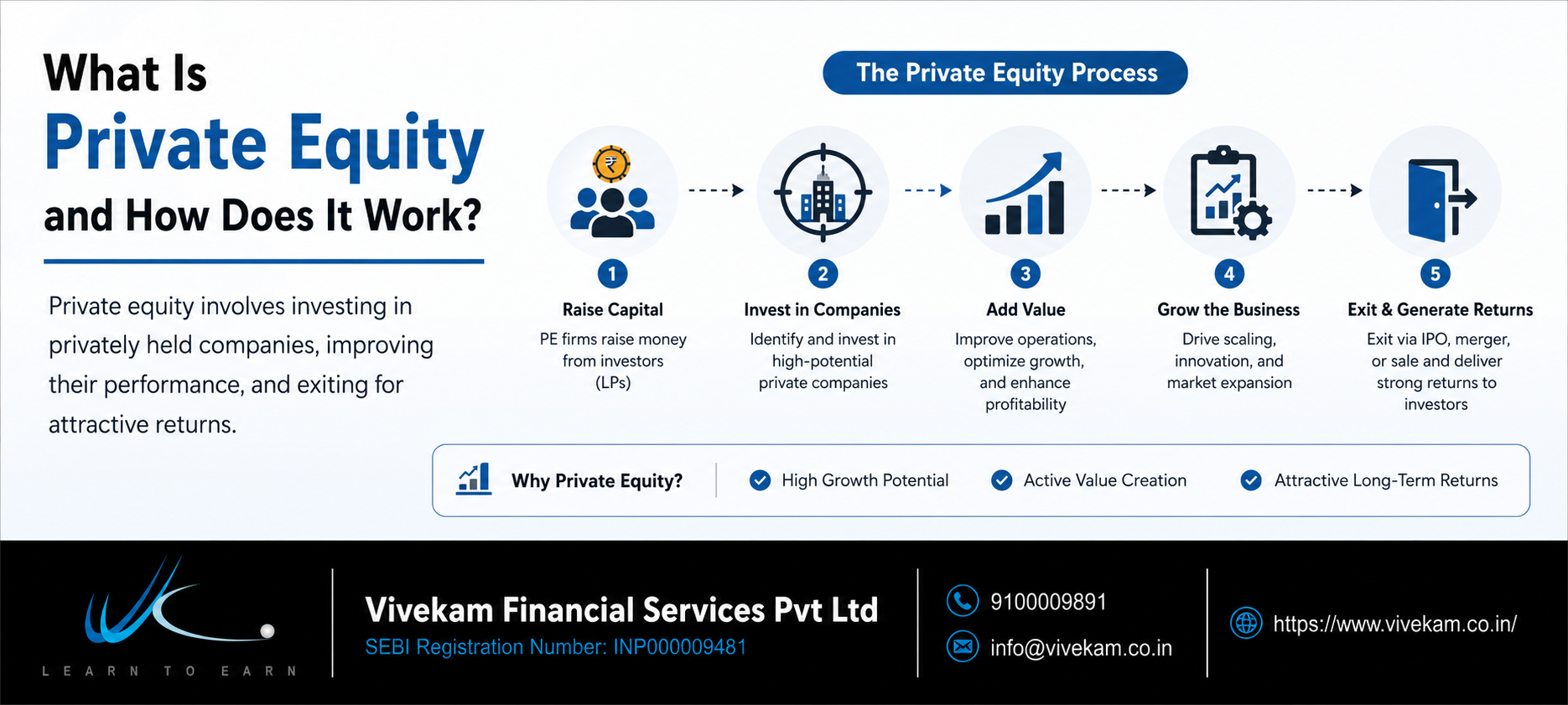
At its core, private equity is built on a simple thesis: acquire a company, improve its operations, financial structure, or growth trajectory over a period of roughly four to seven years, and then sell it — to another company, another PE firm, or the public markets — for meaningfully more than you paid.
That “buy, improve, sell” cycle is the entire industry in one sentence. Everything else — the leverage, the fund structures, the fee models — exists to make that cycle more profitable and more repeatable.
How Does a Private Equity Fund Actually Work?
A private equity fund is a pooled investment vehicle. Institutional investors and wealthy individuals — called limited partners (LPs) — commit capital to the fund. The firm running the show — the general partner (GP) — is responsible for finding deals, executing them, managing the portfolio companies, and eventually exiting them.
Here’s the lifecycle I’ve walked through more times than I can count:
- Fundraising. The GP raises a fixed pool of capital, usually with a 10-year fund life, from pensions, endowments, insurance companies, sovereign wealth funds, and family offices.
- Capital calls. LPs don’t hand over the full amount upfront. The GP “calls” capital as deals close, which is why PE is described as illiquid and long-horizon.
- Deployment. Over the first three to five years — the “investment period” — the GP sources deals, negotiates, and acquires companies.
- Value creation. The firm works with management teams to cut costs, professionalize operations, pursue add-on acquisitions, or accelerate growth.
- Exit. The fund sells the company via a strategic sale, a sale to another PE firm (a “secondary buyout”), or an IPO.
- Distribution. Proceeds flow back to LPs, net of fees and the GP’s profit share.
The economics that make this worthwhile for the GP are the famous “2 and 20” — a 2% annual management fee on committed capital, plus 20% of profits above a minimum return threshold (the “hurdle rate”), known as carried interest.
The Leveraged Buyout: PE’s Signature Move
If there’s one term you need to understand to really grasp what is private equity in practice, it’s the leveraged buyout (LBO).
An LBO is the acquisition of a company using a relatively small amount of the fund’s own equity — often just 30–50% of the purchase price — combined with a large amount of borrowed money, secured against the target company’s own assets and cash flows. The rest is debt the company carries, not the fund itself.
Why does this matter? Because leverage amplifies returns. If a PE firm buys a company for $100 million using $40 million of equity and $60 million of debt, and later sells it for $180 million after paying down some debt, the equity check might have grown from $40 million to $100 million or more. That’s a far higher return than if the entire $100 million had been paid in cash.
Of course, leverage cuts both ways. It magnifies losses just as efficiently as it magnifies gains, which is exactly why underwriting discipline, cash flow stability, and realistic debt service coverage are the difference between a firm that survives a downturn and one that doesn’t. I’ve seen both.
Private Equity vs. Venture Capital: Not the Same Animal
People use these terms interchangeably, and it drives me up the wall, because the risk profiles and mechanics are entirely different.
Private Equity | Venture Capital | |
Target companies | Mature, cash-flow-generating businesses | Early-stage, high-growth startups |
Ownership stake | Often a majority or full control | Usually a minority stake |
Use of leverage | Heavy use of debt (LBOs) | Little to no debt |
Risk profile | Lower company-level risk, higher financial risk from leverage | High company-level risk, no leverage risk |
Value creation | Operational efficiency, restructuring, add-ons | Product growth, market expansion, scaling |
Typical check size | Millions to billions | Thousands to tens of millions |
In short: private equity vs venture capital comes down to this — VC is betting on unproven ideas reaching massive scale, while PE is betting on proven businesses becoming more efficient, more valuable, or more strategically positioned.
Private Equity vs. Hedge Funds: Another Common Mix-Up
The hedge fund vs private equity comparison trips up even experienced professionals, so let’s be precise.
Hedge funds trade liquid securities — public stocks, bonds, currencies, derivatives — and can enter and exit positions quickly. They often use both long and short strategies to generate returns regardless of market direction, and investors can typically redeem their capital on a quarterly or annual basis.
Private equity, by contrast, is illiquid and long-term by design. You cannot exit a PE position on demand — capital is locked up for years while the GP executes an operational turnaround or growth plan. The two industries are sometimes housed under the same alternative-investment umbrella, but the strategies, time horizons, and skill sets required are fundamentally different.
Types of Private Equity
Private equity isn’t a single strategy — it’s an umbrella term covering several distinct approaches. Understanding the types of private equity helps clarify where a given deal fits:
- Leveraged buyouts (LBOs): Acquiring mature, established companies using significant debt, typically taking a controlling stake.
- Growth equity: Investing in companies that are already profitable or near-profitable and need capital to expand, without taking on the full operational overhaul of a buyout. Growth equity sits between venture capital and traditional buyouts — less risk than a startup bet, less leverage than an LBO.
- Venture capital: Technically a subset of private equity, focused on early-stage companies (often discussed separately, as above).
- Distressed/turnaround investing: Acquiring struggling or bankrupt companies at a discount and restructuring them back to health.
- Fund of funds: Investing in other private equity funds rather than directly in companies, providing diversification for LPs.
- Mezzanine financing: A hybrid of debt and equity, often used to fill the gap in an LBO’s capital structure.
- Real estate and infrastructure private equity: Applying the same buy-improve-sell model to physical assets rather than operating companies.
Real-World Private Equity Examples
Talking in the abstract only gets you so far. A few well-known private equity examples illustrate the model in action:
- KKR’s leveraged buyout of RJR Nabisco (1988) — still the deal that defined the modern LBO era and inspired the book Barbarians at the Gate.
- Blackstone’s acquisition of Hilton Hotels (2007) — bought right before the financial crisis, restructured through a brutal downturn, and eventually taken public again for one of the largest PE profits in history.
- Bain Capital and Staples — an early growth-equity-style investment that helped scale the office supply retailer before its IPO.
- Vista Equity Partners and countless enterprise software companies — a firm built almost entirely on buying, operationally improving, and exiting B2B software businesses.
These deals share a common thread: identify an underappreciated or underperforming asset, apply capital and operational discipline, and exit at a higher valuation.
Private Equity Returns: What to Realistically Expect
Let’s talk numbers, because this is where marketing decks often oversell reality.
Historically, top-quartile private equity returns have outpaced public equity markets over long holding periods, with net internal rates of return (IRR) in the mid-to-high teens for strong vintages and top-performing managers. But — and this is the part glossy pitch books gloss over — the dispersion between top-quartile and bottom-quartile funds is enormous. A mediocre PE fund can underperform the public markets significantly, especially after fees.
A few realities every investor should hold onto:
- Returns are illiquid and lumpy — you may see little activity for years, then a large distribution upon exit.
- Manager selection matters enormously. The gap between a top-decile GP and a median GP is far wider in private equity than in public equities.
- Fees compound. The “2 and 20” structure means a fund needs to clear a meaningful hurdle before investors see outsized net returns.
- J-curve effect: early fund years often show negative returns due to fees and unrealized investments, before performance inflects upward as exits occur.
How to Invest in Private Equity
For most of my career, this was a closed door for anyone who wasn’t an institution or a very high-net-worth individual, because of high minimums and accreditation requirements. That’s changing, but the paths still differ significantly.
For institutional and accredited investors:
- Commit directly to a PE fund as a limited partner (minimums often start at $1 million-plus).
- Invest through a fund of funds for diversification across multiple GPs and vintages.
- Access secondary markets, buying existing LP stakes at a discount.
For everyday investors:
- Publicly traded PE firms — companies like Blackstone, KKR, Apollo, and Carlyle trade on public exchanges, giving indirect exposure to the industry’s economics without the illiquidity or minimums.
- Interval funds and evergreen vehicles — a growing category of semi-liquid funds designed to give retail investors access to private markets with periodic redemption windows.
- Business development companies (BDCs) — publicly traded vehicles that invest in private companies, often with a debt or mezzanine focus.
My honest advice after 20-plus years in and around this industry: private equity can meaningfully diversify a portfolio and has historically rewarded patient capital, but it is not a shortcut, and it is not liquid. Understand the lock-up, understand the fee drag, and vet the manager as rigorously as you’d vet the deal.
The Bottom Line
Private equity isn’t mysterious once you strip away the jargon. It’s disciplined capital, deployed into private businesses, often amplified with debt, with a clear thesis for creating value and a defined exit plan. Whether it’s a classic leveraged buyout, a growth equity check into a scaling company, or a distressed turnaround, the underlying logic never changes: buy well, improve deliberately, exit smart.
If you’re evaluating PE investment opportunities — whether as an LP, a public markets investor buying into listed PE firms, or simply trying to understand the forces reshaping the companies around you — start with the fundamentals in this guide. The rest of the industry’s complexity is just variations on this core theme.
This article is for educational purposes only and does not constitute financial or investment advice. Private equity investments carry significant risk, including illiquidity and potential loss of principal. Consult a licensed financial advisor before making investment decisions.